E.P. Bos – författare
Visar alla böcker från författaren E.P. Bos. Handla med fri frakt och snabb leverans.
7 produkter
7 produkter
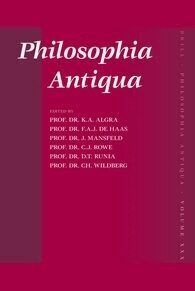
Del 53 - Philosophia Antiqua
On Proclus and his Influence in Medieval Philosophy
Inbunden, Engelska, 1992
2 092 kr
Skickas inom 5-8 vardagar
Proclus (c. 410 - 485) was one of the major Greek philosophers of late Antiquity. In his metaphysics he developed and systematized fundamental problems of Plato's thought, such as participation; transcendence - immanence; causation - participation - return; henads and monads. In a theological way he interpreted some of Plato's dialogues. In the tradition of the neo-platonic school of Athens he tried to bring together Orpheus, Pythagoras and Plato.Before and after his works had been translated into Latin, Proclus influenced the Christian West through the Liber de causis ("Book of Causes"), a Latin translation of an anonymous Arab version of his Elementatio theologica. Among those who commented on the Liber or on some of its theses, were many well-known philosophers: Albert the Great, Thomas Aquinas, Master Eckhart, Berthold of Moosberg and William of Ockham. The Liber de causis stimulated discussions about the concepts of God, first and second causality, universals, metaphysics of being as opposed to metaphysics of the one.In the volume various specialists discuss these problems: Saffrey, De Rijk, Meyer, Steel, De Libera, Aertsen, Beierwaltes and Bos.
Häftad, Engelska, 2013
2 641 kr
Skickas inom 5-8 vardagar
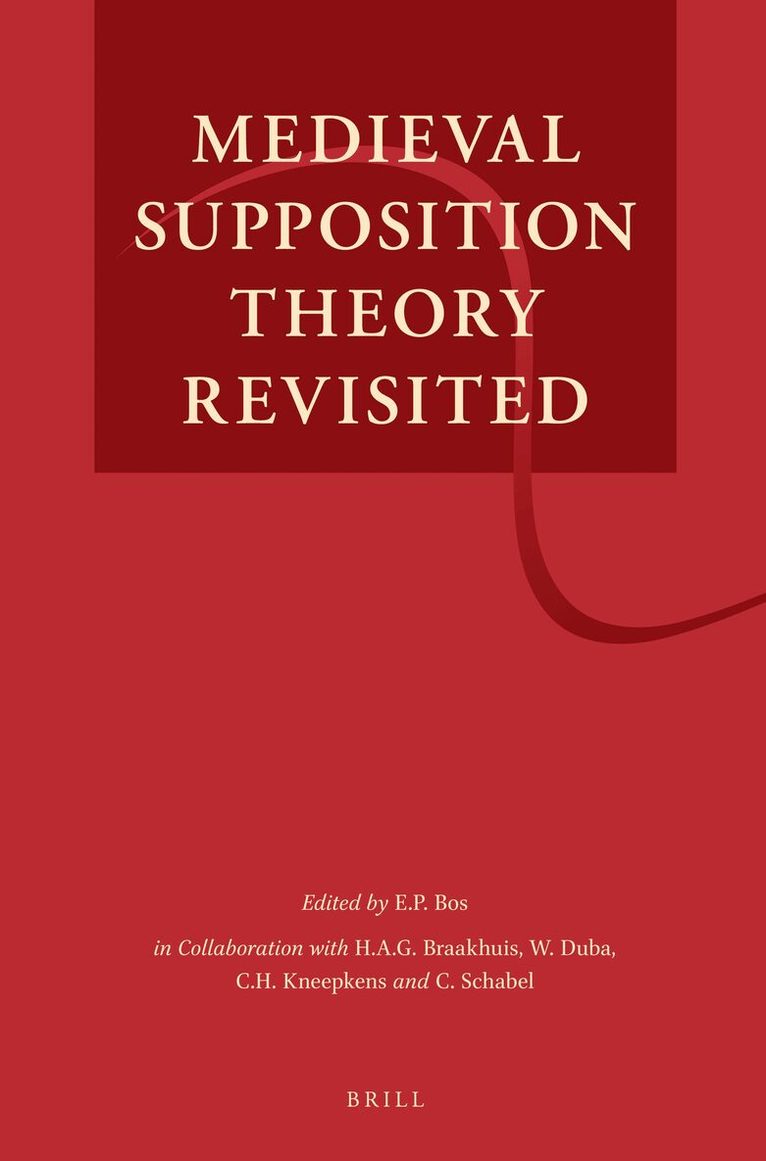
In 1962–1967 Professor L.M. de Rijk published his Logica Modernorum – A Contribution to the History of Early Terminist Logic. The first part (1962) has the title: On the Twelfth Century Theories of Fallacy. The second part (two volumes, 1967) has as title: The Origin and the Early Development of the Theory of Supposition. De Rijk’s Logica Modernorum provides the basis for the modern study of medieval theories of supposition.Now, nearly 50 years later, scholars have made great progress in the study of the properties of terms. De Rijk’s study was primarily about the early development of terminist logic, i.e. during the 12th and 13th centuries. Scholars have also investigated later developments well into the sixteenth and seventeenth centuries. Not only logical texts, but also texts on grammar have been published. Many of the scholars who have contributed to this development, present papers in this volume.Contributors are Fabrizio Amerini, Jenny Ashworth, Allan Bäck, Bert Bos, Julie Brumberg-Chaumont, Laurent Cesalli, Lambert Marie de Rijk, Sten Ebbesen, Alessandro Conti, Catarina Dutilh-Novaes, Onno Kneepkens, Costantino Marmo, Dafne Mure, Claude Panaccio, Ernesto Perini Santos, Joel Lonfat, Angel d’Ors, Göran Sundholm and Luisa Valente.
E-bok
PDF, Engelska, 20161 991 kr
Läs direkt efter köp
Proclus (c. 410 - 485) was one of the major Greek philosophers of late Antiquity. In his metaphysics he developed and systematized fundamental problems of Plato's thought, such as participation; transcendence - immanence; causation - participation - return; henads and monads. In a theological way he interpreted some of Plato's dialogues. In the tradition of the neo-platonic school of Athens he tried to bring together Orpheus, Pythagoras and Plato.Before and after his works had been translated into Latin, Proclus influenced the Christian West through the Liber de causis ("e;Book of Causes"e;), a Latin translation of an anonymous Arab version of his Elementatio theologica. Among those who commented on the Liber or on some of its theses, were many well-known philosophers: Albert the Great, Thomas Aquinas, Master Eckhart, Berthold of Moosberg and William of Ockham. The Liber de causis stimulated discussions about the concepts of God, first and second causality, universals, metaphysics of being as opposed to metaphysics of the one.In the volume various specialists discuss these problems: Saffrey, De Rijk, Meyer, Steel, De Libera, Aertsen, Beierwaltes and Bos.
2 338 kr
Läs direkt efter köp
How advanced students in the 15th century learned to understand Latin with the help of Middle Dutch becomes clear in Master Simon's (?) commentary in the form of questions on the famous medieval didactical poem on grammar Doctinale of Alexander de Villa Dei. The master discusses notions such as the six cases of Latin (nominative, genitive, dative, accusative, vocative and ablative), construction, impediments of construction, and participles. The author has a conceptualist approach of language and criticizes interpretations by realists (Modists). He refers to other important medieval grammars, viz. Commentary on Priscian attributed to Peter Helias, Compendium de modis significandi attributed to Thomas of Erfurt, the Metrista, the Regulae Puerorum and the Florista.
E-bok
PDF, Engelska, 20043 594 kr
Läs direkt efter köp
E-bok
PDF, Engelska, 2012708 kr
Läs direkt efter köp
occurred in the textbooks of medieval logicians. Hubien (1975,1977) did the same in recent articles and other modern logicians with interest in the history of their field of knowledge, or students of the history of logic with knowledge of modern achievements in this field, could be mentioned. For example, Trentman (1977:41) in his recent edition of Vincent Ferrer''s Tractatus de Suppositionibus, ''Treatise on suppositions'', elucidates Ferrer''s theory of natural supposition with the aid of modern logic and points out that in some respects, for example, in the theory of irltensionality, modern theories have been developed with little more success. In the Middle Ages, semantics and logic were entirely interwoven. For, in the opinion of medieval philosophers, thought is enacted in language. This very same language consists of meaningful entities and those entities form propositions that may be used as premisses in argument. In their opinion, language and thought were both related to reality in a natural way (cf. De Rijk, 1977:233). This is also evident from Marsilius'' works (cf., e.g., p. 54, n. 11-23). The semantical presuppositions oT the propositions that may be used in arguments, are analysed. This, indeed, is one of the contributions to logic by medieval logicians (cf. Moody, 1975:385).
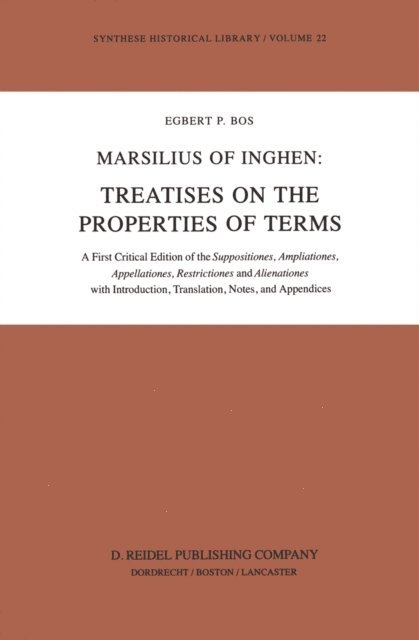
Del 22 - Synthese Historical Library
Marsilius of Inghen: Treatises on the Properties of Terms
A First Critical Edition of the Suppositiones, Ampliationes, Appellationes, Restrictiones and Alienationes with Introduction, Translation, Notes and Appendices
Häftad, Engelska, 2011
556 kr
Skickas inom 10-15 vardagar
occurred in the textbooks of medieval logicians. Hubien (1975,1977) did the same in recent articles and other modern logicians with interest in the history of their field of knowledge, or students of the history of logic with knowledge of modern achievements in this field, could be mentioned. For example, Trentman (1977:41) in his recent edition of Vincent Ferrer's Tractatus de Suppositionibus, 'Treatise on suppositions', elucidates Ferrer's theory of natural supposition with the aid of modern logic and points out that in some respects, for example, in the theory of irltensionality, modern theories have been developed with little more success. In the Middle Ages, semantics and logic were entirely interwoven. For, in the opinion of medieval philosophers, thought is enacted in language. This very same language consists of meaningful entities and those entities form propositions that may be used as premisses in argument. In their opinion, language and thought were both related to reality in a natural way (cf. De Rijk, 1977:233). This is also evident from Marsilius' works (cf., e.g., p. 54, n. 11-23). The semantical presuppositions oT the propositions that may be used in arguments, are analysed. This, indeed, is one of the contributions to logic by medieval logicians (cf. Moody, 1975:385).