Graham W. Griffiths – författare
Visar alla böcker från författaren Graham W. Griffiths. Handla med fri frakt och snabb leverans.
3 produkter
3 produkter
A Compendium of Partial Differential Equation Models
Method of Lines Analysis with Matlab
Inbunden, Engelska, 2009
1 709 kr
Tillfälligt slut
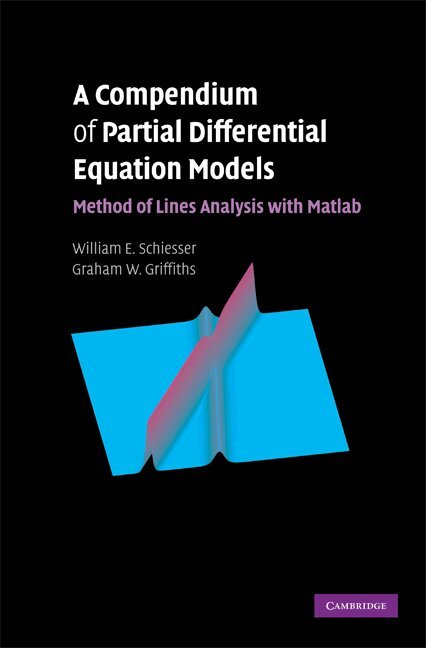
Mathematical modelling of physical and chemical systems is used extensively throughout science, engineering, and applied mathematics. To use mathematical models, one needs solutions to the model equations; this generally requires numerical methods. This book presents numerical methods and associated computer code in Matlab for the solution of a spectrum of models expressed as partial differential equations (PDEs). The authors focus on the method of lines (MOL), a well-established procedure for all major classes of PDEs, where the boundary value partial derivatives are approximated algebraically by finite differences. This reduces the PDEs to ordinary differential equations (ODEs) and makes the computer code easy to understand, implement, and modify. Also, the ODEs (via MOL) can be combined with any other ODEs that are part of the model (so that MOL naturally accommodates ODE/PDE models). This book uniquely includes a detailed line-by-line discussion of computer code related to the associated PDE model.
1 028 kr
Tillfälligt slut
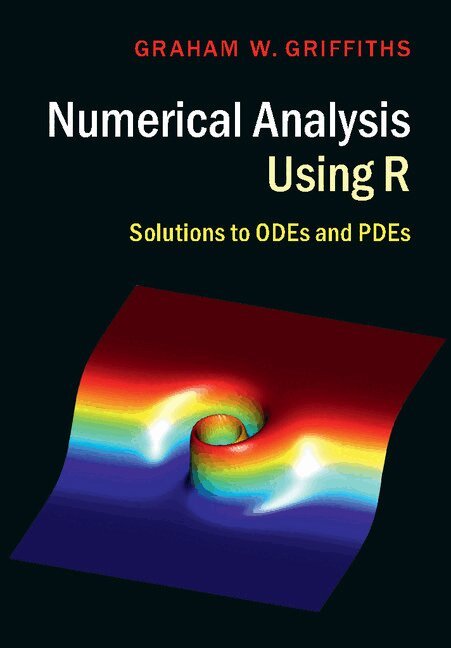
This book presents the latest numerical solutions to initial value problems and boundary value problems described by ODEs and PDEs. The author offers practical methods that can be adapted to solve wide ranges of problems and illustrates them in the increasingly popular open source computer language R, allowing integration with more statistically based methods. The book begins with standard techniques, followed by an overview of 'high resolution' flux limiters and WENO to solve problems with solutions exhibiting high gradient phenomena. Meshless methods using radial basis functions are then discussed in the context of scattered data interpolation and the solution of PDEs on irregular grids. Three detailed case studies demonstrate how numerical methods can be used to tackle very different complex problems. With its focus on practical solutions to real-world problems, this book will be useful to students and practitioners in all areas of science and engineering, especially those using R.
546 kr
Tillfälligt slut
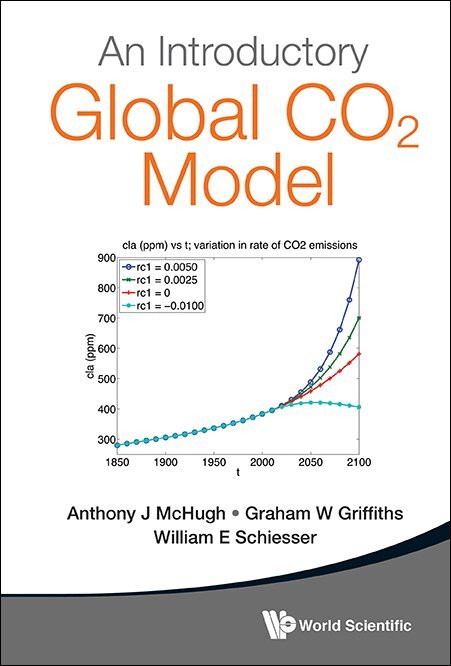
The increasing concentration of atmospheric CO2 is now a problem of global concern. Although the consequences of atmospheric CO2 are still evolving, there is compelling evidence that the global environmental system is undergoing profound changes as seen in the recent spike of phenomena: extreme heat waves, droughts, wildfires, melting glaciers, and rising sea levels. These global problems directly resulting from elevated atmospheric CO2, will last for the foreseeable future, and will ultimately affect everyone.The CO2 problem is generally not well understood quantitatively by a general audience; for example, in respect of the increasing rate of CO2 emissions, and the movement of carbon to other parts of Earth's environmental system, particularly the oceans with accompanying acidification. This book therefore presents an introductory global CO2 mathematical model that gives some key numbers — for example, atmospheric CO2 concentration in ppm and ocean pH as a function of time for the calendar years 1850 (preindustrial) to 2100 (a modest projection into the future). The model is based on seven ordinary differential equations (ODEs), and is intended as an introduction to some basic concepts and a starting point for more detailed study.Quantitative insights into the CO2 problem are provided by the model and can be executed, with postulated changes to parameters, by a modest computer. As basic calculus is the only required mathematical background, this model is accessible to high school students as well as beginning college and university students. The programming of the model is in Matlab and R, two basic, widely used scientific programming systems that are generally accessible and usable worldwide. This book can therefore also be useful to readers interested in Matlab and/or R programming, or a translation of one to the change.