I.M. Yaglom – författare
Visar alla böcker från författaren . Handla med fri frakt och snabb leverans.
4 produkter
4 produkter
Häftad, Engelska, 1979
863 kr
Skickas inom 10-15 vardagar
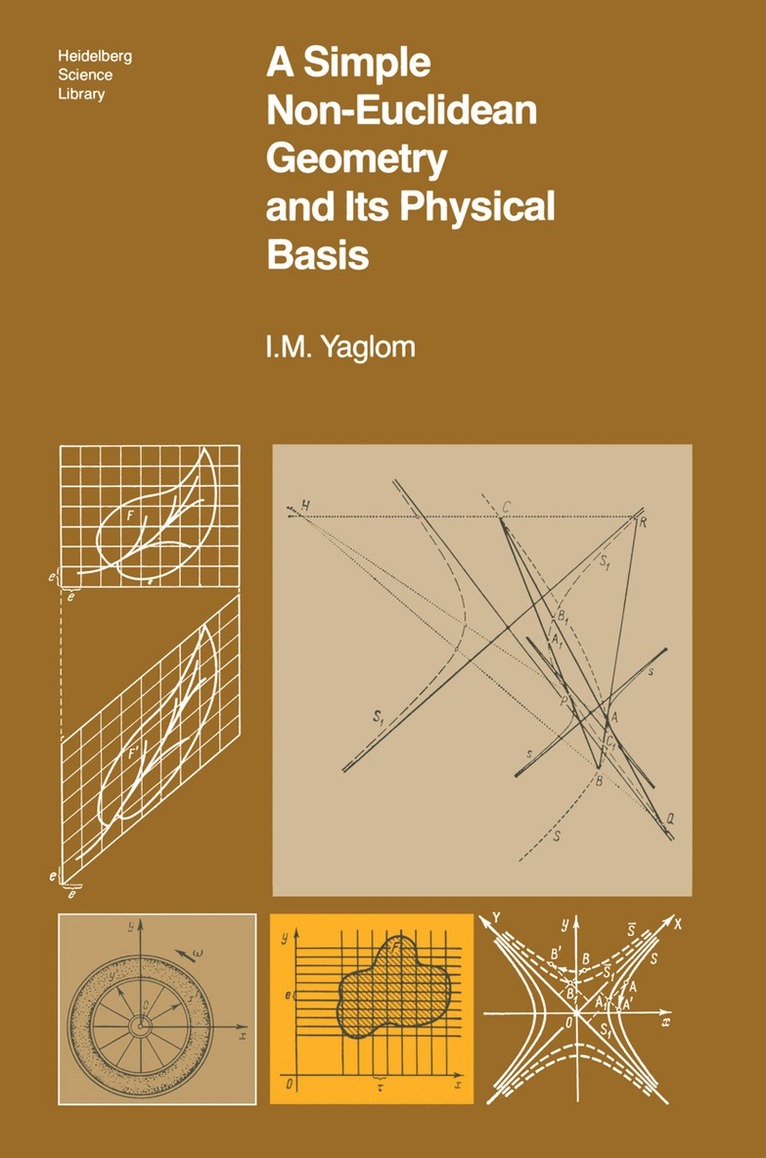
There are many technical and popular accounts, both in Russian and in other languages, of the non-Euclidean geometry of Lobachevsky and Bolyai, a few of which are listed in the Bibliography. This geometry, also called hyperbolic geometry, is part of the required subject matter of many mathematics departments in universities and teachers' colleges-a reflec tion of the view that familiarity with the elements of hyperbolic geometry is a useful part of the background of future high school teachers. Much attention is paid to hyperbolic geometry by school mathematics clubs. Some mathematicians and educators concerned with reform of the high school curriculum believe that the required part of the curriculum should include elements of hyperbolic geometry, and that the optional part of the curriculum should include a topic related to hyperbolic geometry. I The broad interest in hyperbolic geometry is not surprising. This interest has little to do with mathematical and scientific applications of hyperbolic geometry, since the applications (for instance, in the theory of automorphic functions) are rather specialized, and are likely to be encountered by very few of the many students who conscientiously study (and then present to examiners) the definition of parallels in hyperbolic geometry and the special features of configurations of lines in the hyperbolic plane. The principal reason for the interest in hyperbolic geometry is the important fact of "non-uniqueness" of geometry; of the existence of many geometric systems.
Häftad, Engelska, 2009
767 kr
Skickas inom 5-8 vardagar
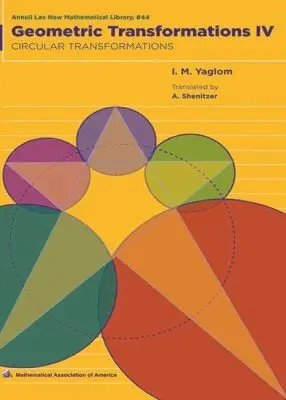
The familiar plane geometry of high school figures composed of lines and circles takes on a new life when viewed as the study of properties that are preserved by special groups of transformations. No longer is there a single, universal geometry: different sets of transformations of the plane correspond to intriguing, disparate geometries.This book is the concluding Part IV of Geometric Transformations, but it can be studied independently of Parts I, II, and III, which appeared in this series as Volumes 8, 21, and 24. Part I treats the geometry of rigid motions of the plane (isometries); Part II treats the geometry of shape-preserving transformations of the plane (similarities); Part III treats the geometry of transformations of the plane that map lines to lines (affine and projective transformations) and introduces the Klein model of non-Euclidean geometry. The present Part IV develops the geometry of transformations of the plane that map circles to circles (conformal or anallagmatic geometry). The notion of inversion, or reflection in a circle, is the key tool employed. Applications include ruler-and-compass constructions and the Poincar model of hyperbolic geometry.The straightforward, direct presentation assumes only some background in high-school geometry and trigonometry. Numerous exercises lead the reader to a mastery of the methods and concepts. The second half of the book contains detailed solutions of all the problems.
E-bok
PDF, Engelska, 20121 108 kr
Läs direkt efter köp
There are many technical and popular accounts, both in Russian and in other languages, of the non-Euclidean geometry of Lobachevsky and Bolyai, a few of which are listed in the Bibliography. This geometry, also called hyperbolic geometry, is part of the required subject matter of many mathematics departments in universities and teachers'' colleges-a reflec tion of the view that familiarity with the elements of hyperbolic geometry is a useful part of the background of future high school teachers. Much attention is paid to hyperbolic geometry by school mathematics clubs. Some mathematicians and educators concerned with reform of the high school curriculum believe that the required part of the curriculum should include elements of hyperbolic geometry, and that the optional part of the curriculum should include a topic related to hyperbolic geometry. I The broad interest in hyperbolic geometry is not surprising. This interest has little to do with mathematical and scientific applications of hyperbolic geometry, since the applications (for instance, in the theory of automorphic functions) are rather specialized, and are likely to be encountered by very few of the many students who conscientiously study (and then present to examiners) the definition of parallels in hyperbolic geometry and the special features of configurations of lines in the hyperbolic plane. The principal reason for the interest in hyperbolic geometry is the important fact of "non-uniqueness" of geometry; of the existence of many geometric systems.
Inbunden, Engelska, 1983
4 071 kr
Skickas inom 10-15 vardagar