John E. Atwell - Böcker
Visar alla böcker från författaren John E. Atwell. Handla med fri frakt och snabb leverans.
3 produkter
3 produkter
503 kr
Skickas inom 7-10 vardagar
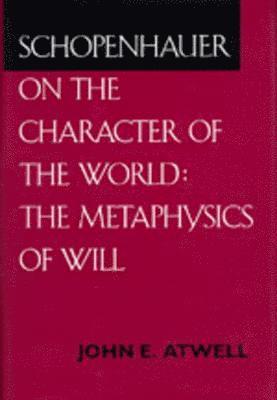
The most extensive English-language study of Schopenhauer's metaphysics of the will yet published, this book represents a major contribution to Schopenhauer scholarship. Here, John E. Atwell critically but sympathetically examines the philosopher's main work, The World as Will and Representation, demonstrating that the philosophical system it puts forth does constitute a consistent whole. The author holds that this system is centered on a single thought, "The world is self-knowledge of the will." He then traces this unifying concept through the four books of The World as Will and Representation, and, in the process, dissolves the work's alleged inconsistencies.
1 062 kr
Skickas inom 10-15 vardagar
Immanuel Kant (1724-1804) stands among the greatest thinkers of the Western world. There is hardly an area of thought, at least of philosophical thought, to which he did not make significant and lasting contributions. Particularly noteworthy are his writings on the foundations and limits of human knowledge, the bidimensional nature of perceptual or "natural" objects (including human beings), the basic principles and ends of morality, the character of a just society and of a world at peace, the movement and direction of human history, the nature of beauty, the end or purpose of all creation, the proper education of young people, the true conception of religion, and on and on. Though Kant was a life-long resident of Konigsberg, Prussia - child, student, tutor, and then professor of philosophy (and other subjects) - his thought ranged over nearly all the world and even beyond. Reports reveal that he (a bachelor) was an amiable man, highly respected by his students and colleagues, and even loved by his several close friends. He was apparently a man of integrity, both in his personal relations and in his pursuit of knowledge and truth. Despite his somewhat pessimistic attitude toward the moral progress of mankind - judging from past history and contemporary events - he never wavered from a deep-seated faith in the goodness of the human heart, in man's "splendid disposition toward the good.
1 062 kr
Skickas inom 10-15 vardagar
Immanuel Kant (1724-1804) stands among the greatest thinkers of the Western world. There is hardly an area of thought, at least of philosophical thought, to which he did not make significant and lasting contributions. Particularly noteworthy are his writings on the foundations and limits of human knowledge, the bidimensional nature of perceptual or "natural" objects (including human beings), the basic principles and ends of morality, the character of a just society and of a world at peace, the movement and direction of human history, the nature of beauty, the end or purpose of all creation, the proper education of young people, the true conception of religion, and on and on. Though Kant was a life-long resident of Konigsberg, Prussia - child, student, tutor, and then professor of philosophy (and other subjects) - his thought ranged over nearly all the world and even beyond. Reports reveal that he (a bachelor) was an amiable man, highly respected by his students and colleagues, and even loved by his several close friends. He was apparently a man of integrity, both in his personal relations and in his pursuit of knowledge and truth. Despite his somewhat pessimistic attitude toward the moral progress of mankind - judging from past history and contemporary events - he never wavered from a deep-seated faith in the goodness of the human heart, in man's "splendid disposition toward the good.