J.S. Murray - Böcker
Visar alla böcker från författaren J.S. Murray. Handla med fri frakt och snabb leverans.
2 produkter
2 produkter
Del 1 - Theoretical and Computational Chemistry
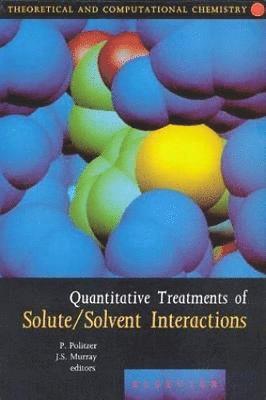
Quantitative Treatments of Solute/Solvent Interactions
Inbunden, Engelska, 1994
689 kr
Skickas inom 7-10 vardagar
The primary objective of this volume, the first in a new series entitled Theoretical and Computational Chemistry, is to survey some effective approaches to understanding, describing and predicting ways in which solutes and solvents interact and the effects they have upon each other. The treatment of solute/solvent interactions that is presented emphasizes a synergism between theory and experiment. Data obtained experimentally are used as a basis for developing quantitative theoretical models that permit the correlation and interpretation of the data, and also provide a predictive capability. The latter being of course a key motivation for these efforts. Linear solvation energy relationships have been quite successful in this respect and accordingly receive considerable attention. Other effective approaches, including computational ones, are also being pursued, and are discussed in several chapters. This is an area that is continually evolving, and it is hoped that the present volume will convey a sense of its dynamic nature.
Del 3 - Theoretical and Computational Chemistry
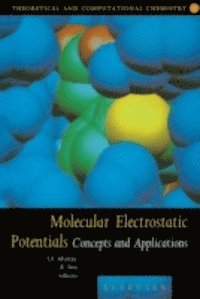
Molecular Electrostatic Potentials
Concepts and Applications
Inbunden, Engelska, 1996
3 020 kr
Skickas inom 7-10 vardagar
Over the past 25 years, the molecular electrostatic potential has become firmly established as an effective guide to molecular interactions. With the recent advances in computational technology, it is currently being applied to a variety of important chemical and biological systems. Its range of applicability has expanded from primarily a focus on sites for electrophilic and nucleophilic attack to now include solvent effects, studies of zeolite, molecular cluster and crystal behavior, and the correlation and prediction of a wide range of macroscopic properties. Moreover, the increasing prominence of density functional theory has raised the molecular electrostatic potential to a new stature on a more fundamental conceptual level. It is rigorously defined in terms of the electron density, and has very interesting topological characteristics since it explicitly reflects opposing contributions from the nuclei and the electrons.
This volume opens with a survey chapter by one of the original pioneers of the use of the electrostatic potential in studies of chemical reactivity, Jacopo Tomasi. Though the flow of the succeeding chapters is not stringently defined, the overall trend is that the emphasis changes gradually from methodology to applications. Chapters discussing more theoretical topics are placed near the end. Readers will find the wide variety of topics provided by an international group of authors both convincing and useful.