Kanaris Tsinganos – författare
Visar alla böcker från författaren Kanaris Tsinganos. Handla med fri frakt och snabb leverans.
4 produkter
4 produkter
Inbunden, Engelska, 2026
1 286 kr
Kommande
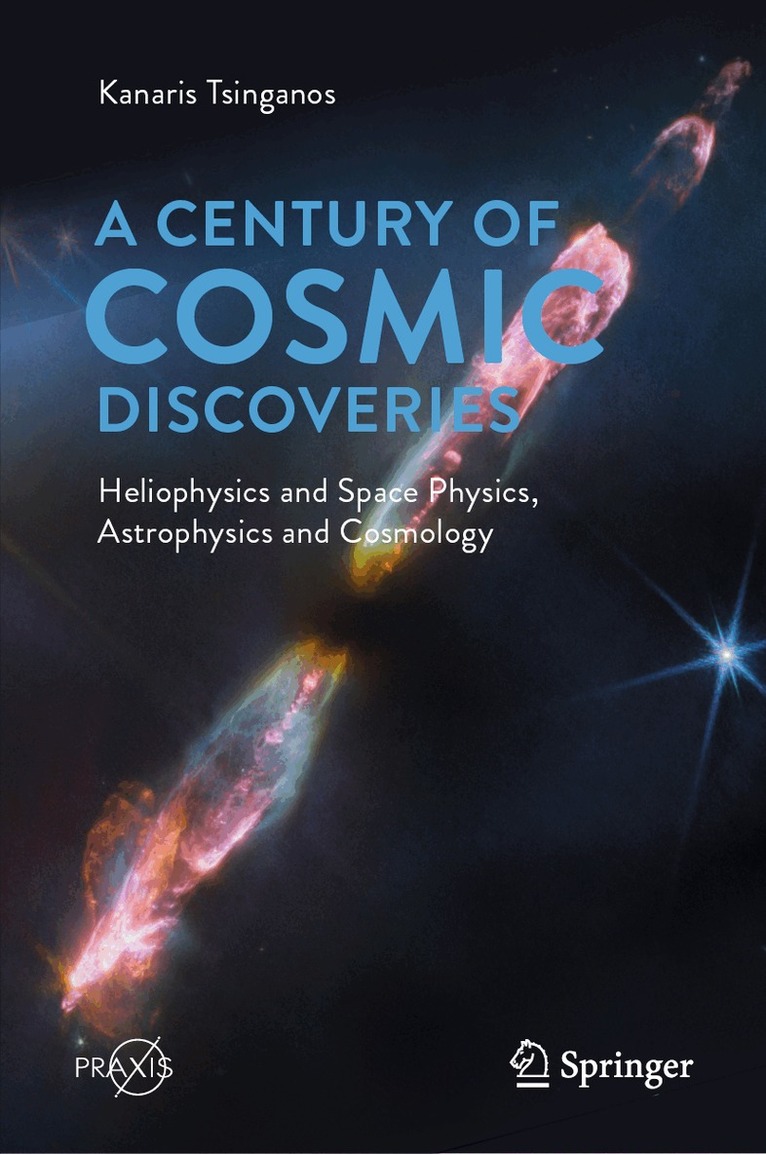
This book provides a concise, non-mathematical summary of key astronomical discoveries, organized chronologically from the founding of the International Astronomical Union in 1919 to the present day. It highlights significant findings related to solar and space physics, exoplanets, astrophysics and cosmology.Focusing on the 20th century, this volume offers a comprehensive overview of major breakthroughs in heliophysics, planetary exploration, the study of the interstellar medium, and the recent discovery of exoplanets. Additionally, it gives an account of the exploration of pulsars, white dwarfs, and neutron stars, alongside developments in high-energy astrophysics, such as the study of supernovae, active galactic nuclei, extragalactic jets, quasars, black holes, and X- and γ-ray astronomy. Further, the book discusses discoveries in galactic hierarchy and the cosmic voids, the bubbles of the cosmic web as well as the discovery of gravitational waves and multi-messenger astronomy. It also explores the investigations into the early Universe, dark matter, and dark energy.This work serves as a valuable resource for students, educators, researchers, and the general public, offering insights into how these groundbreaking discoveries have shaped our understanding of both the nearby and the distant Universe over the last century and into the present day.
Inbunden, Engelska, 2009
3 231 kr
Skickas inom 10-15 vardagar
It is over a quarter of a century since the discovery of out?ows from young stars. The intervening years have led to remarkable advances in our understanding of this phenomenon. Much of the progress can be attributed to advances in facilities and technologies, including not only larger telescopes but also improved instrument and detector performance. In addition protostellar out?ows have now been imaged from the ground and space at high spatial resolution, e. g. with HST, and at a wide - riety of wavelengths from X-rays to radio waves, revealing more and more about their physics. This veritable revolution in observation has been accompanied by an exponential growth in our ability to numerically simulate the launching and pro- gation of jets. Codes continue to improve: they now incorporate more physics and are increasingly ef?cient through, for example, techniques such as adaptive mesh re?nement and the use of parallel processing in cluster environments. Simulating the launching and propagation of a jet all the way from the vicinity of the star up to 4 several thousand AU (a size range of10 ) is now much closer. In more recent times, developments in observation, theory and numerical s- ulation have been joined by laboratory jet experiments reproducing, on centimetre scales, that which is seen in astrophysics to stretch for several parsecs.
Häftad, Engelska, 2012
3 231 kr
Skickas inom 10-15 vardagar
It is over a quarter of a century since the discovery of out?ows from young stars. The intervening years have led to remarkable advances in our understanding of this phenomenon. Much of the progress can be attributed to advances in facilities and technologies, including not only larger telescopes but also improved instrument and detector performance. In addition protostellar out?ows have now been imaged from the ground and space at high spatial resolution, e. g. with HST, and at a wide - riety of wavelengths from X-rays to radio waves, revealing more and more about their physics. This veritable revolution in observation has been accompanied by an exponential growth in our ability to numerically simulate the launching and pro- gation of jets. Codes continue to improve: they now incorporate more physics and are increasingly ef?cient through, for example, techniques such as adaptive mesh re?nement and the use of parallel processing in cluster environments. Simulating the launching and propagation of a jet all the way from the vicinity of the star up to 4 several thousand AU (a size range of10 ) is now much closer. In more recent times, developments in observation, theory and numerical s- ulation have been joined by laboratory jet experiments reproducing, on centimetre scales, that which is seen in astrophysics to stretch for several parsecs.
Häftad, Engelska, 2012
540 kr
Skickas inom 10-15 vardagar
Modern observations, including recent ones with the Hubble Space Telescope, have revealed that the Universe is replete with plasma outflows from all kinds of objects, ranging from stars in all their variety to galaxies. In this masterly survey of plasma astrophysics, written by leading practitioners, the first 15 articles in Part I deal with the use of the MHD approach in several key problems of solar plasma, such as magnetoconvection and magnetic field generation, sunspots and coronal loops, magnetic nonequilibrium and coronal heating, coronal mass ejections, the acceleration of the solar wind, and stellar winds across the Main Sequence. The following 16 articles of Part II deal with the use of the same MHD approach in several central and puzzling aspects of more distant astrophysical plasmas, such as the dynamics of the interstellar medium, collimated outflows from young stellar objects and accretion disks, molecular outflows and jets associated with enigmatic binaries and symbiotic stars, relativistic flows associated with superluminal microquasars in our own galaxy, astrophysical jets from nearby galaxies, or remote active galactic nuclei and quasars, probably fuelled by supermassive black holes. The emphasis throughout is on the striking underlying similarities in the physics of all these problems. Audience: Indispensable for solar physicists and astrophysics alike. An ideal textbook for graduate students in physics and astrophysics.