K.E. Olsen – författare
Visar alla böcker från författaren . Handla med fri frakt och snabb leverans.
2 produkter
2 produkter
Del 3 - Mediaevalia Groningana New Series
Monsters and the Monstrous in Medieval Northwest Europe
Häftad, Engelska, 2001
907 kr
Skickas inom 3-6 vardagar
The essays in this book examine various manifestations of monstrosity in the early literatures of England, Ireland and Scandinavia. The dates of the texts discussed range from the eighth to the thirteenth centuries and were written either in Latin or in one of the vernaculars. The present contributions shed light on the physical, mental and metaphysical qualities that characterize medieval monsters in general. How do such creatures relate to accepted physical norms? How do their behaviours deviate from established cultural practices? How can their presence in both fictional and non-fictional texts be explained either in terms of a textual tradition or as a response to actual events? Such issues are examined from literary, philological, theological, and historical points of view in order to provide a thorough, multifaceted depiction of the sub- and supernatural monsters of medieval Northwest Europe.
Del 2 - Mediaevalia Groningana New Series
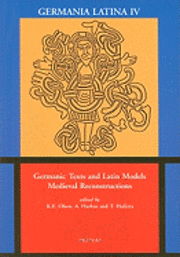
Germanic Texts and Latin Models Medieval Reconstructions
Germania Latina IV
Häftad, Engelska, 2001
1 120 kr
Tillfälligt slut
Medieval writers who 'translated' Latin texts into Germanic vernaculars not only transmitted their originals, but, driven by individualistic impulses and cultural conventions, also transformed them. This process of domesticating texts was fundamentally creative and might more accurately be described as 'reconstruction'. The essays in Germanic Texts and Latin Models: Medieval Reconstructions explore the ways in which Latin texts and traditions were reconstructed in Old English, Old Icelandic and Old High German and cover a range of genres: legal texts, genealogies, histories, and poetry. They examine how medieval Germanic authors negotiated the need to transmit their models while at the same time fulfilling their own political, artistic and didactic objectives in the creation of vernacular texts. These new studies demonstrate the variety of ways in which medieval Germanic texts were indebted to their Latin exemplars, while reflecting their new culturally specific circumstances in the complex nexus of Latin learning and Germanic lore.