Kirsten Gengel – författare
Visar alla böcker från författaren Kirsten Gengel. Handla med fri frakt och snabb leverans.
2 produkter
2 produkter
Del 47 - Oxford Studies in Theoretical Linguistics
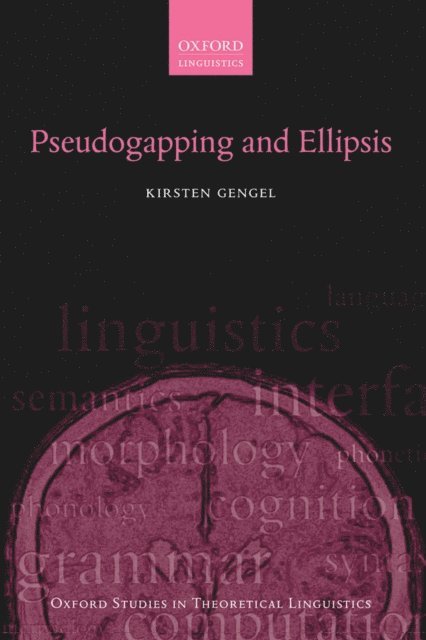
Pseudogapping and Ellipsis
Inbunden, Engelska, 2013
1 625 kr
Skickas inom 5-8 vardagar
This book is all about ellipsis in natural language - the phenomena in which words and phrases go missing in the linguistic signal, but are nonethe less interpreted by the receiver, eg in the following sentence, the second instance of read is understood whether or not it is spoken Claire read a book and Heather [read] a magazine. Contemporary theoretical linguistics has described several forms of ellipsis in English, and different syntactic mechanisms have been proposed which account for their structures. Kirsten Gengel investigates pseudogapping, which, she proposes, is one variety of ellipsis. At the heart of her discussion lies the interaction between focus and deletion. Her analysis - which draws on new research in Icelandic, Norwegian, Danish, and Dutch, as well as data from Portuguese, French, and English - provides a novel approach to not only this particular form of ellipsis but to the derivation of ellipsis in general, and has the potential of unifying several elliptical phenomena in generative grammar.
Del 47 - Oxford Studies in Theoretical Linguistics
Pseudogapping and Ellipsis
Häftad, Engelska, 2013
731 kr
Skickas inom 5-8 vardagar
This book is all about ellipsis in natural language - the phenomena in which words and phrases go missing in the linguistic signal, but are nonethe less interpreted by the receiver, eg in the following sentence, the second instance of read is understood whether or not it is spoken Claire read a book and Heather [read] a magazine. Contemporary theoretical linguistics has described several forms of ellipsis in English, and different syntactic mechanisms have been proposed which account for their structures. Kirsten Gengel investigates pseudogapping, which, she proposes, is one variety of ellipsis. At the heart of her discussion lies the interaction between focus and deletion. Her analysis - which draws on new research in Icelandic, Norwegian, Danish, and Dutch, as well as data from Portuguese, French, and English - provides a novel approach to not only this particular form of ellipsis but to the derivation of ellipsis in general, and has the potential of unifying several elliptical phenomena in generative grammar.