Lord Kelvin – författare
Visar alla böcker från författaren Lord Kelvin. Handla med fri frakt och snabb leverans.
2 produkter
2 produkter
E-bok
Engelska, 201711 kr
Läs direkt efter köp
Contents:1. The Forces of Matter and The Chemical History of a Candle, by Michael Faraday2. On the Conservation of Force and Ice and Glaciers, by Hermann von Helmholtz3. The Wave Theory of Light and The Tides, by Lord Kelvin4. The Extent of the Universe, by Simon Newcomb5. Geographical Evolution, by Sir Archibald Geikie
Häftad, Engelska, 2002
212 kr
Tillfälligt slut
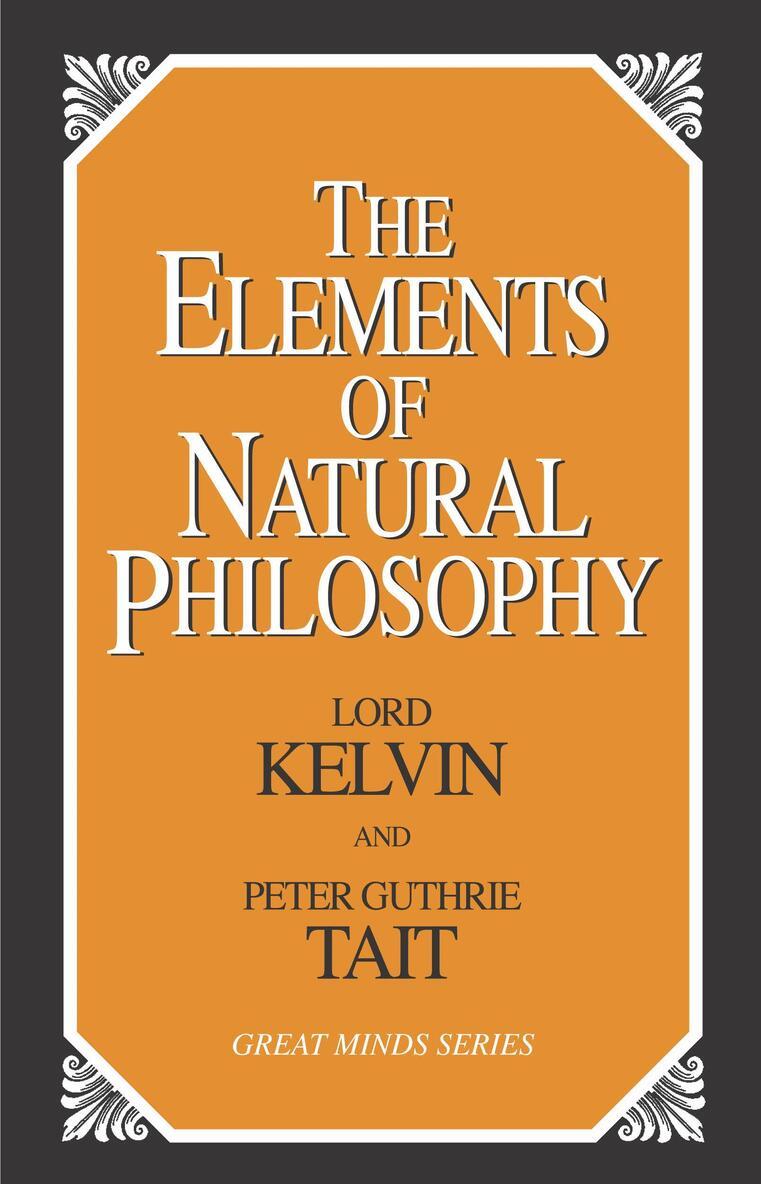
One of the most celebrated scientists of the 19th century, William Thomson, Lord Kelvin, was said to have more letters after his name than any man in the British Empire. His prodigious accomplishments included both theoretical insights and significant inventions. Among his contributions to theory were advances in hydrodynamics, an innovative synthesis of the mathematical relationship between electricity and heat, and major work in the second law of thermodynamics. In the practical realm he created the absolute temperature scale (which bears his name); worked on the development of the first transatlantic telegraph cable; and invented a telegraph receiver, a compass adopted by the British Admiralty, a form of analog computer for measuring tides, and sounding equipment. Always in the forefront of the leading scientists of the day, he collaborated with James Clerk Maxwell, Hermann von Helmholtz, James Prescott Joule, and Peter Guthrie Tait.The Elements of Natural Philosophy was done with Tait, a pioneering physicist and mathematician whose work in advanced algebra formed the basis of vector analysis and was instrumental in the later development of modern mathematical physics. An abridgement of their original Treatise on Natural Philosophy, this work was designed to be accessible to students with a basic knowledge of algebra, geometry, and trigonometry. As such it is a book that nonspecialists can still appreciate.Like Isaac Newton's great summation of "natural philosophy" in the late 17th century (The Principia Mathematica), this work remains of interest to historians of science because it represented a similar summation of the grand synthesis that scientists, building upon Newton's work, envisioned at the end of the 19th century. Not long after its publication, however, was the advent of relativity and quantum physics, which considerably changed and enlarged the picture of the natural world as conceived by earlier generations of scientists.