811 kr
Skickas inom 10-15 vardagar
811 kr
Skickas inom 10-15 vardagar
1 238 kr
Skickas inom 5-8 vardagar
1 372 kr
Skickas inom 5-8 vardagar
949 kr
Läs direkt efter köp
"Knot theory is a fascinating mathematical subject, with multiple links to theoretical physics. This enyclopedia is filled with valuable information on a rich and fascinating subject."
– Ed Witten, Recipient of the Fields Medal
"I spent a pleasant afternoon perusing the Encyclopedia of Knot Theory. It’s a comprehensive compilation of clear introductions to both classical and very modern developments in the field. It will be a terrific resource for the accomplished researcher, and will also be an excellent way to lure students, both graduate and undergraduate, into the field."
– Abigail Thompson, Distinguished Professor of Mathematics at University of California, Davis
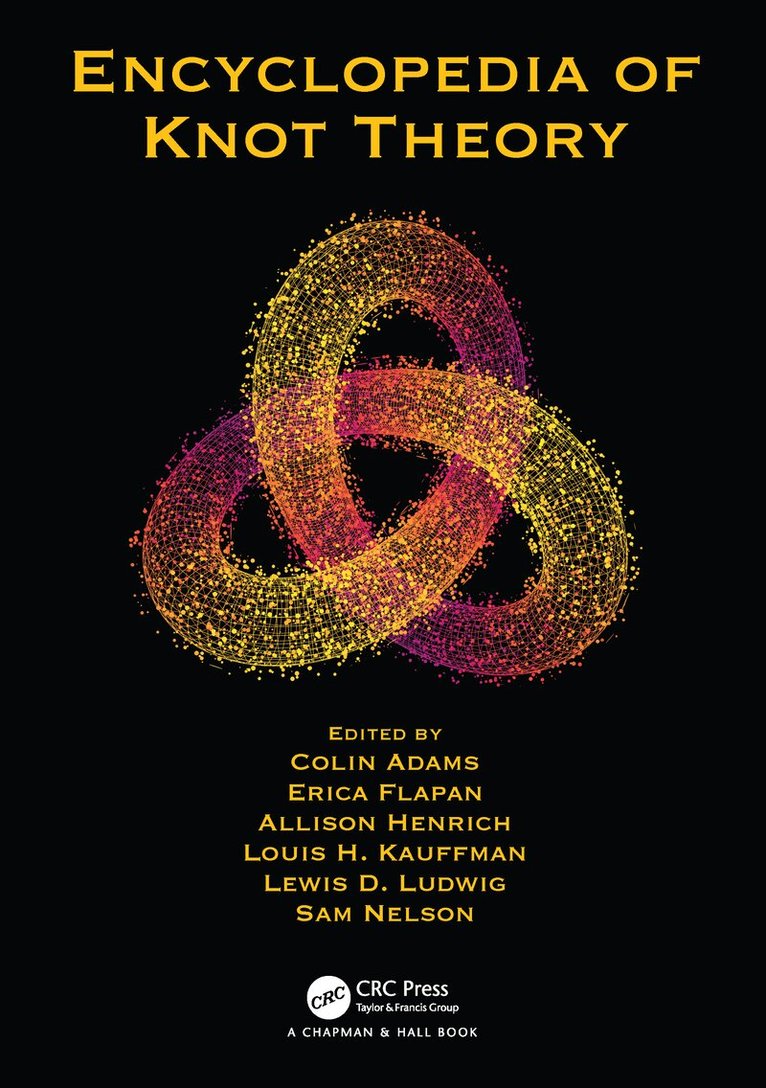
Knot theory has proven to be a fascinating area of mathematical research, dating back about 150 years. Encyclopedia of Knot Theory provides short, interconnected articles on a variety of active areas in knot theory, and includes beautiful pictures, deep mathematical connections, and critical applications. Many of the articles in this book are accessible to undergraduates who are working on research or taking an advanced undergraduate course in knot theory. More advanced articles will be useful to graduate students working on a related thesis topic, to researchers in another area of topology who are interested in current results in knot theory, and to scientists who study the topology and geometry of biopolymers.
Features
Provides material that is useful and accessible to undergraduates, postgraduates, and full-time researchers Topics discussed provide an excellent catalyst for students to explore meaningful research and gain confidence and commitment to pursuing advanced degrees Edited and contributed by top researchers in the field of knot theory949 kr
Läs direkt efter köp
"Knot theory is a fascinating mathematical subject, with multiple links to theoretical physics. This enyclopedia is filled with valuable information on a rich and fascinating subject."
– Ed Witten, Recipient of the Fields Medal
"I spent a pleasant afternoon perusing the Encyclopedia of Knot Theory. It’s a comprehensive compilation of clear introductions to both classical and very modern developments in the field. It will be a terrific resource for the accomplished researcher, and will also be an excellent way to lure students, both graduate and undergraduate, into the field."
– Abigail Thompson, Distinguished Professor of Mathematics at University of California, Davis
Knot theory has proven to be a fascinating area of mathematical research, dating back about 150 years. Encyclopedia of Knot Theory provides short, interconnected articles on a variety of active areas in knot theory, and includes beautiful pictures, deep mathematical connections, and critical applications. Many of the articles in this book are accessible to undergraduates who are working on research or taking an advanced undergraduate course in knot theory. More advanced articles will be useful to graduate students working on a related thesis topic, to researchers in another area of topology who are interested in current results in knot theory, and to scientists who study the topology and geometry of biopolymers.
Features
Provides material that is useful and accessible to undergraduates, postgraduates, and full-time researchers Topics discussed provide an excellent catalyst for students to explore meaningful research and gain confidence and commitment to pursuing advanced degrees Edited and contributed by top researchers in the field of knot theory3 742 kr
Skickas inom 10-15 vardagar
1 911 kr
Läs direkt efter köp
On Knots is a journey through the theory of knots, starting from the simplest combinatorial ideas--ideas arising from the representation of weaving patterns. From this beginning, topological invariants are constructed directly: first linking numbers, then the Conway polynomial and skein theory. This paves the way for later discussion of the recently discovered Jones and generalized polynomials. The central chapter, Chapter Six, is a miscellany of topics and recreations. Here the reader will find the quaternions and the belt trick, a devilish rope trick, Alhambra mosaics, Fibonacci trees, the topology of DNA, and the author''s geometric interpretation of the generalized Jones Polynomial.Then come branched covering spaces, the Alexander polynomial, signature theorems, the work of Casson and Gordon on slice knots, and a chapter on knots and algebraic singularities.The book concludes with an appendix about generalized polynomials.
1 716 kr
Läs direkt efter köp
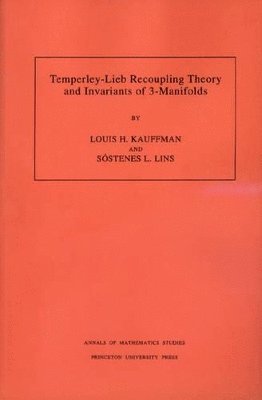
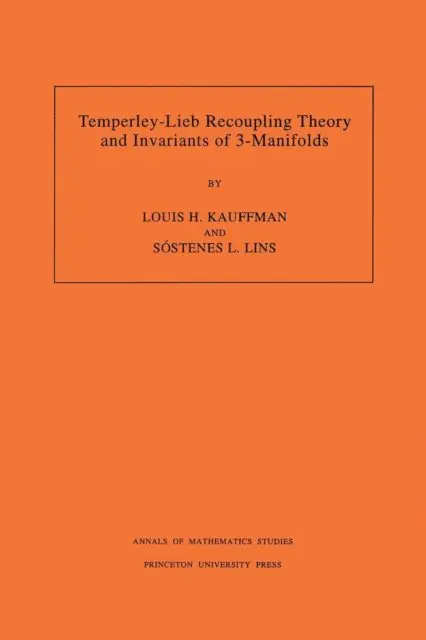
This book offers a self-contained account of the 3-manifold invariants arising from the original Jones polynomial. These are the Witten-Reshetikhin-Turaev and the Turaev-Viro invariants. Starting from the Kauffman bracket model for the Jones polynomial and the diagrammatic Temperley-Lieb algebra, higher-order polynomial invariants of links are constructed and combined to form the 3-manifold invariants. The methods in this book are based on a recoupling theory for the Temperley-Lieb algebra. This recoupling theory is a q-deformation of the SU(2) spin networks of Roger Penrose. The recoupling theory is developed in a purely combinatorial and elementary manner. Calculations are based on a reformulation of the Kirillov-Reshetikhin shadow world, leading to expressions for all the invariants in terms of state summations on 2-cell complexes. Extensive tables of the invariants are included. Manifolds in these tables are recognized by surgery presentations and by means of 3-gems (graph encoded 3-manifolds) in an approach pioneered by Sostenes Lins. The appendices include information about gems, examples of distinct manifolds with the same invariants, and applications to the Turaev-Viro invariant and to the Crane-Yetter invariant of 4-manifolds.
550 kr
Skickas inom 3-6 vardagar
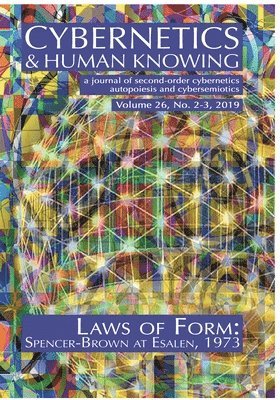
This Special Issue of Cybernetics and Human Knowing contains rare material related to G. Spencer-Brown's book Laws of Form and its contents.
In 1973 there was a conference at Big Sur at which Spencer-Brown discussed his calculus with a group of scientists. This was the AUM Conference at Esalen, and the scientists consisted in an assortment of remarkable individuals exploring the cutting edge of human consciousness and culture, including Alan Watts, Ram Dass, John Lilly, Heinz von Foerster, Kurt von Meier, and others. One of the participants, Walter Barney, has written about this conference and has long been a keeper of the transcripts of Spencer-Brown’s talks. In this issue we print Barney’s transcripts of the conference and an article by Walter Barney and Kurt von Meier reflecting on the AUM conference. The transcripts are a remarkable amalgam of the thinking of Spencer-Brown and the questions and comments of the participants in AUM. The transcripts carry the same lucidity that infuses Laws of Form.
The other articles in this issue include a paper on Flagg Resolution by James Flagg and Louis Kauffman, a paper on Paper Computers and the Emergence of Fermions by Louis Kauffman, and a Virtual Logic Column by Louis Kauffman that is a new take on the Barber paradox and the Russell Paradox, based on satire, mirrors, and the key observation of Douglas Harding that no person can (in the absence of mirrors) perceive his or her own head. There is an American Society for Cybernetics Column by Zane Gillespie about the structure of implausibility in music, art, and cybernetics.
484 kr
Skickas inom 3-6 vardagar
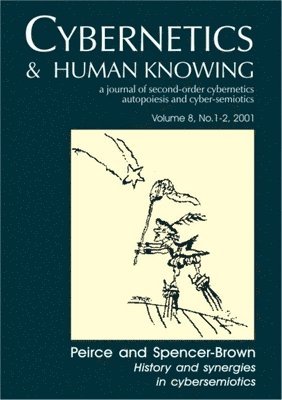
This special double issue of Cybernetics and Human Knowing is comprised of a collection of papers devoted to the cybernetics and mathematics of Charles Sanders Peirce with a special focus on its synergies with George Spencer-Brown's thinking. Peirce was a truly original American philosopher and logician working in the late 1800s and early 1900s; Spencer-Brown is an English polymath, best known as the author of Laws of Form. The contributions reflect the extraordinary richness of Peirce's work and his relevance to present concerns in cybernetics. The similarities in the focus on some of the deep foundational subjects are astonishing, amongst those especially the concept of the void or Firstness and the continuity of mind and matter.
542 kr
Skickas inom 3-6 vardagar
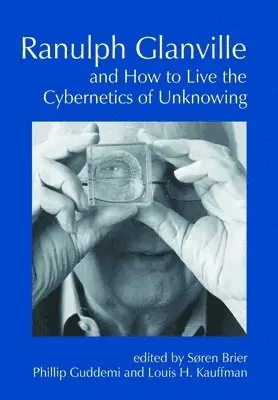
A festschrift issue of Cybernetics and Human Knowing focusing on the work of Ranulph Glanville, cybernetician, design researcher, theorist, educator and multi-platform artist/designer/performer.
286 kr
Skickas
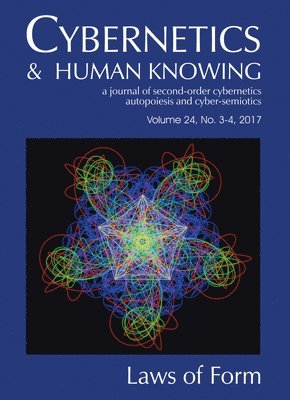
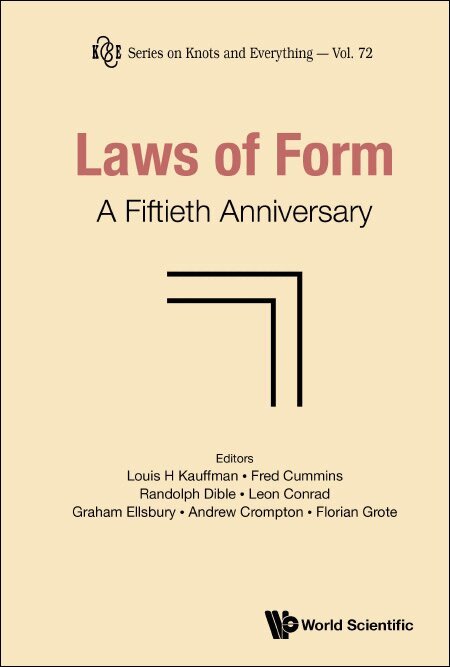
This volume is a collection of articles on themes related to the book Laws of Form by George Spencer-Brown. Laws of Form was first published in 1969 and brings forth a new articulation of the foundations of thought. In Laws of Form we have a mathematical formalism based on one symbol and an approach to the question how the world would appear if a distinction could be drawn. Laws of Form does not answer the question how, given nothing as a beginning, a distinction can, indeed must, inevitably take place. This second question must, in its own structure, be left to each individual thinker. Nevertheless, Laws of Form, beautifully written and content free (form is emptiness, emptiness is form) is the most powerful mathematical text on the edge of nothing that has been produced since Euclid's Elements. These papers are a tribute to Spencer-Brown and his singular achievement.
Knots in Hellas, International Olympic Academy, Greece, July 2016
1 982 kr
Skickas inom 10-15 vardagar
2 517 kr
Läs direkt efter köp
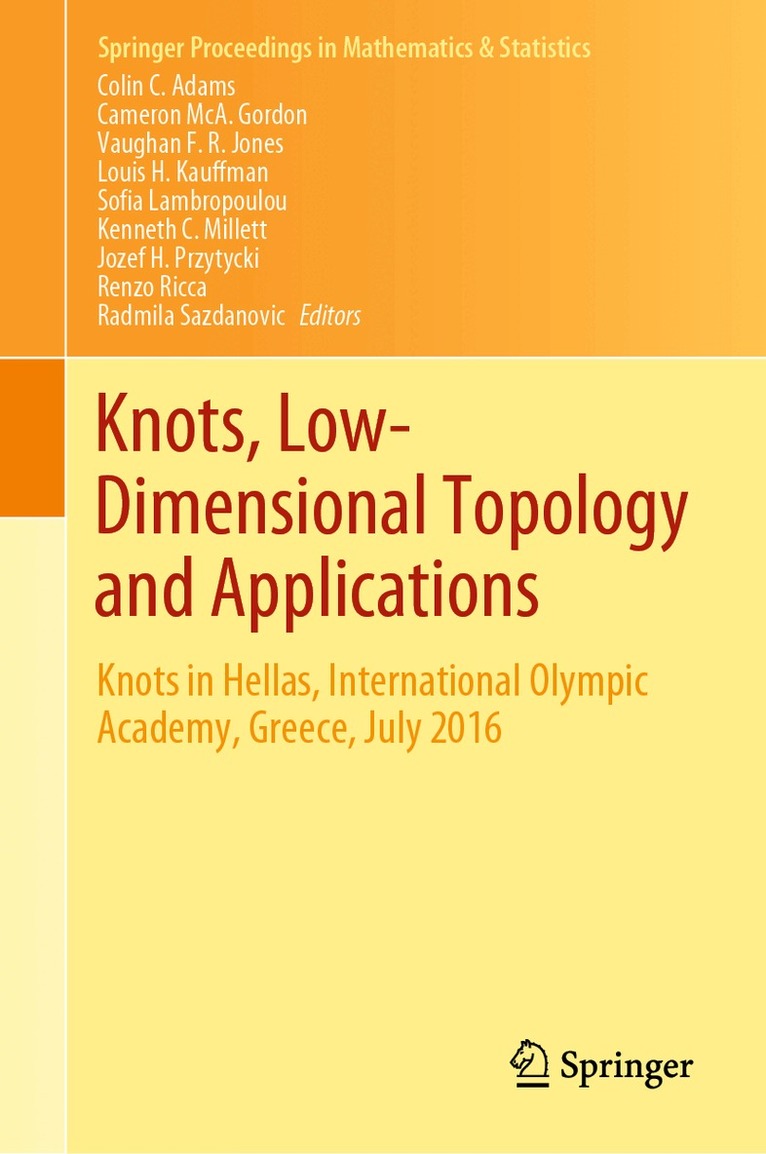
This proceedings volume presents a diverse collection of high-quality, state-of-the-art research and survey articles written by top experts in low-dimensional topology and its applications.
The focal topics include the wide range of historical and contemporary invariants of knots and links and related topics such as three- and four-dimensional manifolds, braids, virtual knot theory, quantum invariants, braids, skein modules and knot algebras, link homology, quandles and their homology; hyperbolic knots and geometric structures of three-dimensional manifolds; the mechanism of topological surgery in physical processes, knots in Nature in the sense of physical knots with applications to polymers, DNA enzyme mechanisms, and protein structure and function.
The contents is based on contributions presented at the International Conference on Knots, Low-Dimensional Topology and Applications – Knots in Hellas 2016, which was held at the International Olympic Academy in Greece in July 2016. The goal of the international conference was to promote the exchange of methods and ideas across disciplines and generations, from graduate students to senior researchers, and to explore fundamental research problems in the broad fields of knot theory and low-dimensional topology.
This book will benefit all researchers who wish to take their research in new directions, to learn about new tools and methods, and to discover relevant and recent literature for future study.
Knots in Hellas, International Olympic Academy, Greece, July 2016
1 982 kr
Skickas inom 10-15 vardagar
THALES, Athens, Greece, July 1-3, 2015
1 653 kr
Skickas inom 10-15 vardagar
2 065 kr
Läs direkt efter köp
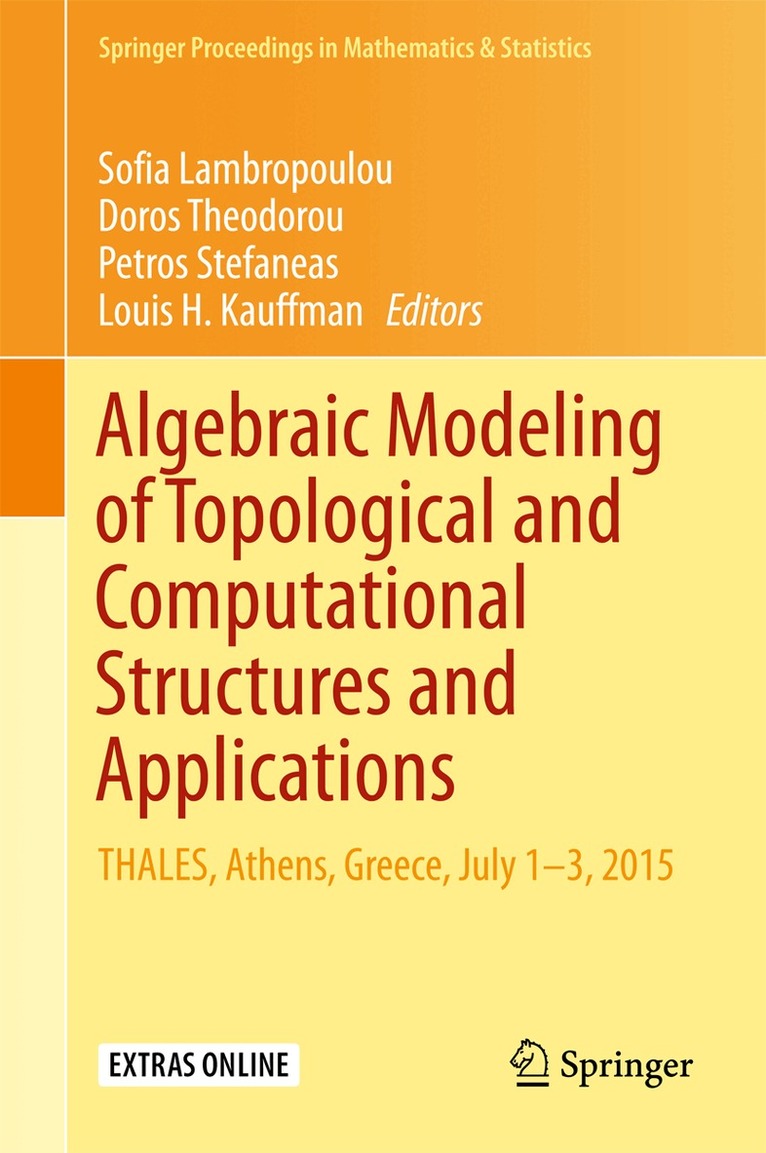
This interdisciplinary book covers a wide range of subjects, from pure mathematics (knots, braids, homotopy theory, number theory) to more applied mathematics (cryptography, algebraic specification of algorithms, dynamical systems) and concrete applications (modeling of polymers and ionic liquids, video, music and medical imaging). The main mathematical focus throughout the book is on algebraic modeling with particular emphasis on braid groups.
The research methods include algebraic modeling using topological structures, such as knots, 3-manifolds, classical homotopy groups, and braid groups. The applications address the simulation of polymer chains and ionic liquids, as well as the modeling of natural phenomena via topological surgery. The treatment of computational structures, including finite fields and cryptography, focuses on the development of novel techniques. These techniques can be applied to the design of algebraic specifications for systems modeling and verification.
This book is the outcome of a workshop in connection with the research project Thales on Algebraic Modeling of Topological and Computational Structures and Applications, held at the National Technical University of Athens, Greece in July 2015. The reader will benefit from the innovative approaches to tackling difficult questions in topology, applications and interrelated research areas, which largely employ algebraic tools.
THALES, Athens, Greece, July 1-3, 2015
1 653 kr
Skickas inom 10-15 vardagar
555 kr
Skickas inom 10-15 vardagar
718 kr
Läs direkt efter köp
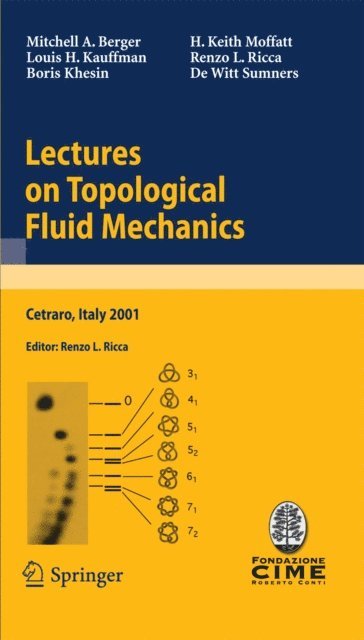
Helmholtz''s seminal paper on vortex motion (1858) marks the beginning of what is now called topological fluid mechanics.After 150 years of work, the field has grown considerably. In the last several decades unexpected developments have given topological fluid mechanics new impetus, benefiting from the impressive progress in knot theory and geometric topology on the one hand, and in mathematical and computational fluid dynamics on the other.
This volume contains a wide-ranging collection of up-to-date, valuable research papers written by some of the most eminent experts in the field. Topics range from fundamental aspects of mathematical fluid mechanics, including topological vortex dynamics and magnetohydrodynamics, integrability issues, Hamiltonian structures and singularity formation, to DNA tangles and knotted DNAs in sedimentation. A substantial introductory chapter on knots and links, covering elements of modern braid theory and knot polynomials, as well as more advanced topics in knot classification, provides an invaluable addition to this material.
1 928 kr
Skickas inom 5-8 vardagar
1 625 kr
Skickas inom 5-8 vardagar
605 kr
Skickas inom 5-8 vardagar
876 kr
Skickas inom 5-8 vardagar
844 kr
Skickas inom 3-6 vardagar
2 104 kr
Skickas inom 3-6 vardagar
2 041 kr
Skickas inom 3-6 vardagar
2 571 kr
Skickas inom 3-6 vardagar
2 703 kr
Skickas inom 3-6 vardagar
3 233 kr
Skickas inom 3-6 vardagar