Nigel P. Weatherill – författare
Visar alla böcker från författaren Nigel P. Weatherill. Handla med fri frakt och snabb leverans.
2 produkter
2 produkter
3 012 kr
Skickas inom 10-15 vardagar
Handbook of Grid Generation addresses the use of grids (meshes) in the numerical solutions of partial differential equations by finite elements, finite volume, finite differences, and boundary elements. Four parts divide the chapters: structured grids, unstructured girds, surface definition, and adaption/quality. An introduction to each section provides a roadmap through the material.This handbook covers:Fundamental concepts and approaches Grid generation process Essential mathematical elements from tensor analysis and differential geometry, particularly relevant to curves and surfaces Cells of any shape - Cartesian, structured curvilinear coordinates, unstructured tetrahedra, unstructured hexahedra, or various combinations Separate grids overlaid on one another, communicating data through interpolation Moving boundaries and internal interfaces in the field Resolving gradients and controlling solution error Grid generation codes, both commercial and freeware, as well as representative and illustrative grid configurationsHandbook of Grid Generation contains 37 chapters as well as contributions from more than 100 experts from around the world, comprehensively evaluating this expanding field and providing a fundamental orientation for practitioners.
Del 44 - Notes on Numerical Fluid Mechanics and Multidisciplinary Design
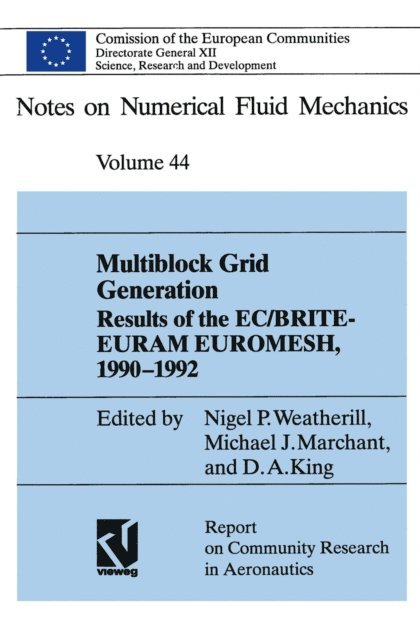
Multiblock Grid Generation
Results of the EC/BRITE-EURAM Project EUROMESH, 1990–1992
Häftad, Engelska, 1993
1 071 kr
Skickas inom 10-15 vardagar
Computational Fluid Dynamics research, especially for aeronautics, continues to be a rewarding and industrially relevant field of applied science in which to work. An enthusiastic international community of expert CFD workers continue to push forward the frontiers of knowledge in increasing number. Applications of CFD technology in many other sectors of industry are being successfully tackled. The aerospace industry has made significant investments and enjoys considerable benefits from the application of CFD to its products for the last two decades. This era began with the pioneering work ofMurman and others that took us into the transonic (potential flow) regime for the first time in the early 1970's. We have also seen momentous developments of the digital computer in this period into vector and parallel supercomputing. Very significant advances in all aspects of the methodology have been made to the point where we are on the threshold of calculating solutions for the Reynolds-averaged Navier-Stokes equations for complete aircraft configurations. However, significant problems and challenges remain in the areas of physical modelling, numerics and computing technology. The long term industrial requirements are captured in the U. S. Governments 'Grand Challenge' for 'Aerospace Vehicle Design' for the 1990's: 'Massively parallel computing systems and advanced parallel software technology and algorithms will enable the development and validation of multidisciplinary, coupled methods. These methods will allow the numerical simulation and design optimisation of complete aerospace vehicle systems throughout the flight envelope'.