Norgauer – författare
Visar alla böcker från författaren Norgauer. Handla med fri frakt och snabb leverans.
3 produkter
3 produkter
644 kr
Skickas inom 5-8 vardagar
556 kr
Skickas inom 10-15 vardagar
The accumulation of white blood cells is a hallmark of inflammation. The penetra- tion through the vessel walls and the infiltration around the inflammatory stimulus is a complex process which involves active adherence and directed migration of the inflammatory cells. Chemotactic factors stimulate both adherence and migration. Technical tools such as the Boyden chamber [1] made it possible to study leukocyte migration in vitro. This technique allows differentiation between migration direct- ed towards a chemotactic stimulus and non-directed migration. Until a decade ago only two naturally occurring molecules had been clearly iden- tified as potent chemotactic attractants of neutrophilic granulocytes. They were the split product of the fifth complement component C5a [2] and the arachidonic acid metabolite leukotriene B4 [3]. In 1986, a novel human monocyte-derived chemo- taxin attracting neutrophilic granulocytes with a similar potency was found [4]. This report was quickly confirmed by several groups [5-8]. The new factor was purified, cloned and sequenced [9, 10]. The term "interleukin 8" (IL-8) replaced the various names proposed previously [4-8].Sequence data revealed that IL-8 belonged to a large family of chemotactic cytokines, now called "chemokines" [11]. Four subfamilies were distinguished on the basis of the number and position of the first cysteine residues. They are desig- nated accordingly as C, CC, CXC and CX C chemokines [11-13]. The number of 3 human chemokines identified so far is close to 40 [11-13].
884 kr
Skickas inom 10-15 vardagar
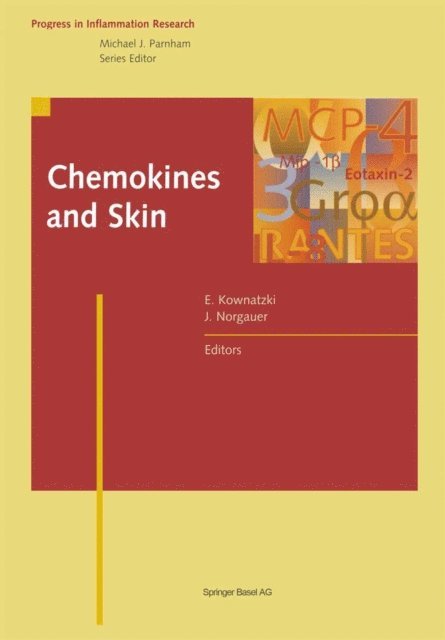
Summarizes the state of information on chemokines focusing on skin diseases. The first three chapters of the text deal with the structure and molecular biology of chemokines and their receptors. The following three review information on the interaction of chemokines with lymphocytes, mast cells and eosinophilic granulocytes. One chapter deals with the expression of chemokines in several inflammatory skin diseases. The final chapter reports on in vitro evidence for a growth-promoting activity of chemokines in skin-derivied tumour cells. The text shold be of relevance to scientists interested in practical aspects of skin diseases and physicians in search for basic mechanisms of skin diseases.