Pan-Tai Liu – författare
Visar alla böcker från författaren . Handla med fri frakt och snabb leverans.
6 produkter
6 produkter
Häftad, Engelska, 1979
4 101 kr
Skickas inom 10-15 vardagar
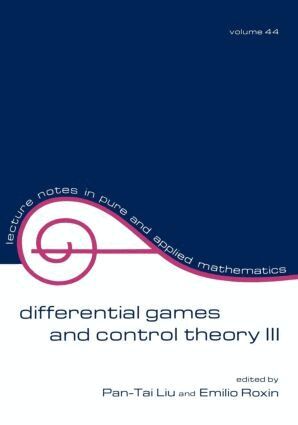
This book is based on the Third Kingston Conference on Differential Games and Control Theory held at the University of Rhode Island June 5-8, 1978. It deals with deterministic systems and stochastic systems, and is helpful for the researchers in applied mathematics.
E-bok
PDF, Engelska, 20204 623 kr
Läs direkt efter köp
This book is based on the Third Kingston Conference on Differential Games and Control Theory held at the University of Rhode Island June 5-8, 1978. It deals with deterministic systems and stochastic systems, and is helpful for the researchers in applied mathematics.
E-bok
Engelska, 20204 461 kr
Läs direkt efter köp
This book is based on the Third Kingston Conference on Differential Games and Control Theory held at the University of Rhode Island June 5-8, 1978. It deals with deterministic systems and stochastic systems, and is helpful for the researchers in applied mathematics.
Inbunden, Engelska, 2017
4 101 kr
Skickas inom 10-15 vardagar
This book is based on the Third Kingston Conference on Differential Games and Control Theory held at the University of Rhode Island June 5-8, 1978. It deals with deterministic systems and stochastic systems, and is helpful for the researchers in applied mathematics.
E-bok
PDF, Engelska, 2013702 kr
Läs direkt efter köp
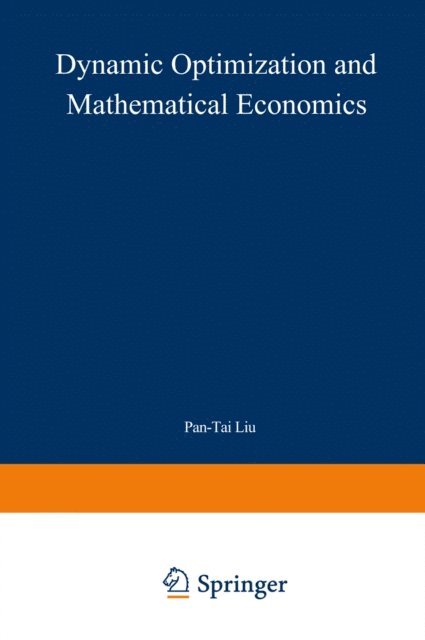
As an outgrowth of the advancement in modern control theory during the past 20 years, dynamic modeling and analysis of economic systems has become an important subject in the study of economic theory. Recent developments in dynamic utility, economic planning, and profit optimiza tion, for example, have been greatly influenced by results in optimal control, stabilization, estimation, optimization under conflicts, multi criteria optimization, control of large-scale systems, etc. The great success that has been achieved so far in utilizing modern control theory in economic systems should be attributed to the effort of control theorists as well as economists. Collaboration between the two groups of researchers has proven to be most successful in many instances; nevertheless, the gap between them has existed for some time. Whereas a control theorist frequently sets up a mathematically feasible model to obtain results that permit economic interpretations, an economist is concerned more with the fidelity of the model in representing a real world problem, and results that are obtained (through possibly less mathematical analysis) are due largely to economic insight. The papers appearing in this volume are divided into three parts. In Part I there are five papers on the application of control theory to economic planning. Part II contains five papers on exploration, exploita tion, and pricing of extractive natural resources. Finally, in Part III, some recent advances in large-scale systems and decentralized control appear.
Häftad, Engelska, 2012
539 kr
Skickas inom 10-15 vardagar
As an outgrowth of the advancement in modern control theory during the past 20 years, dynamic modeling and analysis of economic systems has become an important subject in the study of economic theory. Recent developments in dynamic utility, economic planning, and profit optimiza tion, for example, have been greatly influenced by results in optimal control, stabilization, estimation, optimization under conflicts, multi criteria optimization, control of large-scale systems, etc. The great success that has been achieved so far in utilizing modern control theory in economic systems should be attributed to the effort of control theorists as well as economists. Collaboration between the two groups of researchers has proven to be most successful in many instances; nevertheless, the gap between them has existed for some time. Whereas a control theorist frequently sets up a mathematically feasible model to obtain results that permit economic interpretations, an economist is concerned more with the fidelity of the model in representing a real world problem, and results that are obtained (through possibly less mathematical analysis) are due largely to economic insight. The papers appearing in this volume are divided into three parts. In Part I there are five papers on the application of control theory to economic planning. Part II contains five papers on exploration, exploita tion, and pricing of extractive natural resources. Finally, in Part III, some recent advances in large-scale systems and decentralized control appear.