Peter Bornedal - Böcker
Visar alla böcker från författaren Peter Bornedal. Handla med fri frakt och snabb leverans.
6 produkter
6 produkter
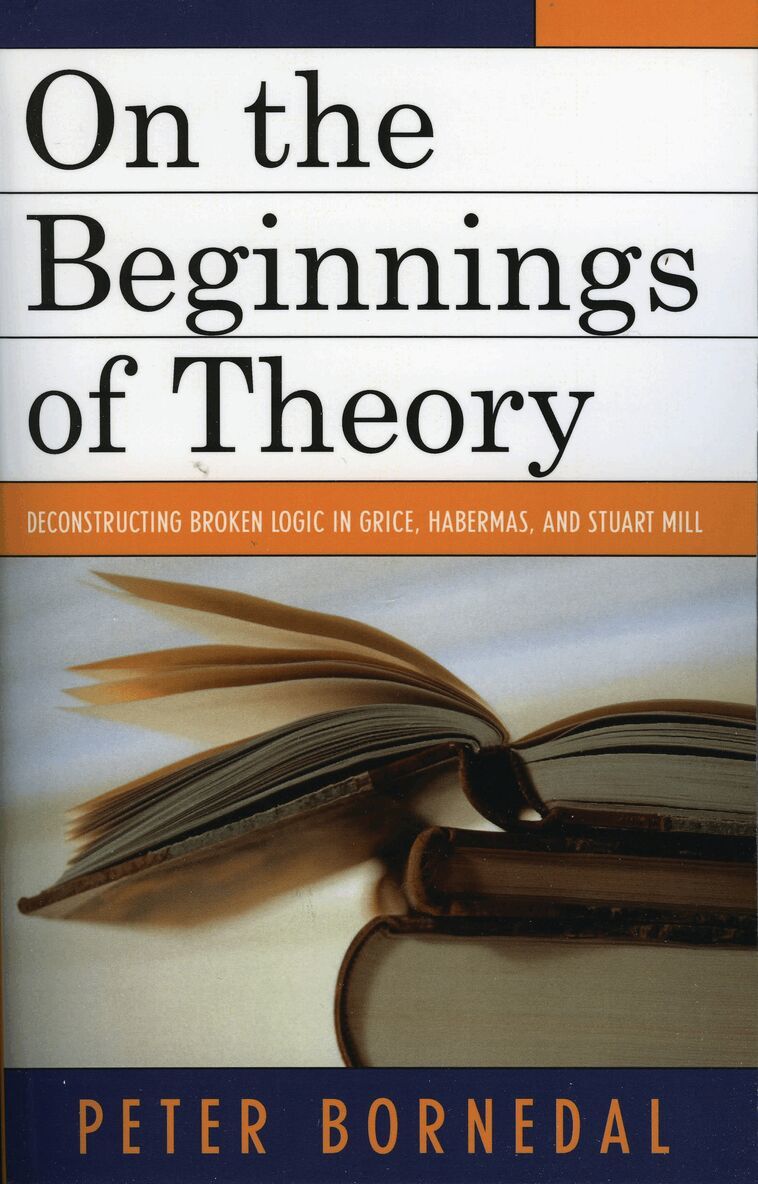
On the Beginnings of Theory
Deconstructing Broken Logic in Grice, Habermas, and Stuart Mill
Häftad, Engelska, 2006
675 kr
Skickas inom 10-15 vardagar
In three exemplary essays, author Peter Bornedal promotes Deconstruction as a cogent analytical method whose distinctive critical object is foundational knowledge. In this, he wants to restore Deconstruction as a rational discourse, while continuing to emphasize it as a critique of metaphysics. Two of the essays discuss the works of Paul Grice and Jürgen Habermas and their theories on language and communication. In these essays, the author demonstrates that despite the attempts of Grice and Habermas to give ontological foundations for inherent communicative rationality, their endeavors are unsuccessful. The third essay discusses John Stuart Mill's utilitarianism and argues that Mill's attempts to decide what is in principle good remain futile and incomplete. Ultimately, Bornedal argues that we cannot give metaphysical reasons for rationality or the good life. We can only decide to pursue these ideals, but there is nothing beyond the decision that makes the pursuit necessary or inherent. According to this position, Deconstruction becomes a kind of Pragmatism; or, as the author states, by way of paradox, "Analytic Deconstruction gives Pragmatism a scientific foundation."
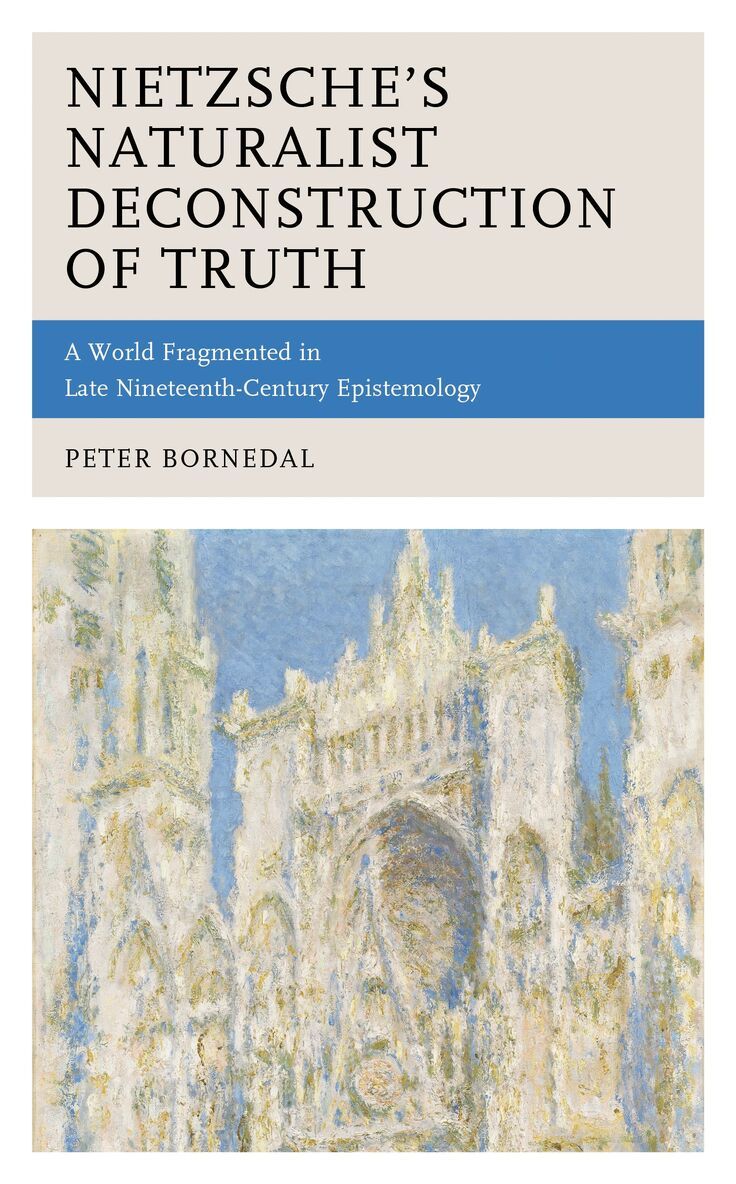
Nietzsche's Naturalist Deconstruction of Truth
A World Fragmented in Late Nineteenth-Century Epistemology
Inbunden, Engelska, 2020
1 476 kr
Skickas inom 10-15 vardagar
Nietzsche’s Naturalist Deconstruction of Truth: A World Fragmented in Late Nineteenth-Century Epistemology offers a new interpretation of Nietzsche’s discussions of truth and knowledge, covering the period from his early essay “On Truth and Lies in an Extra-Moral Sense” to his late notebooks. It places these discussions in the context of the neo-Kantian, Naturalist, Positivist, and Pragmatic schools influential in Nietzsche’s late nineteenth-century Europe. Peter Bornedal argues for a view of Nietzsche’s epistemological thought as an elaboration of this paradigm: proposing ideas that are anti-metaphysical and anti-theological in their polemic orientation, and in general promoting new scientific naturalist ideals in the discussions of knowledge. Bornedal suggests that the rational pursuit of these new ideals to the unencumbered mind logically leads to Nihilism in its most profound epistemological sense. Nietzsche’s “critique of metaphysics” is thus seen as having sprung from sources different from and, at times, in patent opposition to more recent postmodern and deconstructionist critiques. This book contextualizes Nietzsche in relation to a number of philosophical peers and juxtaposes him to contemporary thinkers in a way that resolves some of the difficulties that have plagued recent Nietzsche scholarship.
Nietzsche's Naturalist Deconstruction of Truth
A World Fragmented in Late Nineteenth-Century Epistemology
Häftad, Engelska, 2022
488 kr
Skickas inom 10-15 vardagar
Nietzsche’s Naturalist Deconstruction of Truth: A World Fragmented in Late Nineteenth-Century Epistemology offers a new interpretation of Nietzsche’s discussions of truth and knowledge, covering the period from his early essay “On Truth and Lies in an Extra-Moral Sense” to his late notebooks. It places these discussions in the context of the neo-Kantian, Naturalist, Positivist, and Pragmatic schools influential in Nietzsche’s late nineteenth-century Europe. Peter Bornedal argues for a view of Nietzsche’s epistemological thought as an elaboration of this paradigm: proposing ideas that are anti-metaphysical and anti-theological in their polemic orientation, and in general promoting new scientific naturalist ideals in the discussions of knowledge. Bornedal suggests that the rational pursuit of these new ideals to the unencumbered mind logically leads to Nihilism in its most profound epistemological sense. Nietzsche’s “critique of metaphysics” is thus seen as having sprung from sources different from and, at times, in patent opposition to more recent postmodern and deconstructionist critiques. This book contextualizes Nietzsche in relation to a number of philosophical peers and juxtaposes him to contemporary thinkers in a way that resolves some of the difficulties that have plagued recent Nietzsche scholarship.
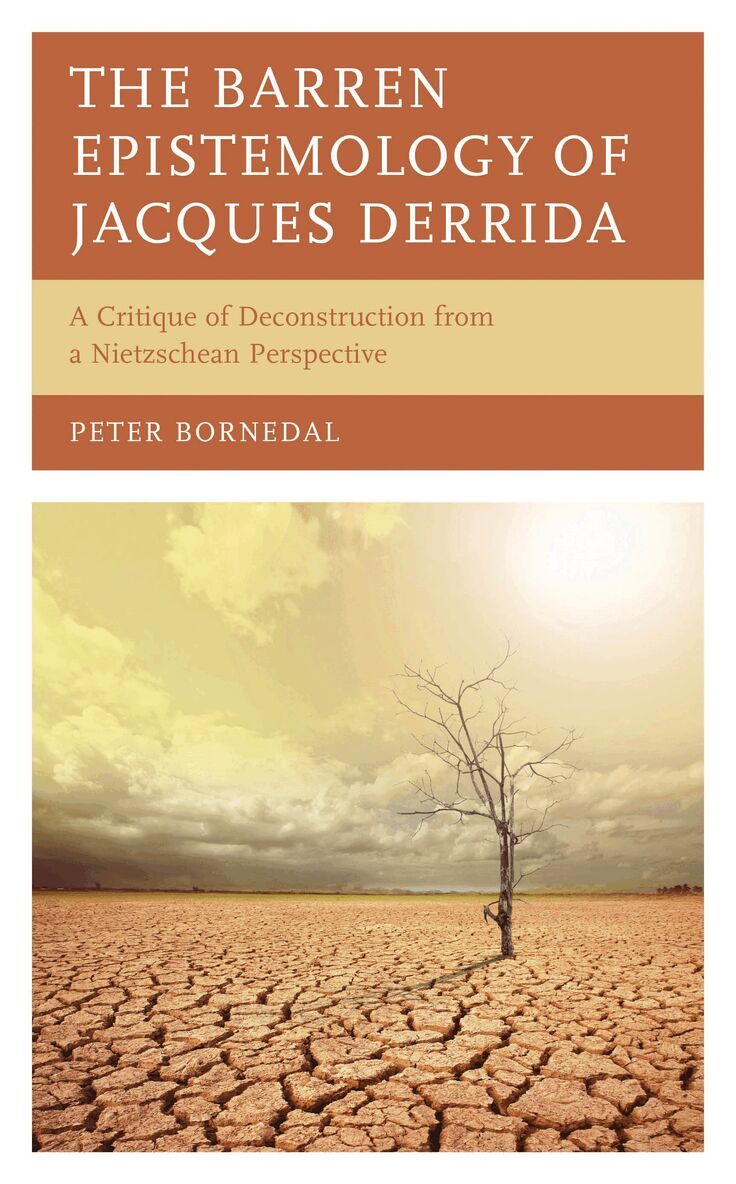
Barren Epistemology of Jacques Derrida
A Critique of Deconstruction from a Nietzschean Perspective
Inbunden, Engelska, 2024
1 314 kr
Skickas inom 10-15 vardagar
This book presents a critique of Derrida from a Nietzschean perspective. Questioning the often-advertised association between Nietzsche and Derrida, it focuses instead on important differences and incompatibilities between Nietzsche’s naturalistic paradigm and Derrida’s textual paradigm. Peter Bornedal argues that Nietzsche’s position points us toward a pragmatic and constructionist epistemology based on a naturalist world-view, which was cutting-edge in his days, while Derrida’s epistemology reduces theories of knowledge to a general textualism. In short, Nietzsche is not the predecessor of deconstruction—or, generally, postmodernism—that he is often portrayed to be. His thinking does not advocate postmodernism’s suspension of truth, reason, logic, and understanding, but rather replicates the paradigms of emerging disciplines of his day, such as biology, psychology, cognitive science, and linguistics. His thinking is not playfulness for its own sake and does not defend formal transcendentalist principles such as ‘différance.’ The Barren Epistemology of Jacques Derrida: A Critique of Deconstruction from a Nietzschean Perspective argues instead that Derrida’s introduction of the supposedly novel différance-logic may be analyzed as a transcendentalist validation of logical errors often addressed in earlier Western thinking in order to be avoided, such as the contradiction in Aristotle, or the paralogism in Kant. With this critical view, the work re-examines différance-thinking and questions whether inconsistencies are manufactured rather than discovered in deconstructionist interpretation.
Del 57 - Monographien und Texte zur Nietzsche-forschung
Surface and the Abyss
Nietzsche as Philosopher of Mind and Knowledge
Inbunden, Engelska, 2010
2 610 kr
Skickas inom 5-8 vardagar
Peter Bornedal provides an interpretation of Nietzsche’s philosophy as a whole in the context of 19th century philosophy of mind and cognition. The study explains Nietzsche’s notion of truth; his epistemology; his notions of the split and fragmented subject, of master, slave, and priest; furthermore, it offers a new interpretation of the enigmatic “eternal recurrence”. It also suggests how important aspects of Nietzsche’s thinking can be read as a sophisticated critique of ideology.From studies in Nietzsche’s work as a whole, not least in his so-called Nachgelassene Fragmente, the book reconstructs aspects of Nietzsche’s thinking that have largely been under-described in especially the Anglo-Saxon Nietzsche-reception. The study makes the case that Nietzsche in his epistemology, his psychology, and his cognitive theory is responding to several scientific discoveries occuring during the 19th century. Read within the context of contemporary cognitive-psychological-evolutionary debates, Nietzsche’s philosophy is seen as far more scientistic, and far less poetical-metaphysical, than it has in recent reception-history been received.
Del 57 - Monographien und Texte zur Nietzsche-forschung
Surface and the Abyss
Nietzsche as Philosopher of Mind and Knowledge
Häftad, Engelska, 2016
334 kr
Skickas inom 3-6 vardagar
Peter Bornedal provides an interpretation of Nietzsche’s philosophy as a whole in the context of 19th century philosophy of mind and cognition. The study explains Nietzsche’s notion of truth; his epistemology; his notions of the split and fragmented subject, of master, slave, and priest; furthermore, it offers a new interpretation of the enigmatic “eternal recurrence”. It also suggests how important aspects of Nietzsche’s thinking can be read as a sophisticated critique of ideology.From studies in Nietzsche’s work as a whole, not least in his so-called Nachgelassene Fragmente, the book reconstructs aspects of Nietzsche’s thinking that have largely been under-described in especially the Anglo-Saxon Nietzsche-reception. The study makes the case that Nietzsche in his epistemology, his psychology, and his cognitive theory is responding to several scientific discoveries occuring during the 19th century. Read within the context of contemporary cognitive-psychological-evolutionary debates, Nietzsche’s philosophy is seen as far more scientistic, and far less poetical-metaphysical, than it has in recent reception-history been received.