666 kr
Skickas inom 10-15 vardagar
666 kr
Skickas inom 10-15 vardagar
413 kr
Skickas inom 5-8 vardagar
611 kr
Skickas inom 10-15 vardagar
877 kr
Läs direkt efter köp
This is an introductory book on discrete statistical distributions and its applications. It discusses only those that are widely used in the applications of probability and statistics in everyday life. The purpose is to give a self-contained introduction to classical discrete distributions in statistics. Instead of compiling the important formulas (which are available in many other textbooks), we focus on important applications of each distribution in various applied fields like bioinformatics, genomics, ecology, electronics, epidemiology, management, reliability, etc., making this book an indispensable resource for researchers and practitioners in several scientific fields. Examples are drawn from different fields. An up-to-date reference appears at the end of the book.
Chapter 1 introduces the basic concepts on random variables, and gives a simple method to find the mean deviation (MD) of discrete distributions. The Bernoulli and binomial distributions are discussedin detail in Chapter 2. A short chapter on discrete uniform distribution appears next. The next two chapters are on geometric and negative binomial distributions. Chapter 6 discusses the Poisson distribution in-depth, including applications in various fields. Chapter 7 is on hypergeometric distribution. As most textbooks in the market either do not discuss, or contain only brief description of the negative hypergeometric distribution, we have included an entire chapter on it. A short chapter on logarithmic series distribution follows it, in which a theorem to find the kth moment of logarithmic distribution using (k-1)th moment of zero-truncated geometric distribution is presented. The last chapter is on multinomial distribution and its applications.
The primary users of this book are professionals and practitioners in various fields of engineering and the applied sciences. It will also be of use to graduate students in statistics, research scholars in science disciplines, and teachers of statistics, biostatistics, biotechnology, education, and psychology.
797 kr
Läs direkt efter köp
791 kr
Läs direkt efter köp
446 kr
Skickas inom 10-15 vardagar
558 kr
Läs direkt efter köp
Generating function (GF) is a mathematical technique to concisely represent a known ordered sequence into a simple continuous algebraic function in dummy variable(s). This Second Edition introduces commonly encountered generating functions (GFs) in engineering and applied sciences, such as ordinary GF (OGF), exponential GF (EGF), as also Dirichlet GF (DGF), Lambert GF (LGF), Logarithmic GF (LogGF), Hurwitz GF (HGF), Mittag-Lefler GF (MLGF), etc. This book is intended mainly for beginners in applied science and engineering fields to help them understand single-variable GFs and illustrate how to apply them in various practical problems. Specifically, the book discusses probability GFs (PGF), moment and cumulant GFs (MGF, CGF), mean deviation GFs (MDGF), survival function GFs (SFGF), rising and falling factorial GFs, factorial moment, and inverse factorial moment GFs. Applications of GFs in algebra, analysis of algorithms, bioinformatics, combinatorics, economics, finance, genomics, geometry, graph theory, management, number theory, polymer chemistry, reliability, statistics and structural engineering have been added to this new edition. This book is written in such a way that readers who do not have prior knowledge of the topic can easily follow through the chapters and apply the lessons learned in their respective disciplines.
446 kr
Skickas inom 10-15 vardagar
499 kr
Skickas inom 5-8 vardagar
638 kr
Läs direkt efter köp
652 kr
Skickas inom 5-8 vardagar
499 kr
Skickas inom 5-8 vardagar
509 kr
Skickas inom 10-15 vardagar
633 kr
Läs direkt efter köp
This book focuses on correlation coefficients and its applications in applied science fields. The book begins by describing the historical development and various types of correlations. Rank correlation methods including Pearson’s, Spearman’s, and Kendall’s correlation are discussed at length. The book also discusses sampling distribution of correlation coefficients and applications of correlations in various fields. The book presents novel topics such as (i) a quick analytical method to approximate Pearson''s correlation, (ii) single-variable correlation, (iii) fractional co-skewness and co-kurtosis, and (iv) the fallacy on correlation between the sample mean and sample variance. This book is ideal for courses on mathematical statistics, engineering statistics, and exploratory data analysis and is primarily aimed at upper-undergraduate and graduate level students. The book is also useful for researchers and professionals in various fields who are interested in data analysis.
509 kr
Skickas inom 10-15 vardagar
453 kr
Skickas inom 10-15 vardagar
558 kr
Läs direkt efter köp
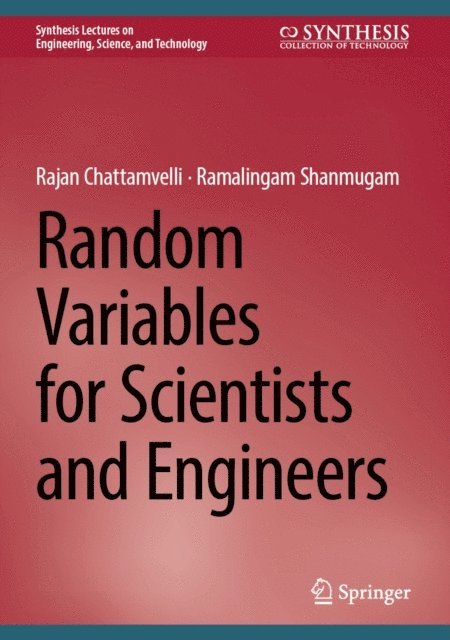
This book provides an introductory overview of random variables and their transformations. The authors approach the topic with statistics students in mind, along with researchers in various fields who are interested in data analysis. The book begins with by defining and explaining mathematical expectation. The authors then discuss transformations of random variables, including distribution functions and special functions. The book also covers joint probability distribution and its applications. The authors have updated and expanded upon their writing on these topics, which they originally covered in their previous book, Statistics for Scientists and Engineers.
453 kr
Skickas inom 10-15 vardagar
676 kr
Kommande
1 331 kr
Tillfälligt slut
483 kr
Tillfälligt slut
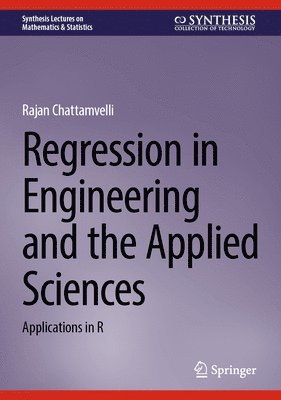
This book presents a broad range of regression models including count regression models, constrained and penalised regression models such as ridge, LASSO, and elasticnet regression that are used in various applied science fields. The author describes the historical development of the least squares principle, simple linear regression, and Polynomial regression. In addition, logistic regression and multiple linear regression are discussed at length. A novel method to estimate the slope of linear regression is presented along with an emphasis on the importance of numeric problems.