R.H. Jr Bremmer – författare
Visar alla böcker från författaren R.H. Jr Bremmer. Handla med fri frakt och snabb leverans.
2 produkter
2 produkter
Del 10 - Mediaevalia Groningana New Series
Signs on the Edge
Space, Text and Margin in Medieval Manuscripts
Häftad, Engelska, 2007
1 224 kr
Skickas inom 3-6 vardagar
Medieval cultures to the north and west of the Alps gained their initial understanding of visual spatialization from the Ancient world, but developed their own ways of managing primary and secondary space on any surface where text and/or art interact. The eleven essays of this volume span the period from early insular manuscripts through to later medieval books or artefacts, and examine specific strategies in scribal layout or prescribed authorial design. These vary in their sophistication from the naïve and inadvertent to the self-conscious and at times parodic intentional, allowing us a fascinating insight into the many different ways in which main and marginal space on the page could be employed by medieval imaginations.
Del 16 - Mediaevalia Groningana New Series
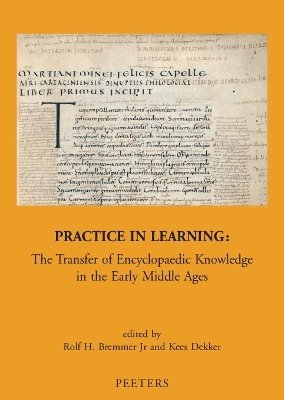
Practice in Learning
The Transfer of Encyclopaedic Knowledge in the Early Middle Ages
Häftad, Engelska, 2010
1 154 kr
Skickas inom 3-6 vardagar
Throughout the early Middle Ages, education and learning in Western Europe underwent a substantial development, from Italy across the Alps, from Latin to the vernacular and from secular to (although not exclusively) religious. With Latin as its prime medium, developments in education and learning were genuinely international and allowed for a steady exchange of teachers and texts across borders and institutions. Members of the fifth-century Gallo-Roman senatorial classes ¿ such as Eucherius of Lyons and Cassiodorus ¿ became bishops, abbots or founders of monasteries, and thereby catalysts in the transformation from secular to religious education. Then as now intellectuals travelled, taking both their learning and their books with them: Theodore of Tarsus travelled from the extreme end of the Mediterranean to Italy and across the Alps; John Scottus Eriugena migrated from Ireland to France; Boniface from England to Germany; while Abbo later made a journey from Fleury to Abingdon and back ¿ to name only a few examples. With the mobility of intellectuals comes the movement of texts and books: ranging from Pliny's Historia naturalis and Isidore's Etymologiae or the works of Bede to many of the smaller texts and fragments which have been the subject of study in the ¿Storehouses' project. Although almost all of the precise details of classroom practice in the early Middle Ages remain hidden to the modern eye, and identifiable students' copy books or note-pads are rare, some of the texts and books that have survived still recall the monastic auditorium or schola because of their potential use in the classroom or in view of the texts found in these books. Often these texts and manuscripts testify to the international developments outlined above and to the international nature of the world of early medieval learning. The articles in this second volume of ¿Storehouses of Wholesome Learning' emanate from the second workshop in the project, this time held at Leiden in June 2005. They focus on illuminating the multifaceted practice of learning by laying bare the exchanges of scholarship between the British Isles and the continent. From the Development of the Foetus, found in Bremmer's contribution, to the Fifteen Signs of Doomsday, the encyclopaedic knowledge that was disseminated all over Western Europe in written texts and, in all likelihood, through oral transmission, featured strongly in the practice of early medieval learning. The subject of that learning was nothing less than life itself, both in the physical and in the spiritual sense of the word.