Rikke Frank Jorgensen – författare
346 kr
Läs direkt efter köp
Scholars from across law and internet and media studies examine the human rights implications of today''s platform society.
Today such companies as Apple, Facebook, Google, Microsoft, and Twitter play an increasingly important role in how users form and express opinions, encounter information, debate, disagree, mobilize, and maintain their privacy. What are the human rights implications of an online domain managed by privately owned platforms? According to the Guiding Principles on Business and Human Rights, adopted by the UN Human Right Council in 2011, businesses have a responsibility to respect human rights and to carry out human rights due diligence. But this goal is dependent on the willingness of states to encode such norms into business regulations and of companies to comply. In this volume, contributors from across law and internet and media studies examine the state of human rights in today''s platform society.
The contributors consider the “datafication” of society, including the economic model of data extraction and the conceptualization of privacy. They examine online advertising, content moderation, corporate storytelling around human rights, and other platform practices. Finally, they discuss the relationship between human rights law and private actors, addressing such issues as private companies'' human rights responsibilities and content regulation.
ContributorsAnja Bechmann, Fernando Bermejo, Agnès Callamard, Mikkel Flyverbom, Rikke Frank Jørgensen, Molly K. Land, Tarlach McGonagle, Jens-Erik Mai, Joris van Hoboken, Glen Whelan, Jillian C. York, Shoshana Zuboff, Ethan Zuckerman
Open access edition published with generous support from Knowledge Unlatched and the Danish Council for Independent Research.
432 kr
Läs direkt efter köp
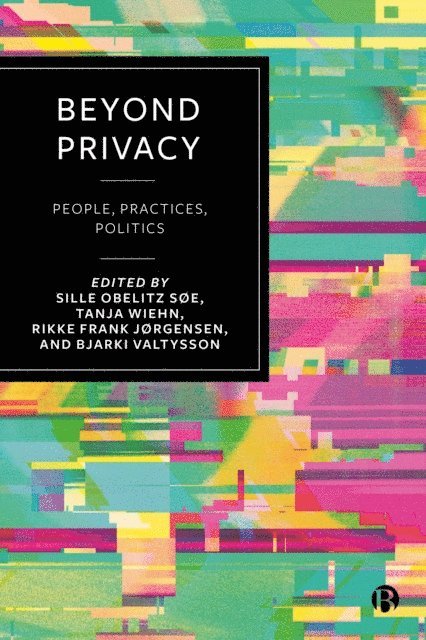
Discussions around digital technologies, new media, platforms and information have long centred on the protection of personal data and privacy. This timely volume extends the conversation to address fundamental societal and structural issues from three perspectives: people, practices and politics.
Organised around an international collection of case studies, the book provides a valuable contribution to our understanding of the challenges of privacy in the digital sphere, from emerging regulatory programmes to surveillance capitalism and big tech companies.
Taking a multidisciplinary approach, this is a new and innovative perspective on our datafied societies that goes beyond privacy. It will be a key resource for scholars and students of communication and media studies, and science and technology studies.
1 527 kr
Läs direkt efter köp
Discussions around digital technologies, new media, platforms and information have long centred on the protection of personal data and privacy. This timely volume extends the conversation to address fundamental societal and structural issues from three perspectives: people, practices and politics.
Organised around an international collection of case studies, the book provides a valuable contribution to our understanding of the challenges of privacy in the digital sphere, from emerging regulatory programmes to surveillance capitalism and big tech companies.
Taking a multidisciplinary approach, this is a new and innovative perspective on our datafied societies that goes beyond privacy. It will be a key resource for scholars and students of communication and media studies, and science and technology studies.
395 kr
Läs direkt efter köp
This timely book suggests four framings to examine human rights challenges in an internet era: the Internet as Infrastructure, the Internet as Public Sphere, the Internet as Medium and the Internet as Culture. These propositions, and the questions that arise from them, are considered in the broad context of the way human rights are translated and applied in the information society, both in academic research and the international community s policy discourse. The author points to the role of private actors vis-à-vis human rights as one of the most crucial and cross-cutting themes that needs to be addressed in order to advance human rights protection on the internet.
Combining research themes that are often dealt with separately, this book will appeal to civil society organizations, journalists, and policy makers in the field of internet and communication policy making. The book''s overview of internet-related academic discourse combined with human rights-based policy analysis will be useful for scholars, students, and practitioners working within these fields.