Roman Kossak – författare
Visar alla böcker från författaren Roman Kossak. Handla med fri frakt och snabb leverans.
14 produkter
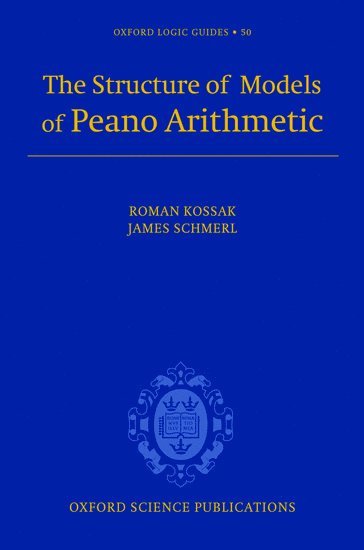
The Structure of Models of Peano Arithmetic
Av Roman Kossak, James Schmerl
Inbunden, 2006
2856 kr
Lägg i varukorg
Aimed at graduate students and research logicians and mathematicians, this much-awaited text covers over forty years of work on relative classification theory for non-standard models of arithmetic. With graded exercises at the end of each chapter, the book covers basic isomorphism invariants: …
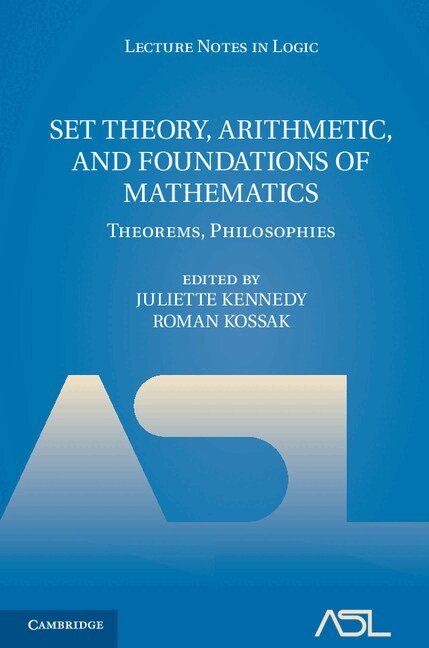
Set Theory, Arithmetic, and Foundations of Mathematics
Theorems, Philosophies
Av Juliette Kennedy, Roman Kossak
Inbunden, 2011
1889 kr
Lägg i varukorg
This collection of papers from various areas of mathematical logic showcases the remarkable breadth and richness of the field. Leading authors reveal how contemporary technical results touch upon foundational questions about the nature of mathematics. Highlights of the volume include: a history of …
Studies in Weak Arithmetics
Volume 3
Av Patrick Cegielski, Ali Enayat m. fl.
Häftad, 2017
456 kr
Lägg i varukorg
The field of weak arithmetics is an application of logical methods to number theory that was developed by mathematicians, philosophers, and theoretical computer scientists. This third volume in the weak arithmetics collection contains nine substantive papers based on lectures delivered during the …
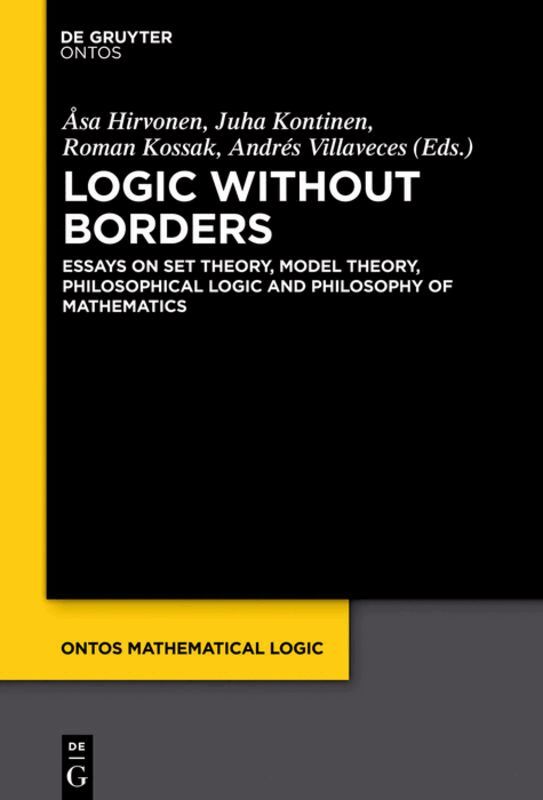
Logic Without Borders
Essays on Set Theory, Model Theory, Philosophical Logic and Philosophy of Mathematics
Av Andres Villaveces, Roman Kossak m. fl.
E-bok, 2015
2232 kr
Lägg i varukorg
In recent years, mathematical logic has developed in many directions, the initial unity of its subject matter giving way to a myriad of seemingly unrelated areas. The articles collected here, which range from historical scholarship to recent research in geometric model theory, squarely address this …
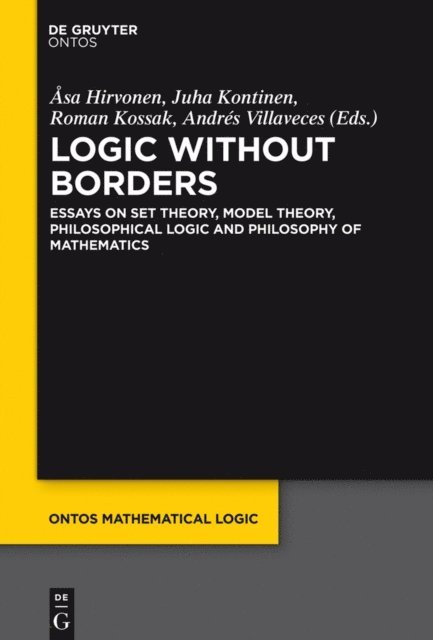
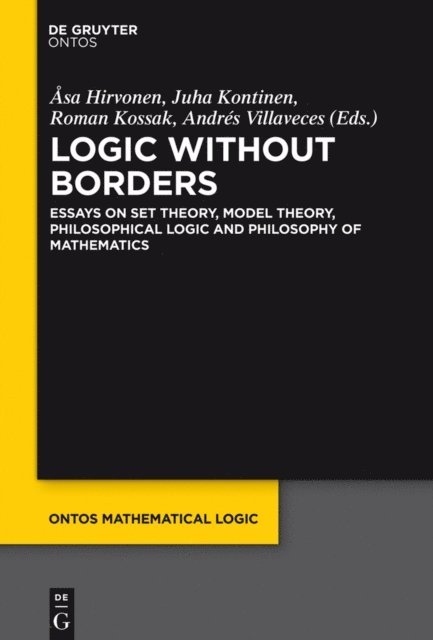
Logic Without Borders
Essays on Set Theory, Model Theory, Philosophical Logic and Philosophy of Mathematics
Av Asa Hirvonen, Juha Kontinen m. fl.
Inbunden, 2015
2206 kr
Lägg i varukorg
In recent years, mathematical logic has developed in many directions, the initial unity of its subject matter giving way to a myriad of seemingly unrelated areas. The articles collected here, which range from historical scholarship to recent research in geometric model theory, squarely address this …
Logic Without Borders
Essays on Set Theory, Model Theory, Philosophical Logic and Philosophy of Mathematics
Av Andres Villaveces, Roman Kossak m. fl.
E-bok, 2015
2184 kr
Lägg i varukorg
In recent years, mathematical logic has developed in many directions, the initial unity of its subject matter giving way to a myriad of seemingly unrelated areas. The articles collected here, which range from historical scholarship to recent research in geometric model theory, squarely address this …
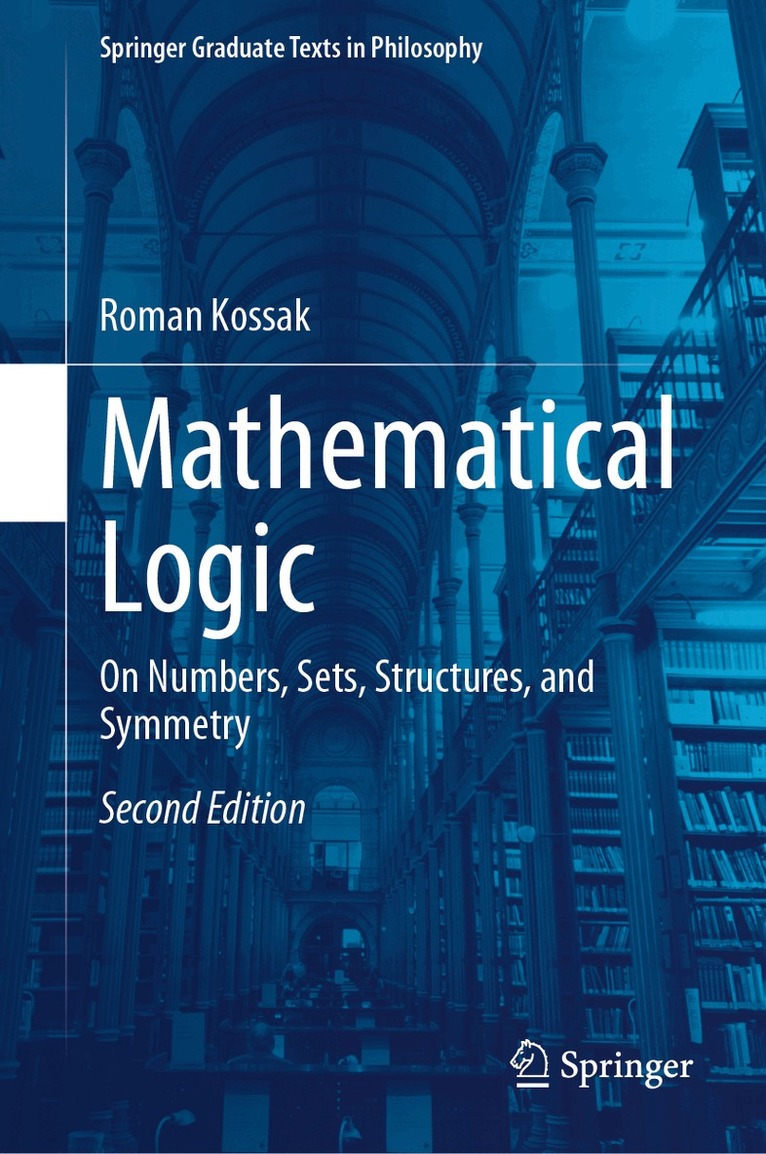
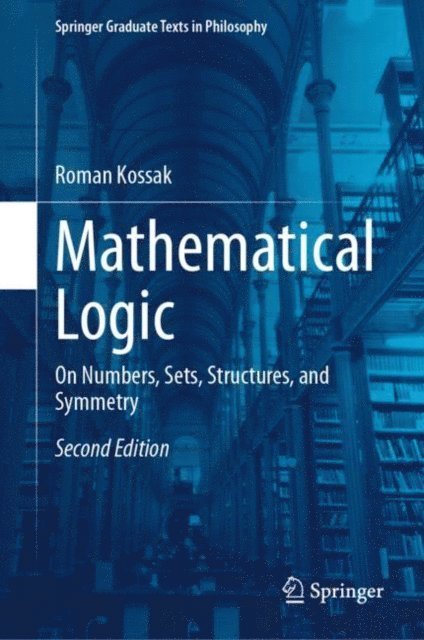
Mathematical Logic
On Numbers, Sets, Structures, and Symmetry
Av Roman Kossak
Inbunden, 2024
1098 kr
Lägg i varukorg
This textbook is a second edition of the successful, Mathematical Logic: On Numbers, Sets, Structures, and Symmetry. It retains the original two parts found in the first edition, while presenting new material in the form of an added third part to the textbook. The textbook offers a slow …
Mathematical Logic
On Numbers, Sets, Structures, and Symmetry
Av Roman Kossak
E-bok, 2024
1459 kr
Lägg i varukorg
This textbook is a second edition of the successful, Mathematical Logic: On Numbers, Sets, Structures, and Symmetry. It retains the original two parts found in the first edition, while presenting new material in the form of an added third part to the textbook. The textbook offers a slow …
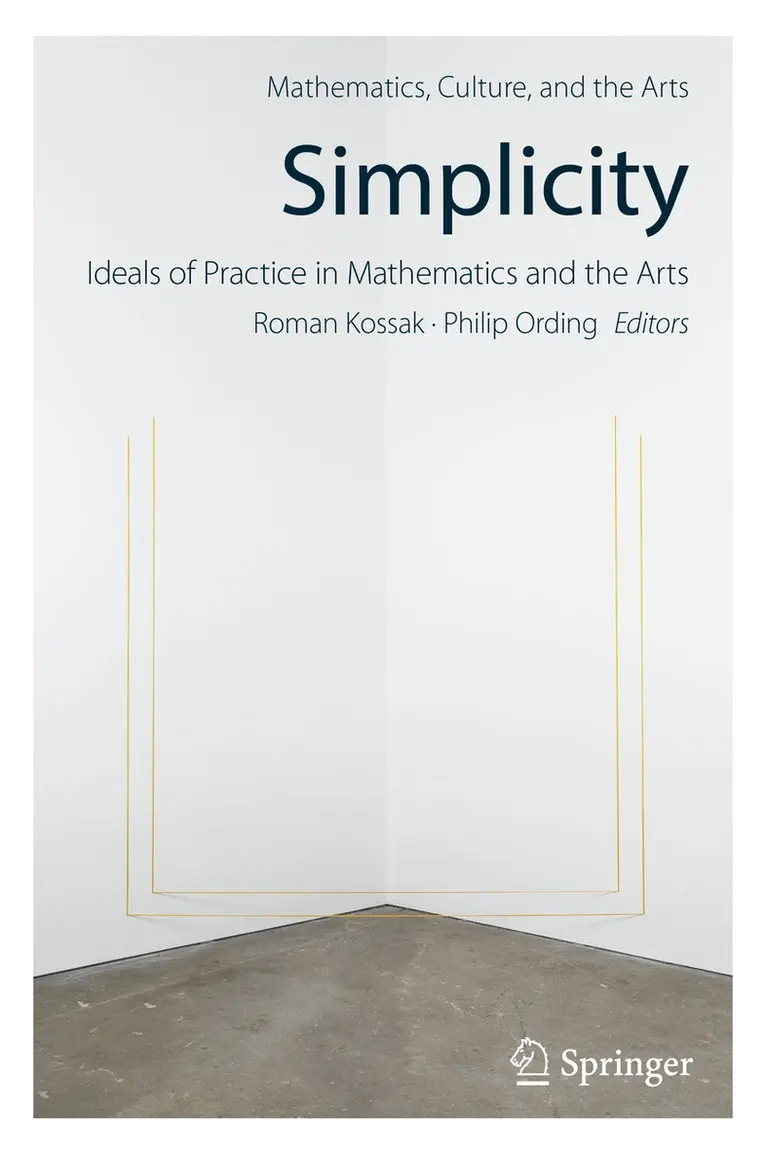
Simplicity: Ideals of Practice in Mathematics and the Arts
Av Roman Kossak, Philip Ording
Inbunden, 2017
418 kr
Lägg i varukorg
To find "criteria of simplicity" was the goal of David Hilbert's recently discovered twenty-fourth problem on his renowned list of open problems given at the 1900 International Congress of Mathematicians in Paris. At the same time, simplicity and economy of means are powerful impulses in the …
Simplicity: Ideals of Practice in Mathematics and the Arts
Av Philip Ording, Roman Kossak
E-bok, 2017
520 kr
Lägg i varukorg
To find "criteria of simplicity" was the goal of David Hilbert''s recently discovered twenty-fourth problem on his renowned list of open problems given at the 1900 International Congress of Mathematicians in Paris. At the same time, simplicity and economy of means are powerful impulses in the …
Simplicity: Ideals of Practice in Mathematics and the Arts
Av Roman Kossak, Philip Ording
Häftad, 2018
418 kr
Lägg i varukorg
To find "criteria of simplicity" was the goal of David Hilbert's recently discovered twenty-fourth problem on his renowned list of open problems given at the 1900 International Congress of Mathematicians in Paris. At the same time, simplicity and economy of means are powerful impulses in the …
Mathematical Logic
On Numbers, Sets, Structures, and Symmetry
Av Roman Kossak
E-bok, 2018
797 kr
Lägg i varukorg
This book, presented in two parts, offers a slow introduction to mathematical logic, and several basic concepts of model theory, such as first-order definability, types, symmetries, and elementary extensions. Its first part, Logic Sets, and Numbers, shows how mathematical logic is used to develop …
Mathematical Logic
On Numbers, Sets, Structures, and Symmetry
Av Roman Kossak
Häftad, 2019
748 kr
Tillfälligt slut
This book, presented in two parts, offers a slow introduction to mathematical logic, and several basic concepts of model theory, such as first-order definability, types, symmetries, and elementary extensions. Its first part, Logic Sets, and Numbers, shows how mathematical logic is used to develop …