Steffen Hindelang – författare
Visar alla böcker från författaren Steffen Hindelang. Handla med fri frakt och snabb leverans.
12 produkter
12 produkter
Inbunden, Engelska, 2016
2 372 kr
Skickas inom 3-6 vardagar
International investment law is in transition. Whereas the prevailing mindset has always been the protection of the economic interests of individual investors, new developments in international investment law have brought about a paradigm shift. There is now more than ever before an interest in a more inclusive, transparent, and public regime. Shifting Paradigms in International Investment Law addresses these changes against the background of the UNCTAD framework to reform investment treaties. The book analyses how the investment treaty regime has changed and how it ought to be changing to reconcile private property interests and the state's duty to regulate in the public interest. In doing so, the volume tracks attempts in international investment law to recalibrate itself towards a more balanced, less isolated, and increasingly diversified regime. The individual chapters of this edited volume address the contents of investment agreements, the system of dispute settlement, the interrelation of investment agreements with other areas of public international law, constitutional questions, and new regional perspectives from Europe, South Africa, the Pacific Rim Region, and Latin America. Together they provide an invaluable resource for scholars, practitioners, and policymakers. The individual chapters of this edited volume address the contents of investment agreements, the system of dispute settlement, the interrelation of investment agreements with other areas of public international law, constitutional questions, and new regional perspectives from Europe, South Africa, the Pacific Rim Region, and Latin America. Together they provide an invaluable resource for scholars, practitioners, and policymakers.
Inbunden, Engelska, 2009
2 226 kr
Skickas inom 5-8 vardagar
The scope of protection offered to foreign investors by EU law has become a matter of intense political debate. Neo-protectionist policies are on the rise within EU Member States, who are struggling to acclimatise to increasing inward direct investment from developing countries. Strict regulations are being implemented to control the flow of this investment, undermining the principle of free movement of capital. Are such policies permitted under EU law? What impact does EU law have on foreign direct investment? This book addresses these questions through a coherent doctrinal reconstruction of the EC Treaty provisions on free movement of capital in a third country context. Opening with a timely restatement of the central features of the EU law of free movement of capital, the book then asks the central question: What rights does a private market participant, engaged in cross-border direct investment originating from or directed to a non-EU Member State, enjoy by virtue of the EC Treaty? The book argues that in principle, the provisions on free movement of capital apply the same liberal standards irrespective of whether intra Community or third country direct investment is involved. Hence, those who participate in third country direct investment enjoy essentially the same guarantees by virtue of the provisions on free movement of capital as those active in intra Community direct investment. Having established the legal doctrine, the book then examines the limits on restrictions to free movement, including financial regulation and discriminatory tax regimes.
Inbunden, Engelska, 2021
1 777 kr
Skickas inom 10-15 vardagar
This book presents the very first, interdisciplinarily grounded, comprehensive appraisal of a future “Common European Law on Investment Screening”.
Häftad, Engelska, 2022
1 777 kr
Skickas inom 10-15 vardagar
This book presents the very first, interdisciplinarily grounded, comprehensive appraisal of a future “Common European Law on Investment Screening”.
Inbunden, Engelska, 2022
1 777 kr
Skickas inom 10-15 vardagar
This volume addresses contemporary challenges, enabled by modern technology, that concern upholding freedom of speech where it conflicts with social rights, such as respect for private and family life, and with economic rights, such as the freedom to conduct business or the right to free movement.In today’s networked world, technological shifts happen faster than most people even realize. Some of these shifts have made us all potentially powerful: media powerful. We used to sit in silence in front of newspapers and TV screens, and the world was explained to us by just a few sources. Today, thanks to the Internet, social media, and Web 2.0, we can not only share our own thoughts with everyone in a more self-determined way, but we can also take part in public debate and even co-shape it ourselves. Of course, the Internet is not a counter-design to the communication (power) structures of the past. Gains in communicative self-determination are threatened due to algorithmisation, platformisation, and value extraction from self-created private markets.At the same time, the empowerment of the individual challenges the old “grand speakers” who are suddenly detecting “fake news”, echo chambers, and filter bubbles everywhere on the Internet. Internet-based communication allegedly hinders us from the “one truth”; as if newspaper hoaxes, propaganda, and narrow-mindedness were an invention of the Internet. The current heated debate over “fake news”, copyright, and “upload filters” shows that we are unsure of how to deal with the newer and more complex phenomena of Internet-based speech. This is due in no small part to the fact that an important benchmark – our constitutional compass – is still firmly rooted in the past. Constitutions change far more slowly than technologies. Societal changes can drive constitutional changes; but what about normative content control?Today, there are already demands for “old-school clarity”: truth filters on social media platforms, horrendous sums of liability for platforms that encourage (overly)thorough cleaning up. However, it is equally true that private individuals “regulate”: they decide what is found on the Internet and who may post on a given platform. Accounting for all interests at play and striking a “fair” balance that avoids both a public and private over- and under-regulation is a complex matter. The authors of this volume not only provide reflections in their highly topical contributions, but also share their understanding of what constitutes a fair balance within the larger frame of freedom of speech in a digital age.
Häftad, Engelska, 2023
1 777 kr
Skickas inom 10-15 vardagar
This volume addresses contemporary challenges, enabled by modern technology, that concern upholding freedom of speech where it conflicts with social rights, such as respect for private and family life, and with economic rights, such as the freedom to conduct business or the right to free movement.In today’s networked world, technological shifts happen faster than most people even realize. Some of these shifts have made us all potentially powerful: media powerful. We used to sit in silence in front of newspapers and TV screens, and the world was explained to us by just a few sources. Today, thanks to the Internet, social media, and Web 2.0, we can not only share our own thoughts with everyone in a more self-determined way, but we can also take part in public debate and even co-shape it ourselves. Of course, the Internet is not a counter-design to the communication (power) structures of the past. Gains in communicative self-determination are threatened due to algorithmisation, platformisation, and value extraction from self-created private markets.At the same time, the empowerment of the individual challenges the old “grand speakers” who are suddenly detecting “fake news”, echo chambers, and filter bubbles everywhere on the Internet. Internet-based communication allegedly hinders us from the “one truth”; as if newspaper hoaxes, propaganda, and narrow-mindedness were an invention of the Internet. The current heated debate over “fake news”, copyright, and “upload filters” shows that we are unsure of how to deal with the newer and more complex phenomena of Internet-based speech. This is due in no small part to the fact that an important benchmark – our constitutional compass – is still firmly rooted in the past. Constitutions change far more slowly than technologies. Societal changes can drive constitutional changes; but what about normative content control?Today, there are already demands for “old-school clarity”: truth filters on social media platforms, horrendous sums of liability for platforms that encourage (overly)thorough cleaning up. However, it is equally true that private individuals “regulate”: they decide what is found on the Internet and who may post on a given platform. Accounting for all interests at play and striking a “fair” balance that avoids both a public and private over- and under-regulation is a complex matter. The authors of this volume not only provide reflections in their highly topical contributions, but also share their understanding of what constitutes a fair balance within the larger frame of freedom of speech in a digital age.
Del 4 - Springer Studies in Law & Geoeconomics
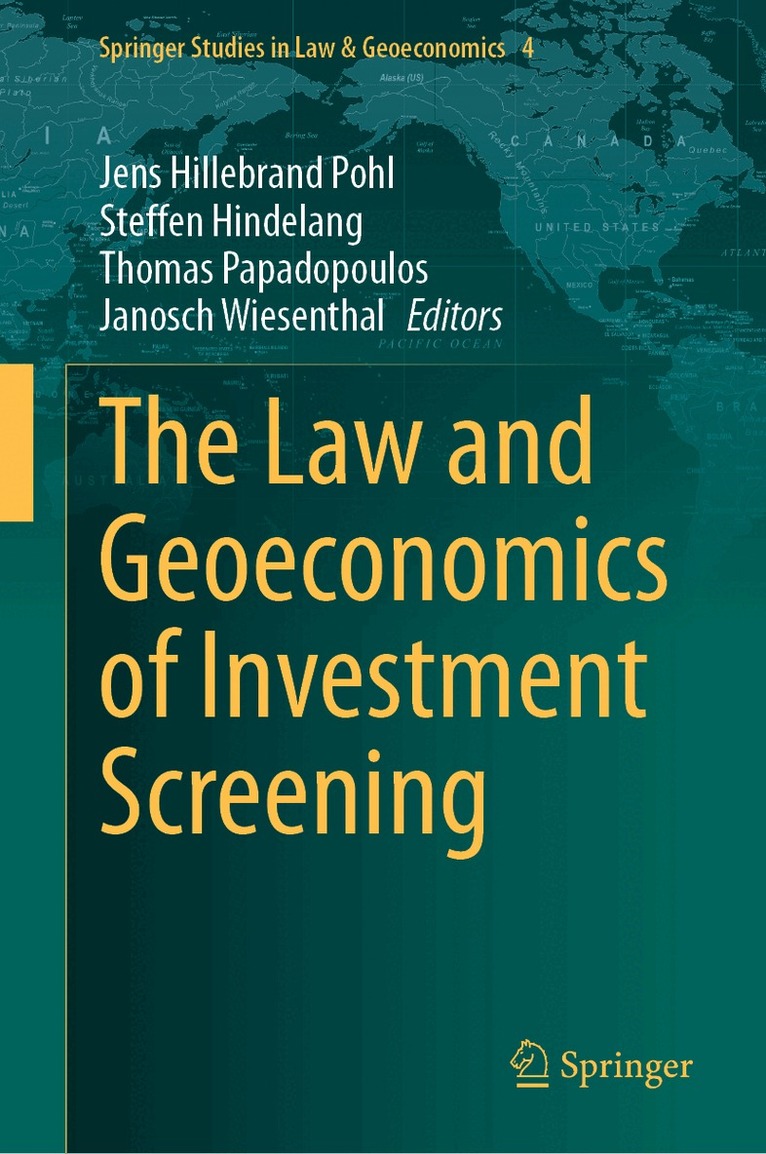
Law and Geoeconomics of Investment Screening
Inbunden, Engelska, 2025
1 777 kr
Skickas inom 10-15 vardagar
This volume presents pioneering research for the purpose of developing a common analytical foundation and framework for the emerging interdisciplinary research field of investment control and national security.
Del 4 - Springer Studies in Law & Geoeconomics
Law and Geoeconomics of Investment Screening
Häftad, Engelska, 2026
1 777 kr
Skickas inom 10-15 vardagar
This volume presents pioneering research for the purpose of developing a common analytical foundation and framework for the emerging interdisciplinary research field of investment control and national security. It deals with legal and regulatory aspects of investment controls, specifically from an international, transnational, and comparative law perspective.
Del 2024 - YSEC Yearbook of Socio-Economic Constitutions
YSEC Yearbook of Socio-Economic Constitutions 2024
What are Socio-Economic Constitutions?
Inbunden, Engelska, 2025
1 679 kr
Skickas inom 10-15 vardagar
The fifth volume of the Yearbook of Socio-Economic Constitutions (YSEC Yearbook) offers an in-depth exploration of socio-economic constitutionalism, a field gaining rapidly in importance as global economies shift.
Inbunden, Engelska, 2011
1 777 kr
Skickas inom 10-15 vardagar
The entry into force of the Lisbon Treaty entails sweeping changes with respect to foreigninvestment regulation. This volume analyzes in depth the new “post-Lisbon situation” in the area of investment policy, provokes further discussion and offers new approaches.
Häftad, Engelska, 2013
1 187 kr
Skickas inom 10-15 vardagar
The entry into force of the Lisbon Treaty entails sweeping changes with respect to foreigninvestment regulation. This volume analyzes in depth the new “post-Lisbon situation” in the area of investment policy, provokes further discussion and offers new approaches.
Inbunden, Tyska, 2019
1 018 kr
Skickas inom 10-15 vardagar
Dieses Buch gibt Antworten darauf, wie in Zeiten von Facebook und Fake News der verfassungsrechtliche Schutz des freien öffentlichen Diskurses gelingen kann. Es untersucht, wie die Verfassung auf einen nicht mehr nur durch Rundfunk und Presse klassischen Zuschnitts, sondern auch durch eine Vielzahl Einzelner organisierten massenmedialen Diskurs reagiert und wie das Verständnis der den Diskurs prägenden verfassungsrechtlichen Bausteine aktualisiert werden kann.Die technischen und wirtschaftlichen Bedingungen massenmedialer Kommunikation haben sich fundamental gewandelt. Das vorherrschende verfassungsdogmatische Schutzkonzept – ein „Ersatzmodell von Freiheit“ – kann diesem Wandel nicht ausreichend Rechnung tragen. Der Einzelne muss heute nicht mehr nur vor, sondern auch in seiner Medienmacht geschützt werden. Ausgehend von kommunikationswissenschaftlichen Erkenntnissen wird ein verfassungsrechtliches Verständnis entwickelt, das den Einzelnen wieder ins Zentrum eines freien massenmedialen Diskurses rückt.