William A Barbieri - Böcker
Visar alla böcker från författaren William A Barbieri. Handla med fri frakt och snabb leverans.
5 produkter
5 produkter
411 kr
Skickas inom 3-6 vardagar
533 kr
Skickas inom 10-15 vardagar
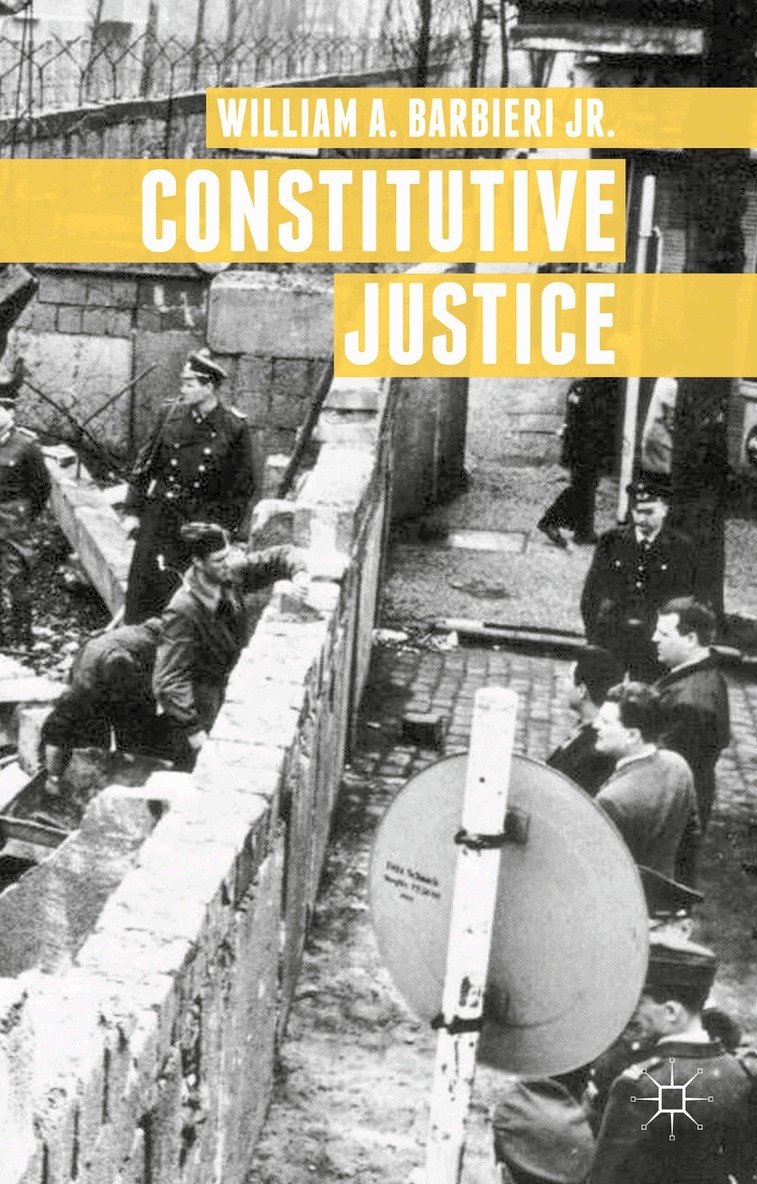
Both classical and modern accounts of justice largely overlook the question of how the communities within which justice applies are constituted in the first place. This book addresses that problem, arguing that we need to accord a place to the theory of 'constitutive justice' alongside traditional categories of distributive and commutative justice.
533 kr
Skickas inom 10-15 vardagar
Both classical and modern accounts of justice largely overlook the question of how the communities within which justice applies are constituted in the first place. This book addresses that problem, arguing that we need to accord a place to the theory of 'constitutive justice' alongside traditional categories of distributive and commutative justice.
1 440 kr
Skickas inom 5-8 vardagar
This book rewrites the history of Christian peace ethics. Christian reflection on reducing violence or overcoming war has roots in ancient Roman philosophy and eventually grew to influence modern international law. This historical overview begins with Cicero, the source of Christian authors like Augustine and Thomas Aquinas. It is highly debatable whether Augustine had a systematic interest in just war or whether his writings were used to develop a systematic just war teaching only by the later tradition. May Christians justifiably use force to overcome disorder and achieve peace? The book traces the classical debate from Thomas Aquinas to early modern-age thinkers like Vitoria, Suarez, Martin Luther, Hugo Grotius and Immanuel Kant. It highlights the diversity of the approaches of theologians, philosophers and lawyers. Modern cosmopolitianism and international law-thinking, it shows, are rooted in the Spanish Scholastics, where Grotius and Kant each found the inspiration to inaugurate a modern peace ethic. In the 20th century the tradition has taken aim not only at reducing violence and overcoming war but at developing a constructive ethic of peace building, as is reflected in Pope John Paul II’s teaching.
250 kr
Skickas inom 3-6 vardagar
This book rewrites the history of Christian peace ethics. Christian reflection on reducing violence or overcoming war has roots in ancient Roman philosophy and eventually grew to influence modern international law. This historical overview begins with Cicero, the source of Christian authors like Augustine and Thomas Aquinas. It is highly debatable whether Augustine had a systematic interest in just war or whether his writings were used to develop a systematic just war teaching only by the later tradition. May Christians justifiably use force to overcome disorder and achieve peace? The book traces the classical debate from Thomas Aquinas to early modern-age thinkers like Vitoria, Suarez, Martin Luther, Hugo Grotius and Immanuel Kant. It highlights the diversity of the approaches of theologians, philosophers and lawyers. Modern cosmopolitianism and international law-thinking, it shows, are rooted in the Spanish Scholastics, where Grotius and Kant each found the inspiration to inaugurate a modern peace ethic. In the 20th century the tradition has taken aim not only at reducing violence and overcoming war but at developing a constructive ethic of peace building, as is reflected in Pope John Paul II’s teaching.