Chapman & Hall/CRC Computer Graphics, Geometric Modeling, and Animation Series - Böcker
Visar alla böcker i serien Chapman & Hall/CRC Computer Graphics, Geometric Modeling, and Animation Series. Handla med fri frakt och snabb leverans.
3 produkter
3 produkter
863 kr
Skickas inom 10-15 vardagar
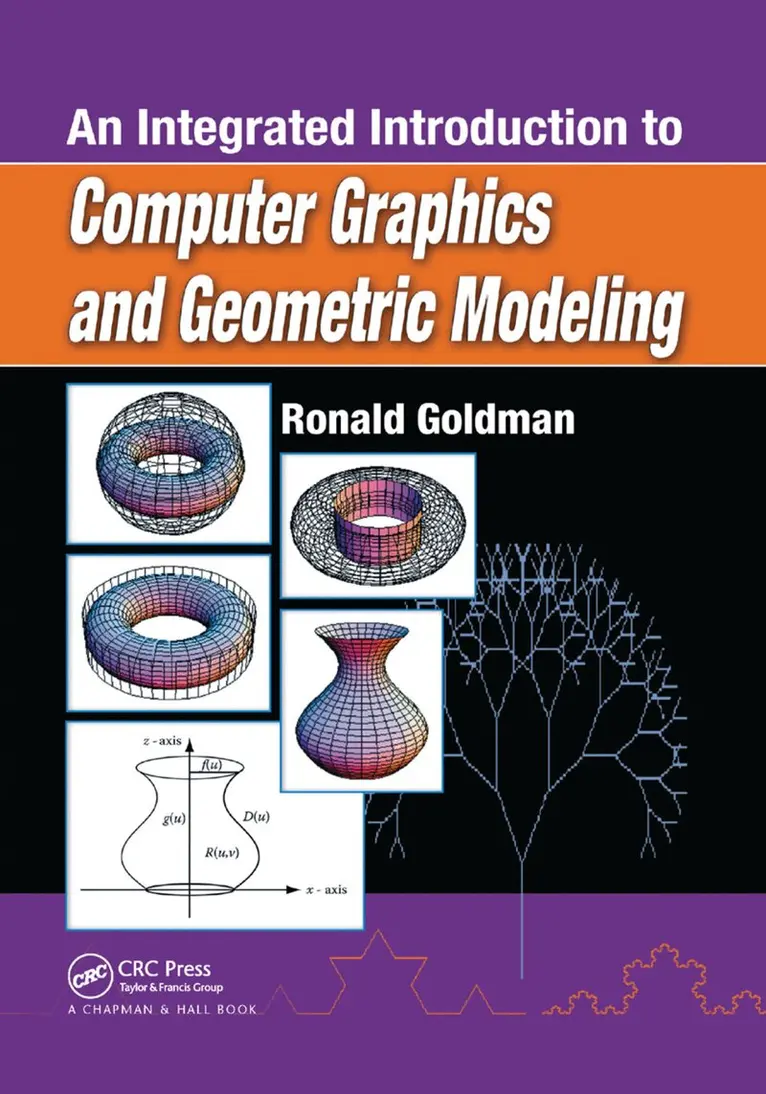
Taking a novel, more appealing approach than current texts, An Integrated Introduction to Computer Graphics and Geometric Modeling focuses on graphics, modeling, and mathematical methods, including ray tracing, polygon shading, radiosity, fractals, freeform curves and surfaces, vector methods, and transformation techniques. The author begins with fractals, rather than the typical line-drawing algorithms found in many standard texts. He also brings the turtle back from obscurity to introduce several major concepts in computer graphics. Supplying the mathematical foundations, the book covers linear algebra topics, such as vector geometry and algebra, affine and projective spaces, affine maps, projective transformations, matrices, and quaternions. The main graphics areas explored include reflection and refraction, recursive ray tracing, radiosity, illumination models, polygon shading, and hidden surface procedures. The book also discusses geometric modeling, including planes, polygons, spheres, quadrics, algebraic and parametric curves and surfaces, constructive solid geometry, boundary files, octrees, interpolation, approximation, Bezier and B-spline methods, fractal algorithms, and subdivision techniques. Making the material accessible and relevant for years to come, the text avoids descriptions of current graphics hardware and special programming languages. Instead, it presents graphics algorithms based on well-established physical models of light and cogent mathematical methods.
1 686 kr
Skickas inom 10-15 vardagar
Taking a novel, more appealing approach than current texts, An Integrated Introduction to Computer Graphics and Geometric Modeling focuses on graphics, modeling, and mathematical methods, including ray tracing, polygon shading, radiosity, fractals, freeform curves and surfaces, vector methods, and transformation techniques. The author begins with fractals, rather than the typical line-drawing algorithms found in many standard texts. He also brings the turtle back from obscurity to introduce several major concepts in computer graphics. Supplying the mathematical foundations, the book covers linear algebra topics, such as vector geometry and algebra, affine and projective spaces, affine maps, projective transformations, matrices, and quaternions. The main graphics areas explored include reflection and refraction, recursive ray tracing, radiosity, illumination models, polygon shading, and hidden surface procedures. The book also discusses geometric modeling, including planes, polygons, spheres, quadrics, algebraic and parametric curves and surfaces, constructive solid geometry, boundary files, octrees, interpolation, approximation, Bezier and B-spline methods, fractal algorithms, and subdivision techniques. Making the material accessible and relevant for years to come, the text avoids descriptions of current graphics hardware and special programming languages. Instead, it presents graphics algorithms based on well-established physical models of light and cogent mathematical methods.
1 238 kr
Skickas inom 10-15 vardagar
Complete Coverage of the Current Practice of Computer GraphicsComputer Graphics: From Pixels to Programmable Graphics Hardware explores all major areas of modern computer graphics, starting from basic mathematics and algorithms and concluding with OpenGL and real-time graphics. It gives students a firm foundation in today’s high-performance graphics.Up-to-Date Techniques, Algorithms, and APIThe book includes mathematical background on vectors and matrices as well as quaternions, splines, curves, and surfaces. It presents geometrical algorithms in 2D and 3D for spatial data structures using large data sets. Although the book is mainly based on OpenGL 3.3, it also covers tessellation in OpenGL 4.0, contains an overview of OpenGL ES 2.0, and discusses the new WebGL, which allows students to use OpenGL with shaders directly in their browser. In addition, the authors describe a variety of special effects, including procedural modeling and texturing, fractals, and non-photorealistic rendering. They also explain the fundamentals of the dominant language (OpenCL) and platform (CUDA) of GPGPUs.Web ResourceOn the book’s CRC Press web page, students can download many ready-to-use examples of C++ code demonstrating various effects. C++ wrappers for basic OpenGL entities, such as textures and programs, are also provided.In-Depth Guidance on a Programmable Graphics PipelineRequiring only basic knowledge of analytic geometry, linear algebra, and C++, this text guides students through the OpenGL pipeline. Using one consistent example, it leads them step by step from simple rendering to animation to lighting and bumpmapping.Key FeaturesCovers the main aspects of modern computer graphics Explains how to create various special effects using OpenGLDescribes a wide range of current topics, such as tessellation, spherical harmonics, and geometric shadersContains practical exercises and examples as well as numerous illustrations, including several color images Offers full, cross-platform source code and examples on the book’s CRC Press web pageFigure slides available upon qualifying course adoption