Competitiveness - Böcker
Visar alla böcker i serien Competitiveness. Handla med fri frakt och snabb leverans.
9 produkter
9 produkter
518 kr
Tillfälligt slut
An increase in global access to goods and knowledge is transforming world-class science and technology (S&T) by bringing it within the capability of an unprecedented number of global parties who must compete for resources, markets, and talent. In particular, globalization has facilitated the success of formal S&T plans in many developing countries, where traditional limitations can now be overcome through the accumulation and global trade of a wide variety of goods, skills, and knowledge. As a result, centers for technological research and development (R&D) are now globally dispersed, setting the stage for greater uncertainty in the political, economic, and security arenas. These changes will have a potentially enormous impact for the U.S. national security policy, which for the past half century was premised on U.S. economic and technological dominance. As the U.S. monopoly on talent and innovation wanes, arms export regulations and restrictions on visas for foreign S&T workers are becoming less useful as security strategies.The acute level of S&T competition among leading countries in the world today suggests that countries that fail to exploit new technologies or that lose the capability for proprietary use of their own new technologies will find their existing industries uncompetitive or obsolete. The increased access to information has transformed the 1950s' paradigm of "control and isolation" of information for innovation control into the current one of "engagement and partnerships" between innovators for innovation creation. Current and future strategies for S&T development need to be considered in light of these new realities. This book analyzes the S&T strategies of Japan, Brazil, Russia, India, China, and Singapore (JBRICS), six countries that have either undergone or are undergoing remarkable growth in their S&T capabilities for the purpose of identifying unique national features and how they are utilized in the evolving global S&T environment.
549 kr
Tillfälligt slut
The goal of this study was to assess the value and feasibility of developing and implementing content standards for engineering education at the K-12 level. Content standards have been developed for three disciplines in STEM education--science, technology, and mathematic--but not for engineering. To date, a small but growing number of K-12 students are being exposed to engineering-related materials, and limited but intriguing evidence suggests that engineering education can stimulate interest and improve learning in mathematics and science as well as improve understanding of engineering and technology. Given this background, a reasonable question is whether standards would improve the quality and increase the amount of teaching and learning of engineering in K-12 education. The book concludes that, although it is theoretically possible to develop standards for K-12 engineering education, it would be extremely difficult to ensure their usefulness and effective implementation. This conclusion is supported by the following findings: (1) there is relatively limited experience with K-12 engineering education in U.S. elementary and secondary schools, (2) there is not at present a critical mass of teachers qualified to deliver engineering instruction, (3) evidence regarding the impact of standards-based educational reforms on student learning in other subjects, such as mathematics and science, is inconclusive, and (4) there are significant barriers to introducing stand-alone standards for an entirely new content area in a curriculum already burdened with learning goals in more established domains of study.
321 kr
Skickas
In the face of so many daunting near-term challenges, U.S. government and industry are letting the crucial strategic issues of U.S. competitiveness slip below the surface. Five years ago, the National Academies prepared Rising Above the Gathering Storm, a book that cautioned: "Without a renewed effort to bolster the foundations of our competitiveness, we can expect to lose our privileged position." Since that time we find ourselves in a country where much has changed--and a great deal has not changed. So where does America stand relative to its position of five years ago when the Gathering Storm book was prepared? The unanimous view of the authors is that our nation's outlook has worsened. The present volume, Rising Above the Gathering Storm, Revisited, explores the tipping point America now faces. Addressing America's competitiveness challenge will require many years if not decades; however, the requisite federal funding of much of that effort is about to terminate.Rising Above the Gathering Storm, Revisited provides a snapshot of the work of the government and the private sector in the past five years, analyzing how the original recommendations have or have not been acted upon, what consequences this may have on future competitiveness, and priorities going forward. In addition, readers will find a series of thought- and discussion-provoking factoids--many of them alarming--about the state of science and innovation in America. Rising Above the Gathering Storm, Revisited is a wake-up call. To reverse the foreboding outlook will require a sustained commitment by both individual citizens and government officials--at all levels. This book, together with the original Gathering Storm volume, provides the roadmap to meet that goal. While this book is essential for policy makers, anyone concerned with the future of innovation, competitiveness, and the standard of living in the United States will find this book an ideal tool for engaging their government representatives, peers, and community about this momentous issue.
Rising Above the Gathering Storm
Energizing and Employing America for a Brighter Economic Future
Häftad, Engelska, 2007
762 kr
Tillfälligt slut
In a world where advanced knowledge is widespread and low-cost labor is readily available, U.S. advantages in the marketplace and in science and technology have begun to erode. A comprehensive and coordinated federal effort is urgently needed to bolster U.S. competitiveness and pre-eminence in these areas. This congressionally requested report by a pre-eminent committee makes four recommendations along with 20 implementation actions that federal policy-makers should take to create high-quality jobs and focus new science and technology efforts on meeting the nation's needs, especially in the area of clean, affordable energy: 1) Increase America's talent pool by vastly improving K-12 mathematics and science education; 2) Sustain and strengthen the nation's commitment to long-term basic research; 3) Develop, recruit, and retain top students, scientists, and engineers from both the U.S. and abroad; and 4) Ensure that the United States is the premier place in the world for innovation. Some actions will involve changing existing laws, while others will require financial support that would come from reallocating existing budgets or increasing them.Rising Above the Gathering Storm will be of great interest to federal and state government agencies, educators and schools, public decision makers, research sponsors, regulatory analysts, and scholars.
334 kr
Tillfälligt slut
What students learn about the science disciplines, technology, engineering, and mathematics during their K-12 schooling shapes their intellectual development, opportunities for future study and work, and choices of career, as well as their capacity to make informed decisions about political and civic issues and about their own lives. Most people share the vision that a highly capable STEM workforce and a population that understands and supports the scientific enterprise are key to the future place of the United States in global economics and politics and to the well-being of the nation. Indeed, the solutions to some of the most daunting problems facing the nation will require not only the expertise of top STEM professionals but also the wisdom and understanding of its citizens. Although much is known about why schools may not succeed, it is far less clear what makes STEM education effective. Successful STEM Education: A Workshop Summary discusses the importance of STEM education.The report describes the primary types of K-12 schools and programs that can support successful education in the STEM disciplines and examines data and research that demonstrate the effectiveness of these school types. It also summarizes research that helps to identify both the elements that make such programs effective and what is needed to implement these elements.
Report of a Workshop on Science, Technology, Engineering, and Mathematics (STEM) Workforce Needs for the U.S. Department of Defense and the U.S. Defense Industrial Base
Häftad, Engelska, 2012
402 kr
Tillfälligt slut
Report of a Workshop on Science, Technology, Engineering, and Mathematics (STEM) Workforce Needs for the U.S. Department of Defense and the U.S. Defense Industrial Base is the summary of a workshop held August 11, 2011, as part of an 18-month study of the issue. This book assesses the STEM capabilities that the Department of Defense (DOD) needs in order to meet its goals, objectives, and priorities; to assess whether the current DOD workforce and strategy will meet those needs; and to identify and evaluate options and recommend strategies that the department could use to help meet its future STEM needs.
844 kr
Tillfälligt slut
America's position as the source of much of the world's global innovation has been the foundation of its economic vitality and military power in the post-war. No longer is U.S. pre-eminence assured as a place to turn laboratory discoveries into new commercial products, companies, industries, and high-paying jobs. As the pillars of the U.S. innovation system erode through wavering financial and policy support, the rest of the world is racing to improve its capacity to generate new technologies and products, attract and grow existing industries, and build positions in the high technology industries of tomorrow. Rising to the Challenge: U.S. Innovation Policy for Global Economy emphasizes the importance of sustaining global leadership in the commercialization of innovation which is vital to America's security, its role as a world power, and the welfare of its people. The second decade of the 21st century is witnessing the rise of a global competition that is based on innovative advantage.To this end, both advanced as well as emerging nations are developing and pursuing policies and programs that are in many cases less constrained by ideological limitations on the role of government and the concept of free market economics. The rapid transformation of the global innovation landscape presents tremendous challenges as well as important opportunities for the United States. This report argues that far more vigorous attention be paid to capturing the outputs of innovation - the commercial products, the industries, and particularly high-quality jobs to restore full employment. America's economic and national security future depends on our succeeding in this endeavor.
Research Universities and the Future of America
Ten Breakthrough Actions Vital to Our Nation's Prosperity and Security
Häftad, Engelska, 2012
560 kr
Tillfälligt slut
Research Universities and the Future of America presents critically important strategies for ensuring that our nation's research universities contribute strongly to America's prosperity, security, and national goals. Widely considered the best in the world, our nation's research universities today confront significant financial pressures, important advances in technology, a changing demographic landscape, and increased international competition. This report provides a course of action for ensuring our universities continue to produce the knowledge, ideas, and talent the United States needs to be a global leader in the 21st century. Research Universities and the Future of America focuses on strengthening and expanding the partnership among universities and government, business, and philanthropy that has been central to American prosperity and security.The report focuses on the top 10 actions that Congress, the federal government, state governments, research universities, and others could take to strengthen the research and education missions of our research universities, their relationships with other parts of the national research enterprise, and their ability to transfer new knowledge and ideas to those who productively use them in our society and economy. This report examines trends in university finance, prospects for improving university operations, opportunities for deploying technology, and improvement in the regulation of higher education institutions. It also explores ways to improve pathways to graduate education, take advantage of opportunities to increase student diversity, and realign doctoral education for the careers new doctorates will follow. Research Universities and the Future of America is an important resource for policy makers on the federal and state levels, university administrators, philanthropic organizations, faculty, technology transfer specialists, libraries, and researchers.
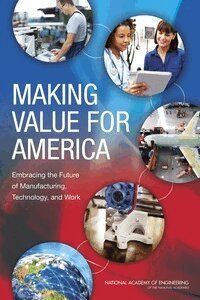
Making Value for America
Embracing the Future of Manufacturing, Technology, and Work
Häftad, Engelska, 2015
542 kr
Skickas
Globalization, developments in technology, and new business models are transforming the way products and services are conceived, designed, made, and distributed in the U.S. and around the world. These forces present challenges - lower wages and fewer jobs for a growing fraction of middle-class workers - as well as opportunities for "makers" and aspiring entrepreneurs to create entirely new types of businesses and jobs. Making Value for America examines these challenges and opportunities and offers recommendations for collaborative actions between government, industry, and education institutions to help ensure that the U.S. thrives amid global economic changes and remains a leading environment for innovation. Filled with real-life examples, Making Value for America presents a roadmap to enhance the nation's capacity to pursue opportunities and adapt to transforming value chains by widespread adoption of best practices, a well-prepared and innovative workforce, local innovation networks to support startups and new products, improved flow of capital investments, and infrastructure upgrades.