Critical Assessments of Major Writers – serie
Visar alla böcker i serien Critical Assessments of Major Writers. Handla med fri frakt och snabb leverans.
3 produkter
3 produkter
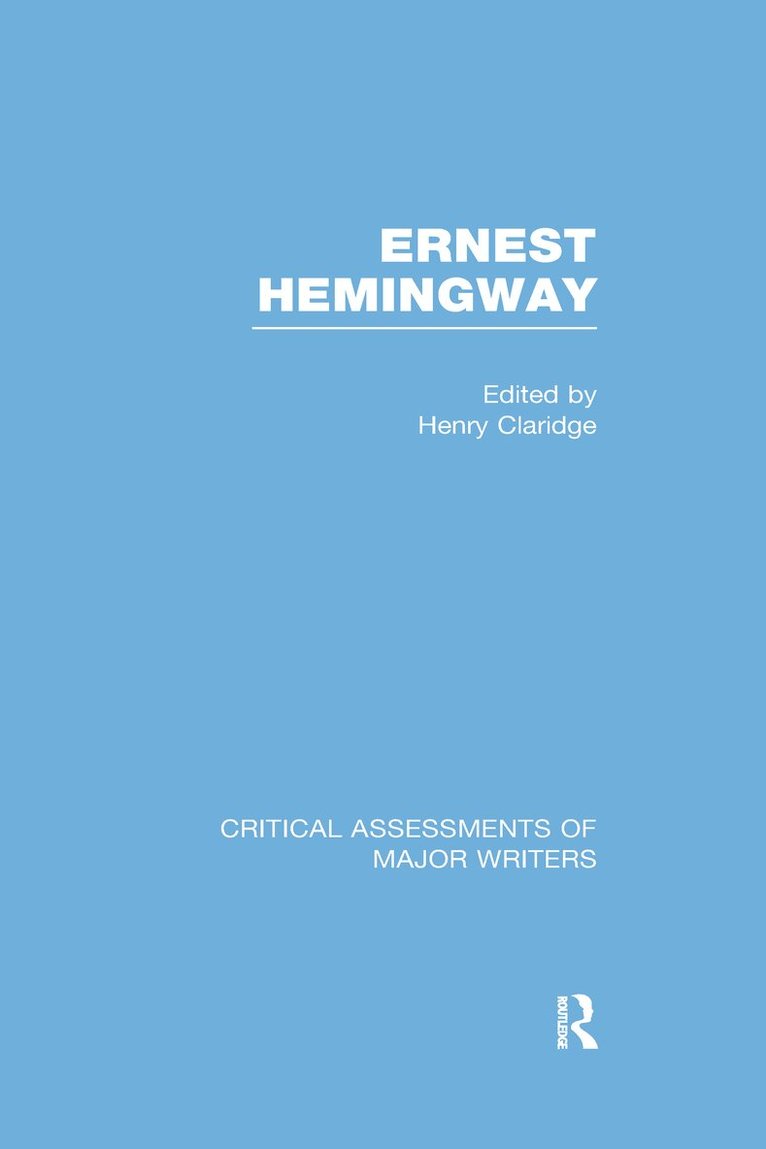
Ernest Hemingway
2011
15 944 kr
Tillfälligt slut
Few twentieth-century American writers have been as influential as Ernest Hemingway (1899–1961). Whilst contemporaries such as F. Scott Fitzgerald and William Faulkner may be as widely taught and studied as Hemingway, neither had an influence on other writers—or indeed, the cognate arts—as great as that of Hemingway. For example, the ‘hard-boiled’ school of detective fiction extending from the novels of Raymond Chandler and Dashiell Hammett to those of James Ellroy and Robert Parker is more or less inconceivable without Hemingway’s stylistic influence. Arguably, film noir is also Hemingwayesque in its laconic detachment. And quite independently of his creative writings, Hemingway’s life continues to exert a profound fascination for both student and the general reader.Hemingway was the subject of extensive enquiry before his death and since then he has generated interpretative and critical commentary on a vast and bewildering scale, in part aided by the continuing publication of works left unpublished at his death (most notably The Garden of Eden in 1987). The dizzying quantity (and variable quality) of Hemingway criticism makes it difficult to discriminate the useful from the tendentious, superficial, and otiose. That is why this new Routledge title is so urgently needed. In four volumes, the collection meets the need for an authoritative reference work to allow researchers and students to make sense of a vast literature and the continuing explosion in research output. Users will now be able easily and rapidly to locate the best and most influential critical scholarship, work that is otherwise often inaccessible or scattered throughout a variety of specialist journals and books. With material gathered into one easy-to-use set, researchers and students can now spend more of their time with the key journal articles, book chapters, and other pieces, rather than on time-consuming (and sometimes fruitless) archival searches.Fully indexed and with a comprehensive introduction newly written by the editor, which places the collected material in its historical and intellectual context, Ernest Hemingway is an essential reference work and is destined to be valued as a vital research resource.
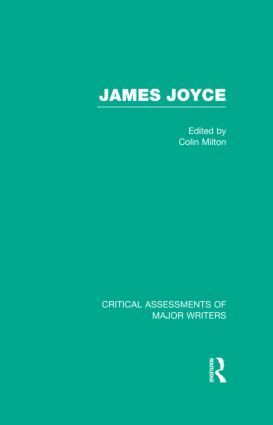
James Joyce
2012
16 661 kr
Tillfälligt slut
James Augustine Aloysius Joyce (1882–1941) is a towering figure in the development of English-language modernist prose fiction. And his influence extends well beyond the anglophone literary world; like his alter ego, Stephen Dedalus, Joyce flew by the nets of nationality, language, and religion, and spent most of his life in continental Europe.The significance of Joyce’s oeuvre—particularly the later and more radical prose works—far outweighs the modesty of its bulk: only two books of verse, a play, one collection of short stories, and three novels (using that term in its most elastic sense) were published in his lifetime. But the combination of a modest output with an increasingly audacious experimentalism has generated interpretative and critical commentary on a vast and bewildering scale. Joyce attracted serious attention (not always favourable) from virtually every significant writer of the age: elder statesmen like Yeats recognized his importance, as did members of his own generation, such as Pound, Eliot, and Lawrence. The major American critics of the era, like Edmund Wilson and Lionel Trilling, and, in France, Eugene Jolas and Jacques Mercanton, also responded with enthusiasm to his work, as did Cyril Connolly and F. R. Leavis in Britain. Joyce’s work has also lent itself to approaches informed by contemporary theory—whether new critical, formalist, structuralist, deconstructionist, feminist, or materialist—such that the development of Joycean criticism maps the spread and transmutations of ‘theory’ and illustrates its applications.So, while the prospective reader of Ulysses or Finnegans Wake is likely to feel a compelling need for some preparation before consuming the text itself, the daunting quantity (and variable quality) of Joyce criticism makes it difficult to discriminate the useful from the tendentious, superficial, and otiose. That is why this new Routledge title is so urgently needed. In four volumes, the collection meets the need for an authoritative reference work to allow researchers and students to make sense of the vast Joycean literature and the continuing explosion in research output. Users will now be able easily and rapidly to locate the best and most influential critical scholarship, work that is otherwise often inaccessible or scattered throughout a variety of specialist journals and books. With material gathered into one easy-to-use set, researchers and students can now spend more of their time with the key journal articles, book chapters, and other pieces, rather than on time-consuming (and sometimes fruitless) archival searches.Fully indexed and with a comprehensive introduction newly written by the editor, which places the collected material in its historical and intellectual context, James Joyce is an essential reference work and is destined to be valued as a vital research resource.
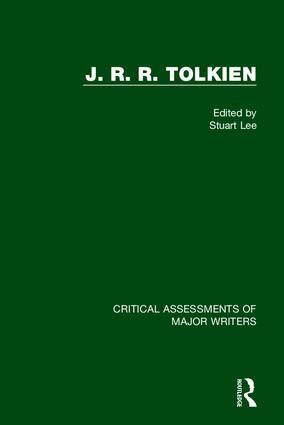
J. R. R. Tolkien
2017
23 040 kr
Skickas inom 10-15 vardagar
J. R. R. Tolkien (1892–1973) is widely regarded as one of the most important writers of the twentieth century. His popularity began with the publication in 1937 of The Hobbit, and was cemented by the appearance of The Lord of the Rings in the early 1950s. However, engagement with his work was until relatively recently sidelined by literary and other scholars. Consequently, many foundational analyses of his fiction, and his work as a medievalist, are dispersed in hard-to-find monographs and obscure journals (often produced by dedicated amateurs). In contrast, over the last decade or so, academic interest in Tolkien has risen dramatically. Indeed, interpretative and critical commentary is now being generated on a bewildering scale, in part aided by the continuing posthumous publication of his work (most recently, his Beowulf translation which appeared in 2014). The dizzying quantity—and variable quality—of this later criticism makes it difficult to discriminate the useful from the tendentious, superficial, and otiose.Now, in four volumes, a new collection from Routledge’s Critical Assessments of Major Writers series meets the need for an authoritative reference work to collect early evaluations and to make sense of the more recent explosion in research output. Users are now able easily and rapidly to locate the best and most influential critical assessments. With material gathered into one easy-to-use set, Tolkien researchers and students can now spend more of their time with the key journal articles, book chapters, and other pieces, rather than on time-consuming (and sometimes fruitless) archival searches.