Human Element in Smart and Intelligent Systems - Böcker
Visar alla böcker i serien Human Element in Smart and Intelligent Systems. Handla med fri frakt och snabb leverans.
7 produkter
7 produkter
Understanding Cybersecurity Technologies
A Guide to Selecting the Right Cybersecurity Tools
Inbunden, Engelska, 2021
1 292 kr
Skickas inom 10-15 vardagar
Cyberattacks on enterprises, government institutions, and individuals are exponentially growing. At the same time, the number of companies, both small and large, offering all types of solutions has been increasing too. Since companies rely on technological solutions to protect themselves against cyberattacks, understanding and selecting the right solutions among those offered presents a significant challenge for professionals, company executives, and newcomers to the cybersecurity field.FEATURES Presents descriptions for each type of cybersecurity technology and their specifications Explains applications, usages, and offers case studies to enhance comprehension Offers an easy-to-understand classification of existing cybersecurity technologies Provides an understanding of the technologies without getting lost in technical details Focuses on existing technologies used in different solutions, without focusing on the companies that offer these technologiesThis book is intended to help all professionals new to cybersecurity, students, and experts to learn or educate their audiences on the foundations of the available solutions.
Smart and Intelligent Systems
The Human Elements in Artificial Intelligence, Robotics, and Cybersecurity
Inbunden, Engelska, 2021
1 698 kr
Skickas inom 10-15 vardagar
"The more we know about smart and intelligent systems and their use, the more productive organizations can become, and the more quality of life will improve."—Gavriel Salvendy, President Academy of Science, Engineering and Medicine of Florida, University Distinguished Professor University of Central Florida""Robots, drones, self-driving cars, and personal assistants are only some of the ‘intelligent’ and ‘smart’ systems which are populating our world and changing the way we use technology to carry out our everyday activities, bringing about both exciting opportunities for human-technology symbiosis, as well as compelling design and development challenges. Through a carefully selected choice of chapters, authored by top scientists in the field, this book, edited by Abbas Moallem, sheds light on fundamental aspects of intelligent and smart systems, investigating the role and impact of affective and psychophysiological computing, machine learning, cybersecurity, agent transparency, and human-agent teaming in the shaping of this new interaction paradigm, as well as the human factors involved in their application in critical domains such as health, education, and manufacturing in the emerging technological landscape."—Constantine Stephanidis, Professor of Computer Science, University of Crete, Distinguished member of Foundation for Research and Technology - Hellas (FORTH) In today’s digital world, the words "smart" and intelligent" are now used to label devices, machinery, systems, and even environments. What is a "smart" system? Is "smart" synonymous with "intelligent"? If not, what does an "intelligent system" mean? Are all smart systems intelligent? This book tries to answer these questions by summarizing the existing research in various areas and providing new research findings. Smart and Intelligent Systems: The Human Elements in Artificial Intelligence, Robotics, and Cybersecurity presents new areas of smart and intelligent system design. It defines smart and intelligent systems, offers a human factors approach, discusses networking applications, and combines the human element with smart and intelligent systems.This book is perfect for engineering students in data sciences and artificial intelligence and practitioners at all levels in the fields of human factors and ergonomics, systems engineering, computer science, software engineering, and robotics.
Smart and Intelligent Systems
The Human Elements in Artificial Intelligence, Robotics, and Cybersecurity
Häftad, Engelska, 2024
670 kr
Skickas inom 10-15 vardagar
"The more we know about smart and intelligent systems and their use, the more productive organizations can become, and the more quality of life will improve."—Gavriel Salvendy, President Academy of Science, Engineering and Medicine of Florida, University Distinguished Professor University of Central Florida""Robots, drones, self-driving cars, and personal assistants are only some of the ‘intelligent’ and ‘smart’ systems which are populating our world and changing the way we use technology to carry out our everyday activities, bringing about both exciting opportunities for human-technology symbiosis, as well as compelling design and development challenges. Through a carefully selected choice of chapters, authored by top scientists in the field, this book, edited by Abbas Moallem, sheds light on fundamental aspects of intelligent and smart systems, investigating the role and impact of affective and psychophysiological computing, machine learning, cybersecurity, agent transparency, and human-agent teaming in the shaping of this new interaction paradigm, as well as the human factors involved in their application in critical domains such as health, education, and manufacturing in the emerging technological landscape."—Constantine Stephanidis, Professor of Computer Science, University of Crete, Distinguished member of Foundation for Research and Technology - Hellas (FORTH) In today’s digital world, the words "smart" and intelligent" are now used to label devices, machinery, systems, and even environments. What is a "smart" system? Is "smart" synonymous with "intelligent"? If not, what does an "intelligent system" mean? Are all smart systems intelligent? This book tries to answer these questions by summarizing the existing research in various areas and providing new research findings. Smart and Intelligent Systems: The Human Elements in Artificial Intelligence, Robotics, and Cybersecurity presents new areas of smart and intelligent system design. It defines smart and intelligent systems, offers a human factors approach, discusses networking applications, and combines the human element with smart and intelligent systems.This book is perfect for engineering students in data sciences and artificial intelligence and practitioners at all levels in the fields of human factors and ergonomics, systems engineering, computer science, software engineering, and robotics.
Understanding Cybersecurity Technologies
A Guide to Selecting the Right Cybersecurity Tools
Häftad, Engelska, 2024
616 kr
Skickas inom 10-15 vardagar
Cyberattacks on enterprises, government institutions, and individuals are exponentially growing. At the same time, the number of companies, both small and large, offering all types of solutions has been increasing too. Since companies rely on technological solutions to protect themselves against cyberattacks, understanding and selecting the right solutions among those offered presents a significant challenge for professionals, company executives, and newcomers to the cybersecurity field.FEATURES Presents descriptions for each type of cybersecurity technology and their specifications Explains applications, usages, and offers case studies to enhance comprehension Offers an easy-to-understand classification of existing cybersecurity technologies Provides an understanding of the technologies without getting lost in technical details Focuses on existing technologies used in different solutions, without focusing on the companies that offer these technologiesThis book is intended to help all professionals new to cybersecurity, students, and experts to learn or educate their audiences on the foundations of the available solutions.
1 319 kr
Skickas inom 10-15 vardagar
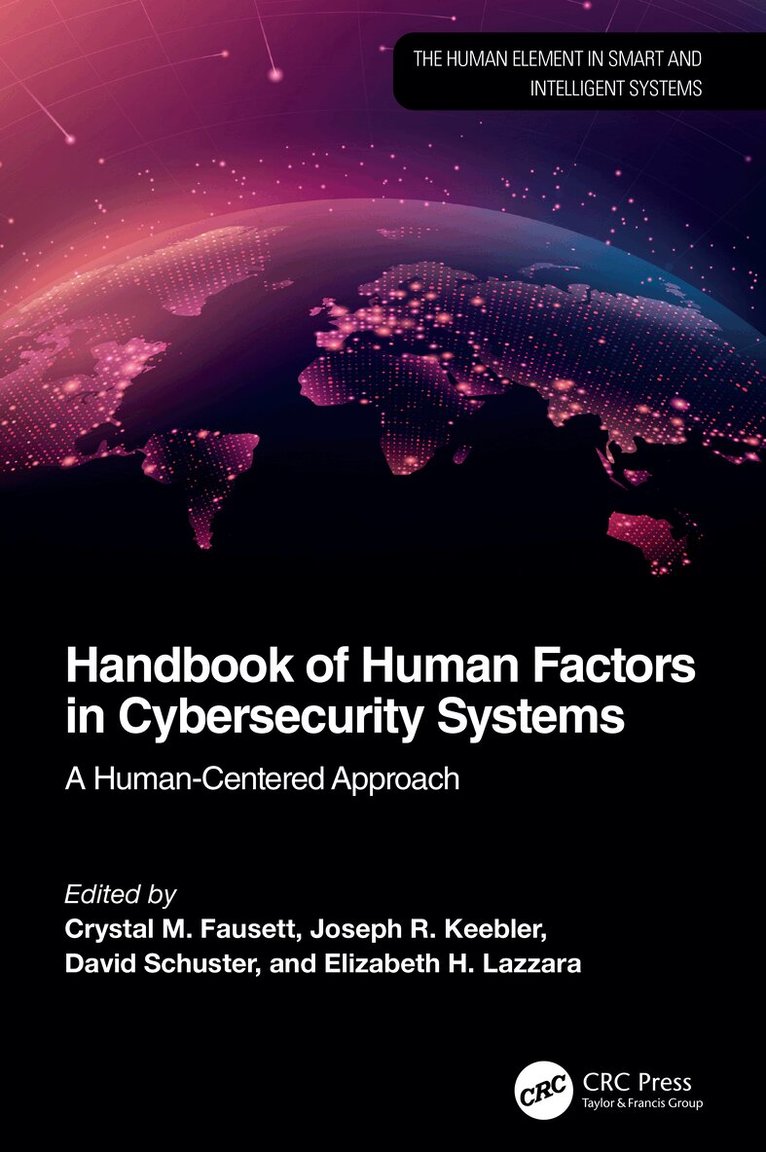
Data and security breaches can cost organizations millions and result in bad publicity and lost income, with humans often being regarded as the “weakest link” in cybersecurity incidents. This book is a cross-disciplinary primer on the latest research on human aspects of cybersecurity, reimagining the role of humans in cybersecurity systems. It aims to increase participation in research on the emerging, critical, and impactful area of human factors of cybersecurity by orienting human factors researchers, professionals, and students to cybersecurity issues while providing them with comprehensive, cross-cutting knowledge from human factors that applies to this emerging area.Across nine chapters, the Handbook of Human Factors in Cybersecurity Systems covers the essential topics for understanding humans to optimize cybersecurity system performance. Topics included cover system safety, cybersecurity teams, safety culture, cyberattacks, defense approaches, phishing, emerging cybersecurity threats and many more. The book investigates cybersecurity across numerous industries, including aviation and healthcare, and is backed up by interesting, real-life case studies. The reader will develop a full and thorough understanding of how to integrate human factors principles with cybersecurity practices.With chapters from a team of global experts, this book is an essential read for any student, academic, or professional in the disciplines of computer engineering, systems engineering, safety engineering, human factors, and ergonomics and cybersecurity engineering.
1 184 kr
Skickas inom 10-15 vardagar
As cyber threat actors have become more sophisticated, data breaches, phishing attacks, and ransomware are increasing, and the global cybercrime damage in 2021 was $16.4 billion a day. While technical issue analyses are fundamental in understanding how to improve system security, analyzing the roles of human agents is crucial. Human Factors Analysis of 23 Cyberattacks addresses, through examples, the human factors behind cybersecurity attacks.Focusing on human factors in individual attack cases, this book aims to understand the primary behaviors that might result in the success of attacks. Each chapter looks at a series of cases describing the nature of the attack through the reports and reviews of the experts, followed by the role and human factors analysis. It investigates where a human agent's intervention was a factor in starting, discovering, monitoring, or suffering from the attacks. Written in an easy-to-understand way and free from technical jargon, the reader will develop a thorough understanding of why cyberattacks occur and how they can be mitigated by comparison to the practical examples provided.This title will appeal to students and practitioners in the fields of ergonomics, human factors, cybersecurity, computer engineering, industrial engineering, and computer science.
1 900 kr
Skickas inom 10-15 vardagar
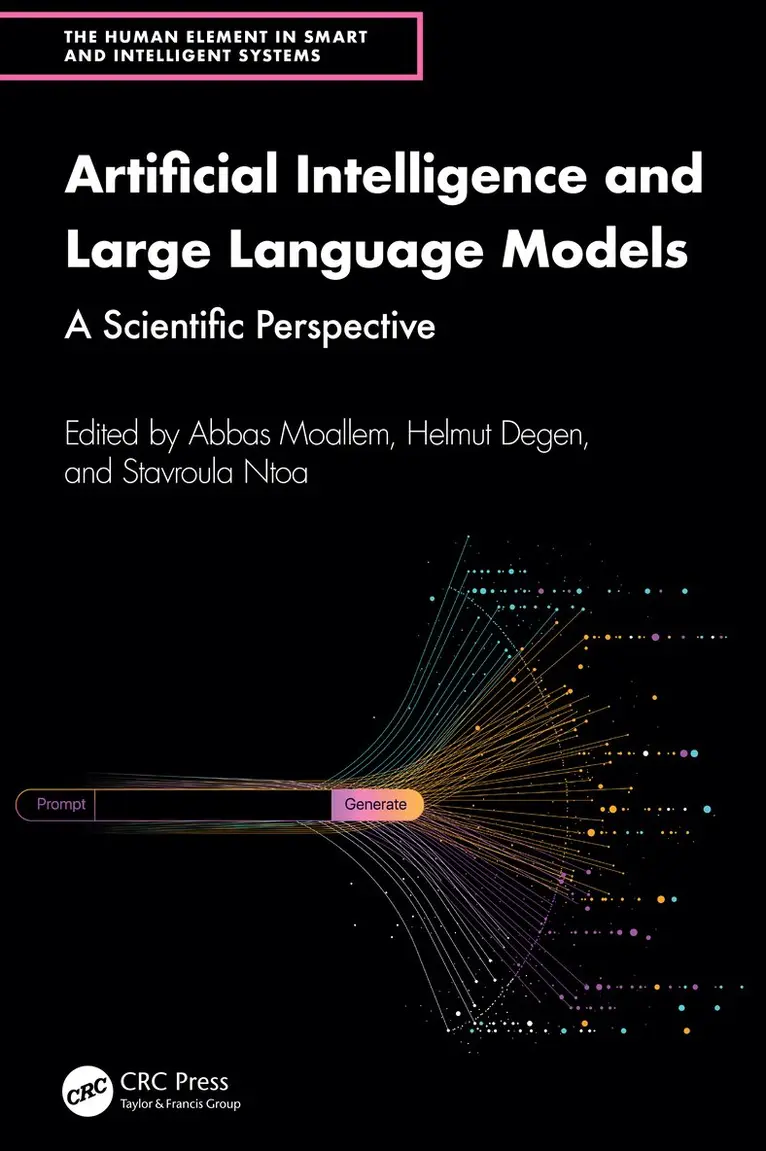
With the latest developments in generative artificial intelligence (AI) and large language model (LLM) applications, like ChatGPT and Gemini, millions of people have started using them in their personal and professional lives. Interest in them continues to grow and they are becoming the go-to applications for students, academics, engineers, lawyers, designers, writers, media experts, programmers, politicians, artists, and citizens across the globe. However, understanding these applications can be technical with precious little advice out there. This book cuts through the jargon to explain the "what", "why" and "how" of generative AI and LLM applications.This book summarizes experiences from a variety of applications, relevant to our daily lives. It brings together scientifically grounded experience reports from different perspectives into a one-stop title. With an international outlook and featuring global case studies, it offers insights into the beneficial use of LLMs and generative AI including future trends for how the journey of using such amazing tools will continue in the future. This book details the history of AI, reviews LLM literature, and covers neural computing and the technical foundation of LLMs. Furthermore, the use and control of LLMs in education are covered. Through reading this book, the reader will develop a full understanding of AI and LLM applications, including knowledge of the key issues of trust, legality, security and technical foundations.Artificial Intelligence and Large Language Models: A Scientific Perspective will appeal to students and academics, as well as people interested in the use of LLMs and generative AI for professional or everyday tasks, including those in Human Factors, Human-Computer Interaction, Computer Science, Software Engineering and Industrial Engineering.