Industrial Safety Series – serie
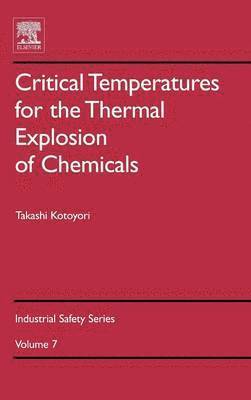
Critical Temperatures for the Thermal Explosion of Chemicals
2 890 kr
Skickas inom 5-8 vardagar
The value of the critical temperature (Tc), below which the thermal explosion of a chemical cannot occur, is indispensable to prevent such a chemical from exploding. In order to determine the Tc it has so far been necessary to measure the value in explosion experiments. Because of the inherent hazards, only few Tc values are available at present.
Critical Temperatures for the Thermal Explosion of Chemicals introduces new and simple procedures to calculate the Tc. As a result Tc can be calculated for a range of chemicals, many of which are listed in this new volume. The calculated values of Tc are shown to be in agreement with experimentally determined values.
The data and methods presented in Critical Temperatures for the Thermal Explosion of Chemicals will be of use to research laboratories as well as in the chemical industry.
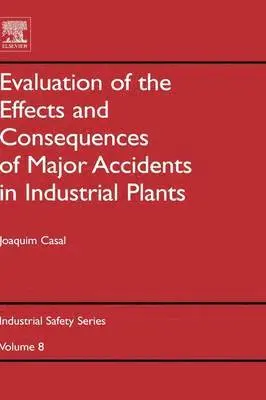
Introduces new and simple procedures for calculating critical temperatures Lists the T(c) values of chemicals in tables Explains mathematical expressions in clear simple termsEvaluation of the Effects and Consequences of Major Accidents in Industrial Plants
3 709 kr
Skickas inom 5-8 vardagar
Evaluation of the Effects and Consequences of Major Accidents in Industrial Plants analyzes the different major accidents which can occur in process plants and during the transportation of hazardous materials. The main features of fires, explosions and toxic releases are discussed, and a set of mathematical models allowing the prediction of their effects and consequences are explained. With a practical approach, the models are applied to simple illustrative examples, as well as to more complex real cases. The use of these calculations in the frame of Quantitative Risk Analysis is also treated.
Evaluation of the effects of major accidents in industrial installations covers the following topics: general introduction, source term, fire accidents, vapour cloud explosions, BLEVEs and vessel explosions, atmospheric dispersion of toxic or flammable clouds, vulnerability, and quantitative risk analysis.
This book is a useful tool for engineering professionals, as well as an interesting reference for teaching at graduate and post-graduate levels.
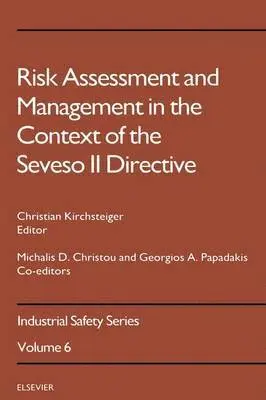
Both the essential aspects and the calculations related to the diverse accidents are discussed The prediction of effects and consequences is performed with a practical approach Recent contributions from literature have been included Subjects of increasing importance have been included: an extense analysis of BLEVEs, for example, or the atmospheric dispersion of pathogenic agentsRisk Assessment and Management in the Context of the Seveso II Directive
2 508 kr
Skickas inom 7-10 vardagar
The "performance based" and "goal oriented" regulatory requirements of the European Council's new "Seveso II Directive" for the identification of large scale industrial hazards, prevention of sudden and uncontrolled releases of dangerous substances from industrial plants and mitigation of serious consequences of industrial accidents to people and the environment are examined. The fact that risk assessment and management are key elements to such forms of regulation is also demonstrated.
While the "Seveso II Directive" defines "what" has to be achieved on the control of major hazards involving dangerous substances within the European Union, the methods of risk assessment and management give guidance on "how" to achieve it. The text provides a practical guide for decision-makers in regulatory bodies and companies with a non-technical background. Scientists and engineers who are not yet familiar with the concepts of risk assessment and who want a survey of some fundamentals of, and principal results from, risk assessment studies and approaches primarily for applications in the context defined by the "Seveso Directives" will also find this book invaluable.