Oxford India Perennials Series – serie
Visar alla böcker i serien Oxford India Perennials Series. Handla med fri frakt och snabb leverans.
11 produkter
11 produkter
Häftad, Engelska, 2012
337 kr
Skickas inom 3-6 vardagar
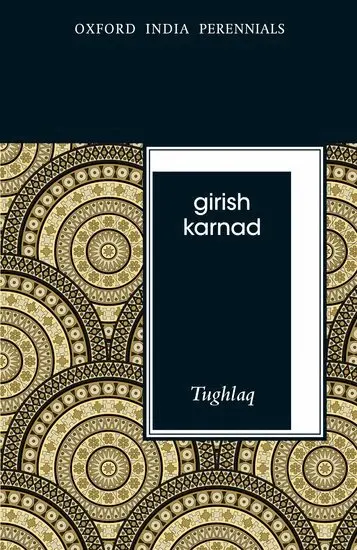
Muhammad Bin Tughlaq, who ruled from Delhi in the fourteenth century, was a man of many dimensions. A well-read scholar of the arts, theology, and philosophy, a brilliant calligraphist, a mystic, as well as a poet, it is the 'madness' that earned him the epithet 'Mad Muhammad', that Karnad explores in the play. Using history and myth in equal measure, Karnad delves into the psyche of Muhammad to understand and interpret the rationale behind his whimsical actions. Operating at both symbolic and metaphoric levels, the action of the play is closely paralleled with 'contemporary' political and social events. The new Prologue by Karnad recounts the personal history behind the genesis of the play as well as its afterlife-the many productions and general reception. With an Introduction by U.R. Ananthamurthy and an essay by Aparna Dharwadker, this Oxford India Perennials edition is the testimony of Tughlaq's enduring influence even after four decades of its first publication.
Häftad, Engelska, 2012
172 kr
Tillfälligt slut
Examining the caste system, culture, religious rules, and traditions, as well as the ambivalent relationship between handed-down cultural values and the new values of a changing world, Samskara looks at deeper moral and philosophical issues like how to lead a righteous life, the validity of customs, and the concept of brahminism in a contemporary world. A classic of modern Indian literature, it is both a religious novel and a contemporary reworking of ancient Hindu themes and myths. Probing multiple meanings of the word 'Samskara', which means rite of passage, ritual, preparation, transformation, as well as death rites, this novel is an engrossing tale of the personal transformation of a man living in a community that refuses to change with the times. This Oxford India Perennials edition includes detailed notes that explain Hindu myths, customs, Indian names, flora, and other terms, an afterword that explores the various dimensions of the novel's substance and meaning, and an essay by Susheela Punitha based on an interview with the author.
Häftad, Engelska, 2012
235 kr
Tillfälligt slut
The Mauryan period witnessed the rise of the first subcontinental empire which required administration appropriate to a changing political economy, communication adequate to a subcontinental territory, and new ideological attempts to draw support from a multicultural population. This book provides a fresh interpretation of the history of early India and its linkages with later developments. It discusses the history of the Mauryas with a special emphasis on the reign and activities of A?oka. The author focuses on sources, socio-economic conditions, administration, Dhamma, foreign relations, and the decline of the Mauryas. This new edition includes a Pre-word, updating the research on the subject. This book is an important reading for undergraduate and postgraduate students and teachers, as well as researchers of ancient Indian history. It will also interest the informed general reader.
Häftad, Engelska, 2012
197 kr
Tillfälligt slut
S.C. Dube's classic work The Kamar was written at a crucial juncture in Indian history - the end of colonial rule and the arrival of Indian independence. It is an important ethnography o an exploited and marginalized tribe in transition and a formative text in the history of Indian anthropology. Based on careful fieldwork and enlivened by ethnographic sensitivity related to the author's long familiarity with region and subject, the study presents a pioneering portrait of the Kamar, an adivasi community of hunter-gatherers and shifting-cultivators of Chhattisgarh and Orissa. Combining brevity of style, economy of expression, and simplicity of structure, in the book, Dube discusses key themes in anthropology and sociology: economic life, social organization, and customary law, myth, legend and ritual; rrligion, magic, and witchcraft; and questions of 'cultural contact' and 'tribal adjustment'. This third edition comes with a new Prologue by Saurabh Dube.
Häftad, Engelska, 2012
213 kr
Tillfälligt slut
Sociological analysis of Hindu caste and ritual has primarily been confined to the empirical study of local communities. In this classic work, the author adds a new dimension to such analysis by basing her data on an examination of selected myths in Puranic and Sutra literature, in particular the Dharmaranya Purana and the Grihya Sutra, going thereby to the sources of the ideology that have given local communities their particular shape and character. The book places the discussion in the wider setting of discussions on Hinduism. This original approach, bridging the gulf that divides Indology from Sociology, resolves many questions that had previously defied definitive explanation, and charts a fruitful alternative direction for future sociological inquiry. The Third Edition comes includes a new Preface by the author.
Häftad, Engelska, 2013
333 kr
Tillfälligt slut
This book provides a comprehensive account of land revenue, administration, agrarian economy, and social structure in India during the Mughal period. It examines areas like agricultural production and technology; trade in agricultural produce, conditions of the peasantry; zamindars; revenue grants and assignments; and the agrarian crisis of the Mughal Empire. The volume also provides information on land measurements; weights; coinages; revenue statistics; price movements; and the village community. Including a comprehensive bibliography, descriptive index, illustrations, and maps, this book is a compulsory read for students, teachers, and scholars of medieval India particularly those interested in agrarian systems.
Häftad, Engelska, 2012
213 kr
Tillfälligt slut
Caste, Class and Power is an intensive study of the changing patterns of social stratification in a multi-caste village in South India, first published in 1965. This village provides the background for this unusual description of contemporary change in a traditional society reacting to outside pressures. It recounts the gradual transformation of a social system that, till the end of the nineteenth century, was structured primarily on distinctions of caste - between the Brahmins, the middle-level non-Brahmins, and the Adi-Dravidas. Beteille shows how the forces of modernization had rendered some areas of village life caste-free, while others were still governed by considerations of caste. The locus of power had shifted from the caste structure to more differentiated institutions such as the panchayats and political parties. With land coming into the market, the distribution of property was disassociated from caste. An intertwining of the still nascent political and economic conditions thus rendered the social system more complex and dynamic. This third edition comes with a new Introduction by Christopher J. Fuller that situates the book in the context of development of social anthropology and its relevance to the current context.
Häftad, Engelska, 2014
238 kr
Tillfälligt slut
This Fissured Land, first published in 1992, presents an interpretative history ecological history of the Indian subcontinent. It offers a theory of ecological prudence and profligacy, testing this theory across the wide sweep of South Asian history. The book especially focuses on the use and abuse of forest resources. In Part One, the authors present a general theory of ecological history. Part Two provides a fresh interpretative history of pre-modern India along with an ecological interpretation of the caste system. In Part Three, the authors draw upon a huge wealth of source material in their socio-ecological analysis of the modes of resource use introduced in India by the British. The Second Edition comes with a new Preface by the authors.
Häftad, Engelska, 2012
301 kr
Tillfälligt slut
This path-breaking work on the social and economic history of colonial India traces the evolution of north Indian towns and merchant communities from the decline of Mughal dominion to the consolidation of British empire following the 1857 'mutiny'. C.A. Bayly analyses the response of the inhabitants of the Ganges Valley to the upheavals in the eighteenth century that paved the way for the incoming British. He shows how the colonial enterprise was built on an existing resilient network of towns, rural bazaars, and merchant communities; and how in turn, colonial trade and administration were moulded by indigenous forms of commerce and politics. This edition comes with a new introduction.This book is an important reading for students, scholars, and teachers of modern Indian history, economic history, and sociology.
Häftad, Engelska, 2012
208 kr
Tillfälligt slut
First published in 1973, Bharathipura is about the practice of untouchability in a traditional society that is evolving into modernity through new economic forces brought in by a certain class of people. The story revolves around the life of an 'enlightened' modern Indian, Jagannatha. Violent and unexpected events follow Jagannatha's attempts to revolutionize everyone and everything by linking his own transformation to the changes he wishes to orchestrate. With its display of literary discipline in handling intertwining themes, the novel exposes the complexities of the caste system and the myth of social justice in modern India.
Häftad, Engelska, 2012
268 kr
Tillfälligt slut
The success of India's economic reforms in accelerating growth and reducing poverty has been well-documented. In view of Manmohan Singh's key role in spearheading India's development process, this volume in his honour, brings together a collection of essays on the economic reforms initiated in 1991 and explores policies, frameworks, and strategies to fully realize their potential.Significantly revised and updated, this new edition:traces India's development experience and transition to an open economy; addresses key issues in India's economy such as poverty and inequality, monetary policy, agriculture, infrastructure development, fiscal stability, and financial liberalization; and highlights the important changes and recent developments in India's economy. Through comparative theoretical and econometric analyses, it captures the evolution of India's policies towards liberalization and its position in the global economy.