River Publishers Series in Circuits and Systems - Böcker
Visar alla böcker i serien River Publishers Series in Circuits and Systems. Handla med fri frakt och snabb leverans.
3 produkter
3 produkter
1 257 kr
Skickas inom 10-15 vardagar
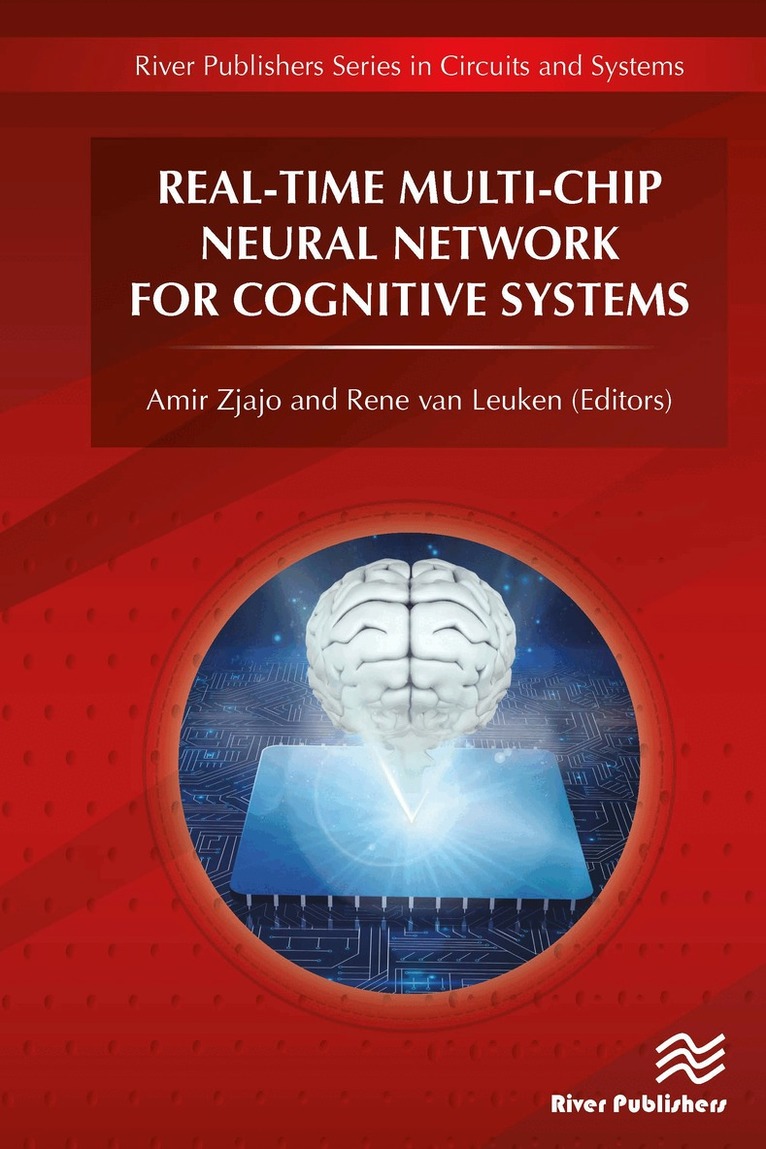
Simulation of brain neurons in real-time using biophysically-meaningful models is a pre-requisite for comprehensive understanding of how neurons process information and communicate with each other, in effect efficiently complementing in-vivo experiments. In spiking neural networks (SNNs), propagated information is not just encoded by the firing rate of each neuron in the network, as in artificial neural networks (ANNs), but, in addition, by amplitude, spike-train patterns, and the transfer rate. The high level of realism of SNNs and more significant computational and analytic capabilities in comparison with ANNs, however, limit the size of the realized networks. Consequently, the main challenge in building complex and biophysically-accurate SNNs is largely posed by the high computational and data transfer demands.Real-Time Multi-Chip Neural Network for Cognitive Systems presents novel real-time, reconfigurable, multi-chip SNN system architecture based on localized communication, which effectively reduces the communication cost to a linear growth. The system use double floating-point arithmetic for the most biologically accurate cell behavior simulation, and is flexible enough to offer an easy implementation of various neuron network topologies, cell communication schemes, as well as models and kinds of cells. The system offers a high run-time configurability, which reduces the need for resynthesizing the system. In addition, the simulator features configurable on- and off-chip communication latencies as well as neuron calculation latencies. All parts of the system are generated automatically based on the neuron interconnection scheme in use. The simulator allows exploration of different system configurations, e.g. the interconnection scheme between the neurons, the intracellular concentration of different chemical compounds (ions), which affect how action potentials are initiated and propagate.
Circuit Design: Anticipate, Analyze, Exploit Variations
Statistical Methods and Optimization
Inbunden, Engelska, 2017
1 053 kr
Skickas inom 10-15 vardagar
Circuit Design = Science + Art! Designers need a skilled “gut feeling” about circuits and related analytical techniques, plus creativity, to solve all problems and to adhere to the specifications, the written and the unwritten ones. You must anticipate a large number of influences, like temperature effects, supply voltages changes, offset voltages, layout parasitics, and numerous kinds of technology variations to end up with a circuit that works. This is challenging for analog, custom-digital, mixed-signal or RF circuits, and often researching new design methods in relevant journals, conference proceedings and design tools unfortunately gives the impression that just a “wild bunch” of “advanced techniques” exist. On the other hand, state-of-the-art tools nowadays indeed offer a good cockpit to steer the design flow, which include clever statistical methods and optimization techniques.Actually, this almost presents a second breakthrough, like the introduction of circuit simulators 40 years ago! Users can now conveniently analyze all the problems (discover, quantify, verify), and even exploit them, for example for optimization purposes.Most designers are caught up on everyday problems, so we fit that “wild bunch” into a systematic approach for variation-aware design, a designer’s field guide and more. That is where this book can help! Circuit Design: Anticipate, Analyze, Exploit Variations starts with best-practise manual methods and links them tightly to up-to-date automation algorithms. We provide many tractable examples and explain key techniques you have to know. We then enable you to select and setup suitable methods for each design task – knowing their prerequisites, advantages and, as too often overlooked, their limitations as well.The good thing with computers is that you yourself can often verify amazing things with little effort, and you can use software not only to your direct advantage in solving a specific problem, but also for becoming a better skilled, more experienced engineer. Unfortunately, EDA design environments are not good at all to learn about advanced numerics. So with this book we also provide two apps for learning about statistic and optimization directly with circuit-related examples, and in real-time so without the long simulation times. This helps to develop a healthy statistical gut feeling for circuit design. The book is written for engineers, students in engineering and CAD / methodology experts. Readers should have some background in standard design techniques like entering a design in a schematic capture and simulating it, and also know about major technology aspects.
1 189 kr
Skickas inom 10-15 vardagar
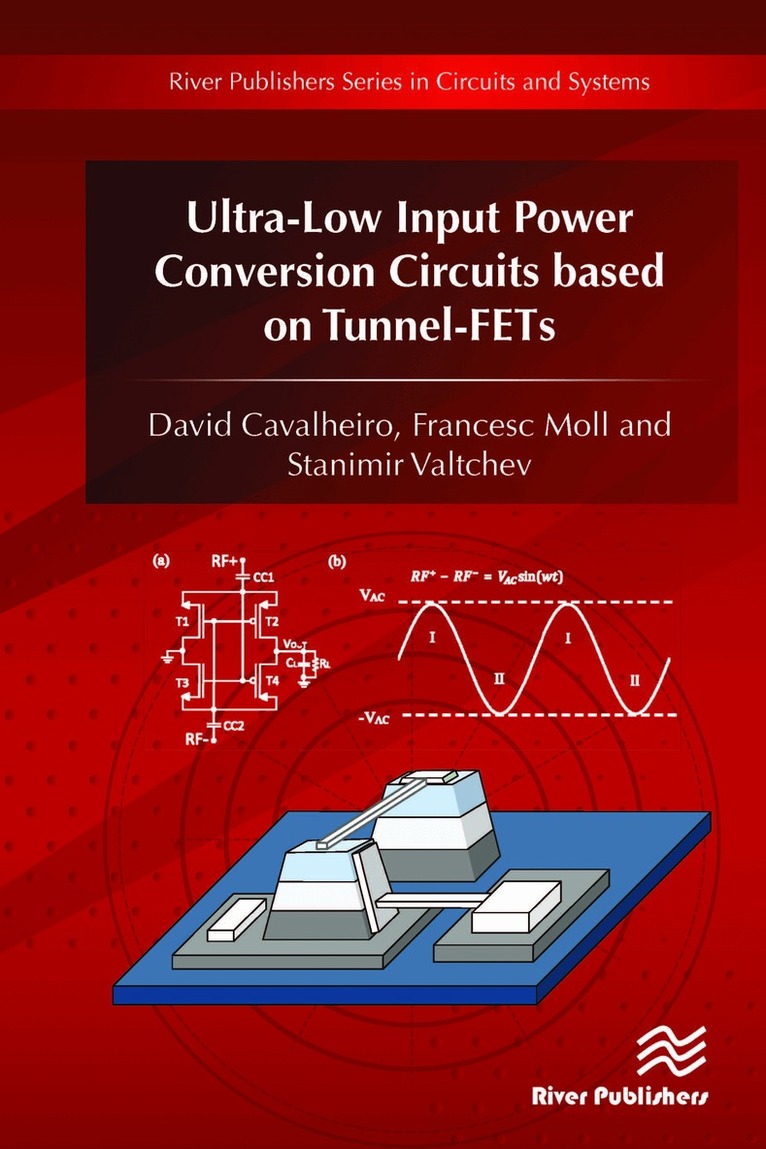
The increasing demand in electronic portability imposes low power consumption as a key metric to analog and digital circuit design. Tunnel FET (TFET) devices have been explored mostly in digital circuits, showing promising results for ultra-low power and energy efficient circuit applications. The TFET presents a low inverse sub-threshold slope (SS) that allows a low leakage energy consumption, desirable in many digital circuits, especially memories.In this book, the TFET is explored as an alternative technology also for ultra-low power and voltage conversion and management circuits, suitable for weak energy harvesting (EH) sources. The TFET distinct electrical characteristics under reverse bias conditions require changes in conventional circuit topologies. In this book, ultra-low input power conversion circuits based on TFETs are designed and analyzed, evaluating their performance as rectifiers, charge pumps and power management circuits (PMC) for RF and DC EH sources.