Routledge Library Editions: Women in Islamic Societies - Böcker
Visar alla böcker i serien Routledge Library Editions: Women in Islamic Societies. Handla med fri frakt och snabb leverans.
9 produkter
9 produkter
2 113 kr
Skickas inom 10-15 vardagar
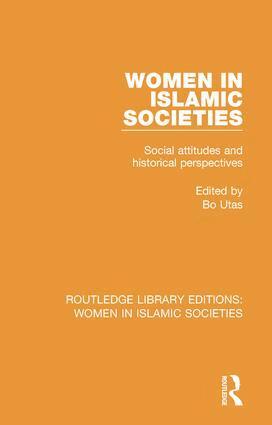
First published in 1983, this edited collection is based on contributions at a Scandinavian symposium on the place of women in Islamic society. It offers perspectives which illuminate our understanding of social relationships and structures pertaining to a vast number of the world’s population dispersed throughout Asia and Africa. Sociological and anthropological investigations of social organization and the behavioural patterns provided in these papers demonstrate that the status of women, their rights, duties and control over property, their body, the degree of seclusion and veiling, vary considerably. Overall, this collection of papers show that the relationship between Islam and the everyday lives of Muslim women is a complex picture, one that is confronted with a considerable range of interpretations of laws and traditions. This book will be of particular interest to those studying women and Islam, anthropology, religion and sociology.
618 kr
Skickas inom 10-15 vardagar
First published in 1983, this edited collection is based on contributions at a Scandinavian symposium on the place of women in Islamic society. It offers perspectives which illuminate our understanding of social relationships and structures pertaining to a vast number of the world’s population dispersed throughout Asia and Africa. Sociological and anthropological investigations of social organization and the behavioural patterns provided in these papers demonstrate that the status of women, their rights, duties and control over property, their body, the degree of seclusion and veiling, vary considerably. Overall, this collection of papers show that the relationship between Islam and the everyday lives of Muslim women is a complex picture, one that is confronted with a considerable range of interpretations of laws and traditions. This book will be of particular interest to those studying women and Islam, anthropology, religion and sociology.
5 301 kr
Tillfälligt slut
Women in Islamic societies are often seen as a hidden and homogenous group. The volumes in this set, originally published between 1960 and 1983, explore the wide variety of women’s roles in a range of Islamic societies, from Yemen, the United Arab Emirates and Kurdistan to Malaysia, West Africa, Iran and Turkey. Due to their anthropological focus, each book pays particular attention to the everyday lives of women in these regions, including their agency and power within their own communities. The titles also explore women’s changing roles in the modernising Muslim world of the 20th century.This set will be of interest to those studying women, gender, Islam and anthropology.
2 113 kr
Skickas inom 10-15 vardagar
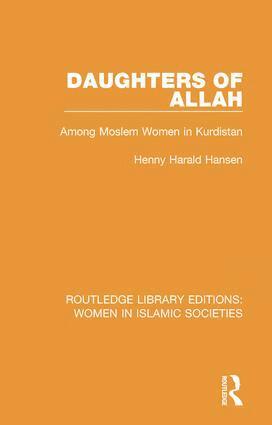
In 1957, Henny Harald Hansen, the first Danish female anthropologist, was invited to take part in an archaeological expedition to the site of the projected Dokan Dam on the Little Zab river in Northern Iraq. Although her responsibilities were originally ethnological, she became the guest first of the local sheik and later of her interpreter’s family and as a result, the doors of many Kurdish homes were opened to her that normally would have remained closed to foreigners. She travelled widely among the mountain villages of Iraqi Kurdistan and was able to see from very close range the everyday life of women. First published in 1958 and translated in 1960, this book contains the intimate and fascinating account of Henny Harald Hansen’s travels and her encounters with the women of Kurdistan. It will be of keen interest to those studying women in Islamic societies and anthropology.
550 kr
Skickas inom 10-15 vardagar
In 1957, Henny Harald Hansen, the first Danish female anthropologist, was invited to take part in an archaeological expedition to the site of the projected Dokan Dam on the Little Zab river in Northern Iraq. Although her responsibilities were originally ethnological, she became the guest first of the local sheik and later of her interpreter’s family and as a result, the doors of many Kurdish homes were opened to her that normally would have remained closed to foreigners. She travelled widely among the mountain villages of Iraqi Kurdistan and was able to see from very close range the everyday life of women. First published in 1958 and translated in 1960, this book contains the intimate and fascinating account of Henny Harald Hansen’s travels and her encounters with the women of Kurdistan. It will be of keen interest to those studying women in Islamic societies and anthropology.
1 705 kr
Skickas inom 10-15 vardagar
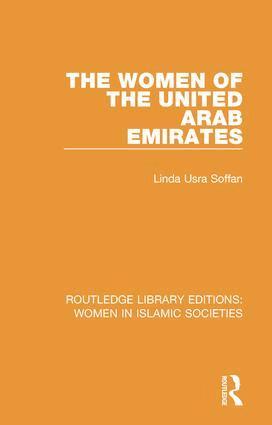
First published in 1980, this book looks at the factors which influenced the position held by women in the United Arab Emirates in the second half of the 20th century. It argues that Islamic Law has granted women rights and privileges in the spheres of family life, marriage, education and economic pursuits, which aim at improving their status in society. However, due to the interpretations of various religious scholars, influenced by local traditions and social trends, women have often not been given these rights, particularly in family life and marriage. In contrast, the book also explores how the wealth brought about by the discovery of oil has served to further strengthen the position of UAE women, principally in the fields of education, social affairs and economic activity. This book will be of interest to those studying women in Islamic society and modernisation in the Middle East.
550 kr
Skickas inom 10-15 vardagar
First published in 1980, this book looks at the factors which influenced the position held by women in the United Arab Emirates in the second half of the 20th century. It argues that Islamic Law has granted women rights and privileges in the spheres of family life, marriage, education and economic pursuits, which aim at improving their status in society. However, due to the interpretations of various religious scholars, influenced by local traditions and social trends, women have often not been given these rights, particularly in family life and marriage. In contrast, the book also explores how the wealth brought about by the discovery of oil has served to further strengthen the position of UAE women, principally in the fields of education, social affairs and economic activity. This book will be of interest to those studying women in Islamic society and modernisation in the Middle East.
1 705 kr
Skickas inom 10-15 vardagar
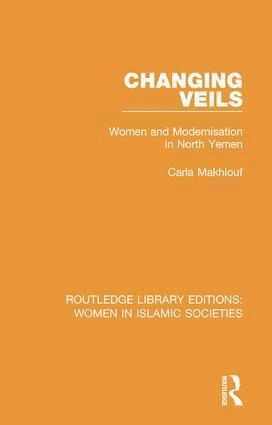
In Yemen, where current poverty is combined with a rich cultural heritage, the distinctions between the traditional and the modern are particularly difficult. First published in 1979, this is a study of social change as experienced and perceived by the women of San’a, the capital city of North Yemen. It presents a synthesised view of the process of change rather than focusing on the issues of exploitation and emancipation, and draws upon observations of women’s daily routine and ritual activities as well as the media and the provocative insights of Yemeni poets. The veil is the focus of the study because it can be seen as a symbol of the contradictions inherent in Yemeni society, not just about the female but also about all social relations. It can be interpreted as both an instrument of oppression and the incitement of liberation and is thus illustrative of deep cultural ambiguities.This book will be of interest to those studying women, gender, Islam, the Middle East and anthropology.
550 kr
Skickas inom 10-15 vardagar
In Yemen, where current poverty is combined with a rich cultural heritage, the distinctions between the traditional and the modern are particularly difficult. First published in 1979, this is a study of social change as experienced and perceived by the women of San’a, the capital city of North Yemen. It presents a synthesised view of the process of change rather than focusing on the issues of exploitation and emancipation, and draws upon observations of women’s daily routine and ritual activities as well as the media and the provocative insights of Yemeni poets. The veil is the focus of the study because it can be seen as a symbol of the contradictions inherent in Yemeni society, not just about the female but also about all social relations. It can be interpreted as both an instrument of oppression and the incitement of liberation and is thus illustrative of deep cultural ambiguities.This book will be of interest to those studying women, gender, Islam, the Middle East and anthropology.