Encyclopedia of Mass Spectrometry, Ten-Volume Set – serie
Visar alla böcker i serien Encyclopedia of Mass Spectrometry, Ten-Volume Set. Handla med fri frakt och snabb leverans.
7 produkter
The Encyclopedia of Mass Spectrometry
Volume 2: Biological Applications Part A
Av Richard Caprioli, Michael L. Gross
Inbunden, 2004
6199 kr
Lägg i varukorg
The focus of Volume 2 of the Encyclopedia of Mass Spectrometry is on peptides and proteins, separation techniques, preparation protocols, and the fundamental characteristics as ionic gas phase species that lie within the breadth of the field of mass spectrometry. This volume is divided into four …
The Encyclopedia of Mass Spectrometry
Volume 6: Ionization Methods
Av Michael L. Gross, Richard Caprioli
Inbunden, 2006
5629 kr
Lägg i varukorg
Volume 6: Ionization Methods captures the story of molecular ionization and its phenomenal evolution that makes mass spectrometry the powerful method it is today. Chapters 1 and 2 cover fundamentals and various issues that are common to all ionization (e.g., accurate mass, isotope clusters, and …
The Encyclopedia of Mass Spectrometry
Volume 1: Theory and Ion Chemistry
Inbunden, 2003
6932 kr
Lägg i varukorg
Theory and Ion Chemistry concentrates on the fundamental aspects of a set of 13 carefully chosen topics covering the whole field of mass spectrometry. It covers both primary (basic) considerations, as well as advanced topics, the former aimed at newcomers to the field, the latter at the experienced …
The Encyclopedia of Mass Spectrometry
Volume 3: Biological Applications Part B
Inbunden, 2005
6036 kr
Lägg i varukorg
Volume 3 looks at classes of biomolecules including carbohydrates, nucleic acids, and lipids. In addition, special areas of application are included, such as pharmaceuticals, natural products, isotope ratio methods for biomolecules analysis, and clinical applications. The articles are arranged …
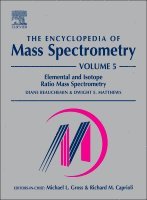
The Encyclopedia of Mass Spectrometry, Volume 5
Elemental and Isotope Ratio Mass Spectrometry
Inbunden, 2010
5221 kr
Lägg i varukorg
Volume 5: Elemental and Isotope Ratio Mass Spectrometry focuses on (1) the plethora of mostly atomic ionization techniques that have been coupled to MS for elemental analysis, the measurement of isotope ratios, and even the determination of inorganic compounds and (2) the precise measurement of …
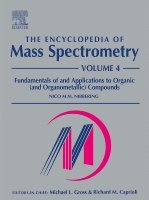
The Encyclopedia of Mass Spectrometry
Volume 4: Fundamentals of and Applications to Organic (and Organometallic) Compounds
Inbunden, 2004
6199 kr
Lägg i varukorg
Volume 4: Organic and Organometallic Compounds presents a cross section of applications in organic and organometallic chemistry in two parts. Chapters 1 to 6 are devoted to the fundamentals whereas chapters 7 and 8 cover applications to organic and organometallic compounds, either available as pure …
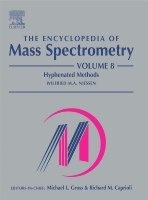
The Encyclopedia of Mass Spectrometry
Volume 8: Hyphenated Methods
Inbunden, 2006
5629 kr
Lägg i varukorg
Volume 8: Hyphenated Methods Starting with gas chromatography-mass spectrometry (GC-MS) and continuing through GCxGC-MS, LC-MSn, and LC-NMR-MS, hyphenated methods have revolutionized chemical analysis. This volume covers that revolution in two parts. The first (Chapters 1-4) describes principles, …