Yale Law Library Series in Legal History and Reference – serie
Visar alla böcker i serien Yale Law Library Series in Legal History and Reference. Handla med fri frakt och snabb leverans.
20 produkter
20 produkter
Inbunden, Engelska, 2009
1 395 kr
Skickas inom 3-6 vardagar
More than 700 concise biographies of leading figures in the history of American law, from the colonial era to the present dayThis book is the first to gather in a single volume concise biographies of the most eminent men and women in the history of American law. Encompassing a wide range of individuals who have devised, replenished, expounded, and explained law, The Yale Biographical Dictionary of American Law presents succinct and lively entries devoted to more than 700 subjects selected for their significant and lasting influence on American law.Casting a wide net, editor Roger K. Newman includes individuals from around the country, from colonial times to the present, encompassing the spectrum of ideologies from left-wing to right, and including a diversity of racial, ethnic, and religious groups. Entries are devoted to the living and dead, the famous and infamous, many who upheld the law and some who broke it. Supreme Court justices, private practice lawyers, presidents, professors, journalists, philosophers, novelists, prosecutors, and others—the individuals in the volume are as diverse as the nation itself.Entries written by close to 600 expert contributors outline basic biographical facts on their subjects, offer well-chosen anecdotes and incidents to reveal accomplishments, and include brief bibliographies. Readers will turn to this dictionary as an authoritative and useful resource, but they will also discover a volume that delights and entertains.Listed in The Yale Biographical Dictionary of American Law:John AshcroftRobert H. BorkBill ClintonRuth Bader GinsburgPatrick HenryJ. Edgar HooverJames MadisonThurgood MarshallSandra Day O’ConnorJanet RenoFranklin D. RooseveltJulius and Ethel RosenbergJohn T. ScopesO. J. SimpsonAlexis de TocquevilleScott TurowAnd more than 700 others
Inbunden, Engelska, 2012
962 kr
Skickas inom 5-8 vardagar
Making extensive use of archival and other primary sources, David Schorr demonstrates that the development of the “appropriation doctrine,” a system of private rights in water, was part of a radical attack on monopoly and corporate power in the arid West. Schorr describes how Colorado miners, irrigators, lawmakers, and judges forged a system of private property in water based on a desire to spread property and its benefits as widely as possible among independent citizens. He demonstrates that ownership was not dictated by concerns for economic efficiency, but by a regard for social justice.
Inbunden, Engelska, 2022
532 kr
Skickas inom 5-8 vardagar
How the medieval right to appoint a parson helped give birth to English common law Appointing a parson to the local church following a vacancy—an “advowson”—was one of the most important rights in medieval England. The king, the monasteries, and local landowners all wanted to control advowsons because they meant political, social, and economic influence. The question of law turned on who had the superior legal claim to the vacancy—which was a type of property—at the time the position needed to be filled. In tracing how these conflicts were resolved, Joshua C. Tate takes a sharply different view from that of historians who focus only on questions of land ownership, and he shows that the English needed new legal contours to address the questions of ownership and possession that arose from these disputes. Tate argues that the innovations made necessary by advowson law helped give birth to modern common law and common law courts.
Inbunden, Engelska, 2012
851 kr
Skickas inom 5-8 vardagar
Not just for lawyers, these illuminating histories of popular law-related expressions will delight anyone fascinated by words, by history, or by law and law enforcementLaw-related words and phrases abound in our everyday language, often without our being aware of their origins or their particular legal significance: boilerplate, jailbait, pound of flesh, rainmaker, the third degree. This insightful and entertaining book reveals the unknown stories behind familiar legal expressions that come from sources as diverse as Shakespeare, vaudeville, and Dr. Seuss. Separate entries for each expression follow no prescribed formula but instead focus on the most interesting, enlightening, and surprising aspects of the words and their evolution. Popular myths and misunderstandings are explored and exploded, and the entries are augmented with historical images and humorous sidebars.Lively and unexpected, Lawtalk will draw a diverse array of readers with its abundance of linguistic, legal, historical, and cultural information. Those readers should be forewarned: upon finishing one entry, there is an irresistible temptation to turn to another, and yet another . . .
Häftad, Engelska, 2012
820 kr
Skickas inom 5-8 vardagar
This groundbreaking book is the first to look at administration and administrative law in the earliest days of the American republic. Jerry Mashaw demonstrates that from the very beginning Congress delegated vast discretion to administrative officials and armed them with extrajudicial adjudicatory, rulemaking, and enforcement authority. The legislative and administrative practices of the U.S. Constitution’s first century created an administrative constitution hardly hinted at in its formal text. This book, in the author’s words, will "demonstrate that there has been no precipitous fall from a historical position of separation-of-powers grace to a position of compromise; there is not a new administrative constitution whose legitimacy should be understood as not only contestable but deeply problematic."
Häftad, Engelska, 2013
756 kr
Skickas inom 5-8 vardagar
In America today, a public official’s lawful income consists of a salary. But until a century ago, the law frequently provided for officials to make money on a profit-seeking basis. Prosecutors won a fee for each defendant convicted. Tax collectors received a percentage of each evasion uncovered. Naval officers took a reward for each ship sunk. Numerous other officers were likewise paid for “performance.” This book is the first to document the American government’s for-profit past, to discover how profit-seeking defined officialdom’s relationship to the citizenry, and to explain how lawmakers—by ultimately banishing the profit motive in favor of the salary—transformed that relationship forever.
Inbunden, Engelska, 2017
788 kr
Skickas inom 5-8 vardagar
A compelling account of how women shaped the common law right to privacy during the late nineteenth and early twentieth centuriesDrawing on a wealth of original research, Jessica Lake documents how the advent of photography and cinema drove women—whose images were being taken and circulated without their consent—to court. There they championed the creation of new laws and laid the groundwork for America’s commitment to privacy. Vivid and engagingly written, this powerful work will draw scholars and students from a range of fields, including law, women’s history, the history of photography, and cinema and media studies.
Häftad, Engelska, 2016
241 kr
Skickas inom 5-8 vardagar
To be convicted of a crime in the United States, a person must be proven guilty “beyond a reasonable doubt.” But what is reasonable doubt? Even sophisticated legal experts find this fundamental doctrine difficult to explain. In this accessible book, James Q. Whitman digs deep into the history of the law and discovers that we have lost sight of the original purpose of “reasonable doubt.” It was not originally a legal rule at all, he shows, but a theological one. The rule as we understand it today is intended to protect the accused. But Whitman traces its history back through centuries of Christian theology and common-law history to reveal that the original concern was to protect the souls of jurors. In Christian tradition, a person who experienced doubt yet convicted an innocent defendant was guilty of a mortal sin. Jurors fearful for their own souls were reassured that they were safe, as long as their doubts were not “reasonable.” Today, the old rule of reasonable doubt survives, but it has been turned to different purposes. The result is confusion for jurors, and a serious moral challenge for our system of justice.
Häftad, Engelska, 2017
705 kr
Skickas inom 5-8 vardagar
A highly engaging account of the developments—not only legal, but also socioeconomic, political, and cultural—that gave rise to Americans’ distinctively lawyer-driven legal cultureWhen Americans imagine their legal system, it is the adversarial trial—dominated by dueling larger-than-life lawyers undertaking grand public performances—that first comes to mind. But as award-winning author Amalia Kessler reveals in this engrossing history, it was only in the turbulent decades before the Civil War that adversarialism became a defining American practice and ideology, displacing alternative, more judge-driven approaches to procedure. By drawing on a broad range of methods and sources—and by recovering neglected influences (including from Europe)—the author shows how the emergence of the American adversarial legal culture was a product not only of developments internal to law, but also of wider socioeconomic, political, and cultural debates over whether and how to undertake market regulation and pursue racial equality. As a result, adversarialism came to play a key role in defining American legal institutions and practices, as well as national identity.
Inbunden, Engelska, 2019
532 kr
Skickas inom 5-8 vardagar
A Civil War-era treatise addressing the power of governments in moments of emergencyThe last work of Abraham Lincoln’s law of war expert Francis Lieber was long considered lost—until Will Smiley and John Fabian Witt discovered it in the National Archives. Lieber’s manuscript on emergency powers and martial law addresses important contemporary debates in law and political philosophy and stands as a significant historical discovery. As a key legal advisor to the Lincoln White House, Columbia College professor Francis Lieber was one of the architects and defenders of Lincoln’s most famous uses of emergency powers during the Civil War. Lieber’s work laid the foundation for rules now accepted worldwide. In the years after the war, Lieber and his son turned their attention to the question of emergency powers. The Liebers’ treatise addresses a vital question, as prominent since 9/11 as it was in Lieber’s lifetime: how much power should the government have in a crisis? The Liebers present a theory that aims to preserve legal restraint, while giving the executive necessary freedom of action. Smiley and Witt have written a lucid introduction that explains how this manuscript is a key discovery in two ways: both as a historical document and as an important contribution to the current debate over emergency powers in constitutional democracies.
Inbunden, Engelska, 2023
844 kr
Skickas inom 5-8 vardagar
The most authoritative account of a pivotal event in legal and cultural history: the trials of Oscar Wilde on charges of “gross indecency” Among the most infamous prosecutions of a literary figure in history, the two trials of Oscar Wilde for committing acts of “gross indecency” occurred at the height of his fame. After being found guilty, Wilde spent two years in prison, emerged bankrupt, and died in a cheap hotel room in Paris a few years after his release. The trials prompted a new intolerance toward homosexuality: habits of male bonding that were previously seen as innocent were now viewed as a threat, and an association grew in the public mind between gay men and the arts. Oscar Wilde on Trial assembles accounts from a variety of sources, including official and private letters, newspaper accounts, and previously published (but very incomplete) transcripts, to provide the most accurate and authoritative account to date of events that were pivotal in both legal and cultural history.
Inbunden, Engelska, 2024
437 kr
Skickas inom 5-8 vardagar
A synthesis of legal, political, and social history to show how the post-founding generations were forced to rethink and substantially revise the U.S. constitutional vision Between 1815 and 1861, American constitutional law and politics underwent a profound transformation. These decades of the Interbellum Constitution were a foundational period of both constitutional crisis and creativity. The Interbellum Constitution was a set of widely shared legal and political principles, combined with a thoroughgoing commitment to investing those principles with meaning through debate. Each of these shared principles—commerce, concurrent power, and jurisdictional multiplicity—concerned what we now call “federalism,” meaning that they pertain to the relationships among multiple levels of government with varying degrees of autonomy. Alison L. LaCroix argues, however, that there existed many more federalisms in the early nineteenth century than today’s constitutional debates admit. As LaCroix shows, this was a period of intense rethinking of the very basis of the U.S. national model—a problem debated everywhere, from newspapers and statehouses to local pubs and pulpits, ultimately leading both to civil war and to a new, more unified constitutional vision. This book is the first that synthesizes the legal, political, and social history of the early nineteenth century to show how deeply these constitutional questions dominated the discourse of the time.
Inbunden, Engelska, 2020
440 kr
Skickas
An examination of how two fundamental concepts of order influence our ideas about sovereignty, citizenship, law, and historyWestern accounts of natural and political order have deployed two basic ideas: project and system. In a project, order is produced by the intentional act of a subject; in a system, order is immanent in the world. In the former, order is made; in the latter, discovered. Paul W. Kahn shows how project and system have long been at work in our theological and philosophical tradition. Against this background, Kahn explains the development of the modern legal imagination in the nineteenth century as a movement from project to system. Americans began the century imagining the constitutional order as their common project: a deliberate construction of We the People. They ended the century imagining that order is continuous with the common law: an immanent development of the principles of civilization. This imaginative shift affected ideas of legal text, sovereignty, citizenship, interpretation, history, and science.
Inbunden, Engelska, 2023
708 kr
Skickas inom 5-8 vardagar
A compelling reexamination of how Britain used law to shape its empire For many years, Britain tried to impose its own laws on the peoples it conquered, and English common law usually followed the Union Jack. But the common law became less common after Britain emerged from the Seven Years’ War (1754–63) as the world’s most powerful empire. At that point, imperial policymakers adopted a strategy of legal pluralism: some colonies remained under English law, while others, including parts of India and former French territories in North America, retained much of their previous legal regimes. As legal historian Christian R. Burset argues, determining how much English law a colony received depended on what kind of colony Britain wanted to create. Policymakers thought English law could turn any territory into an anglicized, commercial colony; legal pluralism, in contrast, would ensure a colony’s economic and political subordination. Britain’s turn to legal pluralism thus reflected the victory of a new vision of empire—authoritarian, extractive, and tolerant—over more assimilationist and egalitarian alternatives. Among other implications, this helps explain American colonists’ reverence for the common law: it expressed and preserved their equal status in the empire. This book, the first empire-wide overview of law as an instrument of policy in the eighteenth-century British Empire, offers an imaginative rethinking of the relationship between tolerance and empire.
Häftad, Engelska, 2021
530 kr
Skickas inom 5-8 vardagar
An examination of how two fundamental concepts of order influence our ideas about sovereignty, citizenship, law, and historyWestern accounts of natural and political order have deployed two basic ideas: project and system. In a project, order is produced by the intentional act of a subject; in a system, order is immanent in the world. In the former, order is made; in the latter, discovered. Paul W. Kahn shows how project and system have long been at work in our theological and philosophical tradition. Against this background, Kahn explains the development of the modern legal imagination in the nineteenth century as a movement from project to system. Americans began the century imagining the constitutional order as their common project: a deliberate construction of We the People. They ended the century imagining that order is continuous with the common law: an immanent development of the principles of civilization. This imaginative shift affected ideas of legal text, sovereignty, citizenship, interpretation, history, and science.
Häftad, Engelska, 2024
291 kr
Skickas inom 5-8 vardagar
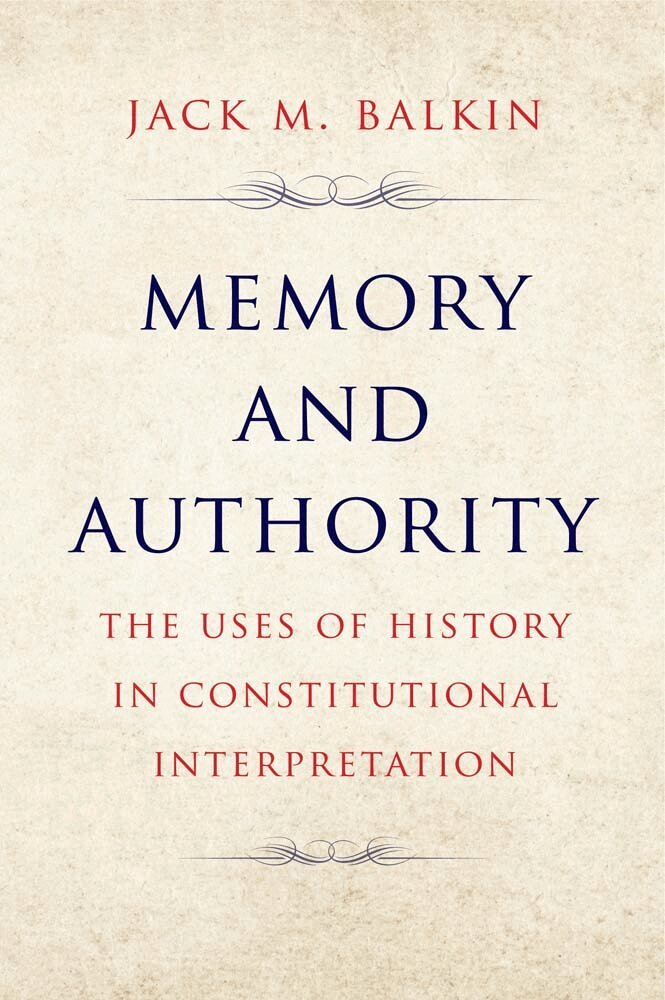
From one of the nation’s preeminent constitutional scholars, a sweeping rethinking of the uses of history in constitutional interpretation Fights over history are at the heart of most important constitutional disputes in America. The Supreme Court’s current embrace of originalism is only the most recent example of how lawyers and judges try to use history to establish authority for their positions. Jack M. Balkin argues that fights over constitutional interpretation are often fights over collective memory. Lawyers and judges construct—and erase—memory to lend authority to their present-day views; they make the past speak their values so they can then claim to follow it. The seemingly opposed camps of originalism and living constitutionalism are actually mirror images of a single phenomenon: how lawyers use history to adapt an ancient constitution to a constantly changing world. Balkin shows how lawyers and judges channel history through standard forms of legal argument that shape how they use history and even what they see in history. He explains how lawyers and judges invoke history selectively to construct authority for their claims and undermine the authority of opposing views. And he elucidates the perpetual quarrel between historians and lawyers, showing how the two can best join issue in legal disputes. This book is a sweeping rethinking of the uses of history in constitutional interpretation.
Inbunden, Engelska, 2024
1 436 kr
Skickas inom 5-8 vardagar
From one of the nation’s preeminent constitutional scholars, a sweeping rethinking of the uses of history in constitutional interpretation Fights over history are at the heart of most important constitutional disputes in America. The Supreme Court’s current embrace of originalism is only the most recent example of how lawyers and judges try to use history to establish authority for their positions. Jack M. Balkin argues that fights over constitutional interpretation are often fights over collective memory. Lawyers and judges construct—and erase—memory to lend authority to their present-day views; they make the past speak their values so they can then claim to follow it. The seemingly opposed camps of originalism and living constitutionalism are actually mirror images of a single phenomenon: how lawyers use history to adapt an ancient constitution to a constantly changing world. Balkin shows how lawyers and judges channel history through standard forms of legal argument that shape how they use history and even what they see in history. He explains how lawyers and judges invoke history selectively to construct authority for their claims and undermine the authority of opposing views. And he elucidates the perpetual quarrel between historians and lawyers, showing how the two can best join issue in legal disputes. This book is a sweeping rethinking of the uses of history in constitutional interpretation.
Inbunden, Engelska, 2025
390 kr
Skickas inom 5-8 vardagar
How the privileged legal status of marriage survived decades of constitutional struggle and social change The United States is unusual among wealthy western nations in the degree to which the law channels public benefits and private economic resources through marriage. This remains so despite seismic changes in American family life in the last several decades of the twentieth century. During this period, marriage rates declined while divorce and nonmarital childbearing soared. Social movements—for racial and economic justice, women’s and gay rights and liberation, civil liberties, and reproductive freedom—transformed the legal landscape. In Marital Privilege, Serena Mayeri tells the stories of parents and partners, activists and lawyers who challenged the legal primacy of marriage. They made innovative constitutional claims in courts and launched grassroots efforts to change laws and practices that penalized nonmarital relationships. But even though reforms eliminated the most visible discrimination against women, people of color, and children born to unmarried parents—and, eventually, against gay and lesbian Americans—marriage’s privileged status endured. Because marriage increasingly correlated with education and wealth, marital primacy intensified racial and economic inequality. Marital Privilege explains how, as American law selectively incorporated principles of liberty and equality, the benefits of marriage became increasingly unavailable to those who needed them most.
Häftad, Engelska, 2025
200 kr
Skickas inom 5-8 vardagar
A detailed and compelling examination of how the legal theory of originalism ignores and distorts the very constitutional history from which it derives interpretive authority “What are the chances that, in 2024, a new book could fundamentally reorient how we understand America’s founding? Jonathan Gienapp . . . has written such a book. . . . You read it, and you get vertigo. . . . Gienapp’s book comes as a thunderclap.”—Cass Sunstein, Washington Post Winner of the Order of the Coif Book Award, 2025 • Longlisted for the Cundill History Prize, 2025 • History Today Book of the Year, 2024 Constitutional originalism stakes law to history. The theory’s core tenet—that the U.S. Constitution should be interpreted according to its original meaning—has us decide questions of modern constitutional law by consulting the distant constitutional past. Yet originalist engagement with history is often deeply problematic. And now that a majority of justices on the U.S. Supreme Court champion originalism, the task of scrutinizing originalists’ use and abuse of history has never been more urgent. In this comprehensive and novel critique of originalism, Jonathan Gienapp targets originalists’ unspoken assumptions about the Constitution and its history. Originalists are committed to recovering the Constitution laid down at the American Founding, yet they often assume that the Constitution is fundamentally modern. Rather than recovering the original Constitution, they project their own understandings onto it, assuming that eighteenth-century constitutional thinking was no different than their own. They take for granted what it meant to write a constitution down, what law was, how it worked, and where it came from, and how a constitution’s meaning was fixed. In the process, they erase the Constitution that eighteenth-century Americans in fact created. By understanding how originalism fails, we can better understand the Constitution that we have.
Inbunden, Engelska, 2024
358 kr
Tillfälligt slut
A detailed and compelling examination of how the legal theory of originalism ignores and distorts the very constitutional history from which it derives interpretive authority “What are the chances that, in 2024, a new book could fundamentally reorient how we understand America’s founding? Jonathan Gienapp . . . has written such a book. . . . You read it, and you get vertigo. . . . Gienapp’s book comes as a thunderclap.”—Cass Sunstein, Washington Post Longlisted for the Cundill History Prize, 2025 • History Today Book of the Year, 2024 Constitutional originalism stakes law to history. The theory’s core tenet—that the U.S. Constitution should be interpreted according to its original meaning—has us decide questions of modern constitutional law by consulting the distant constitutional past. Yet originalist engagement with history is often deeply problematic. And now that a majority of justices on the U.S. Supreme Court champion originalism, the task of scrutinizing originalists’ use and abuse of history has never been more urgent. In this comprehensive and novel critique of originalism, Jonathan Gienapp targets originalists’ unspoken assumptions about the Constitution and its history. Originalists are committed to recovering the Constitution laid down at the American Founding, yet they often assume that the Constitution is fundamentally modern. Rather than recovering the original Constitution, they project their own understandings onto it, assuming that eighteenth-century constitutional thinking was no different than their own. They take for granted what it meant to write a constitution down, what law was, how it worked, and where it came from, and how a constitution’s meaning was fixed. In the process, they erase the Constitution that eighteenth-century Americans in fact created. By understanding how originalism fails, we can better understand the Constitution that we have.