• Fri frakt över 249 kr
  • •
  • Snabba leveranser
  • •
  • Billiga böcker
Kundservice

Du är på sajten för privatpersoner.

Företag, bibliotek eller offentlig verksamhet?

Du handlar på classic.bokus.com, där alla dina funktioner finns intakta.
Till classic.bokus.com
Bokus logotyp. Gå till startsidan.
  • Erbjudanden
  • Nyheter
  • Student
  • Topplistor
  • Barn & ungdom
  • Bokus Play
  • E-böcker
  • Pocketböcker
  • Spel & pussel

10% rabatt på allt med kod: NYSTART10 →

Sidfot

Mina sidor

    Hjälp

    • Kundservice
    • Vanliga frågor och svar
    • Frakt och leverans
    • Retur vid ångerrätt
    • Reklamera vara
    • Betalning
    • Köpvillkor
    • Allmänna villkor
    • Information om webbplatsens tillgänglighet

    Om Bokus

    • Om oss
    • Pressrum
    • För studenter
    • För företag
    • För bibliotek och offentlig verksamhet
    • För leverantörer
    • Hållbarhet

    Populärt

    • Aktuella erbjudanden
    • Presentkort
    • Studentlitteratur
    • Nya böcker
    • Topplistor
    • Signerade böcker
    • Engelska böcker

    Inspiration

    • Boktips
    • BookTok
    • Populära bokserier
    • Barnbokskaraktärer
    • Populära författare
    Logotyp för Bokus
    Följ oss på Facebook (extern länk)Följ oss på Instagram (extern länk)Följ oss på YouTube (extern länk)Följ oss på TikTok (extern länk)
    bokus @ CookiesAnpassa cookiesIntegritetspolicyKöpvillkor
    Till Citymail hemsida (extern länk)Till Budbee hemsida (extern länk)Till Postnord hemsida (extern länk)Till Schenker hemsida (extern länk)Till Early Bird hemsida (extern länk)Till Walleys hemsida (extern länk)
    1. Naturvetenskap och teknik
    2. Matematik och naturvetenskap
    3. Kemi
    4. Fysikalisk kemi

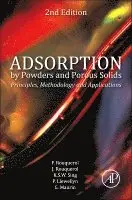
    Adsorption by Powders and Porous Solids

    Principles, Methodology and Applications

    AvJean Rouquerol,Fran�oise Rouquerol

    Inbunden, Engelska, 2013

    1 141 kr

    Beställningsvara. Skickas inom 10-15 vardagar. Fri frakt över 249 kr.

    Fler format och utgåvor

    Häftad

    Kommande

    Beskrivning

    The declared objective of this book is to provide an introductory review of the various theoretical and practical aspects of adsorption by powders and porous solids with particular reference to materials of technological importance. The primary aim is to meet the needs of students and non-specialists who are new to surface science or who wish to use the advanced techniques now available for the determination of surface area, pore size and surface characterization. In addition, a critical account is given of recent work on the adsorptive properties of activated carbons, oxides, clays and zeolites.

    • Provides a comprehensive treatment of adsorption at both the gas/solid interface and the liquid/solid interface
    • Includes chapters dealing with experimental methodology and the interpretation of adsorption data obtained with porous oxides, carbons and zeolites
    • Techniques capture the importance of heterogeneous catalysis, chemical engineering and the production of pigments, cements, agrochemicals, and pharmaceuticals

    Produktinformation

    • Utgivningsdatum:2013-10-01
    • Mått:152 x 229 x 32 mm
    • Vikt:1 120 g
    • Format:Inbunden
    • Språk:Engelska
    • Antal sidor:646
    • Upplaga:2
    • Förlag:Elsevier Science
    • ISBN:9780080970356

    Utforska kategorier

    • Fysikalisk kemi inom Naturvetenskap och teknik

    Mer om författaren

    Jean Rouquerol is the former Director of the CNRS Thermodynamics and Microcalorimetry Center in Marseilles, France and is now Emeritus Director of Research at the MADIREL Laboratory, Aix-Marseille University, France. He is a leading authority on adsorption thermodynamics, thermal analysis methodology and adsorption calorimetry. Françoise Rouquerol leads a Research team at the Centre de Thermodynamique et de Microcalorimetrie and the Centre National de la Recherche Scientifique in Marseille, France. She is also a Senior Professor at the University of Provence, France. Philip Llewellyn was Team Leader at MADIREL Laboratory, France until 2020; he is now CCUS R&D Program Manager for TotalEnergie in Pau, France. He is a renowned scientist in gas adsorption and its applications. Guillaume Maurin is a Professor and Team Leader at the Institut Charles Gerhart of Montpellier, University of Montpellier, France. He is an internationally recognized in the field of molecular simulations applied to the adsorption in porous solids. Kenneth Sing (1925-2016) was an Emeritus Professor at Brunel University and Visiting Professor at Bristol University, both in the UK. He was an influential figure in colloid and surface science and was co-author of the well-known book Adsorption, Surface Area and Porosity.

    Recensioner i media

    "An introductory chapter summarizes relevance, history, and terminology of adsorption, including chemisorption vs. physisorption, and discusses energetics, molecular modeling, and diffusion. The following chapters treat thermodynamics at a gas/solid and solid/liquid interfaces, measurement and monitoring technique, isotherm theory and interpretation, mathematical modeling of adsorption processes, and use of adsorption to measure surface area and porosity of materials." --ProtoView.com, January 2014Review of first edition:"A long-awaited but worthy successor to the book considered by many to be the bible of porous materials characterization: ‘Gregg & Sing’ (2nd Edition, 1982). This collaboration between the Rouquerols and Ken Sing has created a detailed handbook covering not only important theoretical aspects, but copious experimental and application information too. Adsorption calorimetry gets more attention than before (not surprising given the Rouquerols' affiliation), as do ‘new’ materials such as MCM's and ‘new’ calculation models like DFT (Density Functional Theory) and Monte Carlo simulation. Importantly, there is a great deal of coverage given to adsorptives other than nitrogen (the most common but not necessarily the most appropriate in all cases). Hundreds of references are given for follow-up reading in areas of special interest. Anyone seeking a reliable, broad, yet highly informative coverage of adsorption methodology for porous materials characterization should invest in this title." --Worthy Successor by "thomasetc" (USA), June 2000, Amazon.com

    Innehållsförteckning

    • PrefaceList of main symbols 1. Introduction         1.1. Importance of adsorption1.2. Historical aspects1.3. IUPAC definitions and terminology1.4. Physisorption and chemisorption1.5. Physisorption isotherms1.6. Energetics of physisorption and molecular modelling 1.7. Diffusion of adsorbed molecules2. Thermodynamics of adsorption at the gas-solid interface    2.1. Introduction2.2. Quantitative expression of adsorption 2.3. Thermodynamic potentials of adsorption2.4. Thermodynamic quantities related to the adsorbed states in the Gibbs representation2.5. Thermodynamic quantities related to the adsorption process2.6. Indirect derivation of the adsorption quantities of adsorption from of a series of Experimental physisorption isotherms : the isosteric method2.7. Derivation of the adsorption quantities from calorimetric data 2.8. Other methods for the determination of differential enthalpies of gas adsorption2.9. State equations for high pressure: single gas and mixtures3. Methodology of gas adsorption       3.1. Introduction3.2. Determination of the surface excess amount (and amount adsorbed)3.3. Gas adsorption calorimetry3.4. Adsorbent outgassing3.5. Presentation of experimental data4. Adsorption at the liquid-solid interface     4.1. Introduction4.2. Energetics of immersion in pure liquid4.3. Adsorption from liquid solution 5. The interpretation of physisorption isotherms at the gas-solid interface: the classical approach 5.1. Introduction5.2. Adsorption of a pure gas5.3. Adsorption of a gas mixture 6. Molecular simulation and modelling of physisorption in porous solids    6.1. Introduction6.2. Microscopic description of the porous solids6.3. Intermolecular potential function6.4. Characterization computational tools6.5. Modeling of adsorption in porous solids6.6. Modeling of diffusion in porous solids. 6.7. Conclusions and future challenges7. Assessment of surface area     7.1. Introduction7.2. The BET method 7.3. Empirical methods of isotherm analysis7.4. The fractal approach7.5. Conclusions and recommendations8. Assessment of mesoporosity 8.1. Introduction     8.2. Mesopore volume, porosity and mean pore size8.3. Capillary condensation and the Kelvin equation8.4. ‘Classical’ computation of the mesopore size distribution8.5. DFT computation of the mesopore size distribution 8.6. Hysteresis loops8.7. Conclusions and recommendations9. Assessment of microporosity                  9.1. Introduction9.2. Gas physisorption isotherm analysis9.3. Microcalorimetric methods9.4. Conclusions and recommendations10. Adsorption by active carbons  10.1. Introduction10.2. Active carbons: preparation, properties and applications10.3. Physisorption of gases by non-porous carbons10.4. Physisorption of gases by porous carbons10.5. Adsorption at the carbon-liquid interface10.6. Low pressure hysteresis and adsorbent deformation10.7. Characterization of active carbons: conclusions and recommendations 11. Adsorption by metal oxides    11.1. Introduction11.2. Silica11.3. Alumina11.4. Titanium dioxide11.5. Magnesium oxide11.6. Other oxides: chromium, iron, zinc, zirconium, beryllium and uranium11.7. Applications of adsorbent properties of metal oxides 12. Adsorption by clays, pillared clays, zeolites and aluminophosphates 12.1. Introduction12.2. Structure, morphology and adsorbent properties of layer silicates12.3. Pillared clays – structures and properties12.4. Zeolites – synthesis, pore structures and molecular sieve properties12.5. Aluminophosphate molecular sieves – structures and properties12.6. Applications of clays, zeolites and phosphate-based molecular sieves13. Adsorption by ordered mesoporous materials 13.1. Introduction13.2. Ordered mesoporous silicas 13.3. Effect of surface functionalization on adsorption properties13.4. Ordered organosilica materials13.5. Replica materials14. Adsorption by metal-organic frameworks  14.1. Introduction14.2. Assessment and meaning of the BET area of MOFs14.3. Effect of changing the nature of the ligands14.4. Effect of changing the metal centre14.5. Changing the nature of other surface sites14.6. Influence of extra-framework species14.7. Special case of the flexibility of MOFs14.8. Towards application performances