• Fri frakt över 249 kr
  • •
  • Snabba leveranser
  • •
  • Billiga böcker
Kundservice

Du är på sajten för privatpersoner.

Företag, bibliotek eller offentlig verksamhet?

Du handlar på classic.bokus.com, där alla dina funktioner finns intakta.
Till classic.bokus.com
Bokus logotyp. Gå till startsidan.
  • Erbjudanden
  • Nyheter
  • Student
  • Topplistor
  • Barn & ungdom
  • Bokus Play
  • E-böcker
  • Pocketböcker
  • Spel & pussel

10% rabatt på allt med kod: NYSTART10 →

Sidfot

Mina sidor

    Hjälp

    • Kundservice
    • Vanliga frågor och svar
    • Frakt och leverans
    • Retur vid ångerrätt
    • Reklamera vara
    • Betalning
    • Köpvillkor
    • Allmänna villkor
    • Information om webbplatsens tillgänglighet

    Om Bokus

    • Om oss
    • Pressrum
    • För studenter
    • För företag
    • För bibliotek och offentlig verksamhet
    • För leverantörer
    • Hållbarhet

    Populärt

    • Aktuella erbjudanden
    • Presentkort
    • Studentlitteratur
    • Nya böcker
    • Topplistor
    • Signerade böcker
    • Engelska böcker

    Inspiration

    • Boktips
    • BookTok
    • Populära bokserier
    • Barnbokskaraktärer
    • Populära författare
    Logotyp för Bokus
    Följ oss på Facebook (extern länk)Följ oss på Instagram (extern länk)Följ oss på YouTube (extern länk)Följ oss på TikTok (extern länk)
    bokus @ CookiesAnpassa cookiesIntegritetspolicyKöpvillkor
    Till Citymail hemsida (extern länk)Till Budbee hemsida (extern länk)Till Postnord hemsida (extern länk)Till Schenker hemsida (extern länk)Till Early Bird hemsida (extern länk)Till Walleys hemsida (extern länk)
    1. Naturvetenskap och teknik
    2. Geovetenskap
    3. Geovetenskap
    4. Geologi

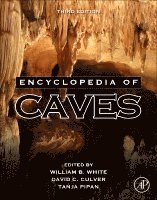
    Encyclopedia of Caves

    AvWilliam B. White,David C. Culver

    Häftad, Engelska, 2019

    1 709 kr

    Beställningsvara. Skickas inom 5-8 vardagar. Fri frakt över 249 kr.

    Beskrivning

    Encyclopedia of Caves, Third Edition, provides detailed background information to anyone with a serious interest in caves. This includes students, both undergraduate and graduate, in the earth, biological and environmental sciences, and consultants, environmental scientists, land managers and government agency staff whose work requires them to know something about caves and the biota that inhabit them. Caves touch on many scientific interests in geology, climate science, biology, hydrology, archaeology, and paleontology, as well as more popular interests in sport caving and cave exploration. Case studies and descriptions of specific caves selected for their special features and public interest are also included.

    This book will appeal to these audiences by providing in-depth essays written by expert authors chosen for their expertise in their assigned subject.


    • Features 14 new chapters and 13 completely rewritten chapters
    • Contains beautifully illustrated content, with more than 500 color images of cave life and features
    • Provides extensive bibliographies that allow readers to access their subject of interest in greater depth

    Produktinformation

    • Utgivningsdatum:2019-06-18
    • Mått:216 x 276 x 53 mm
    • Vikt:2 310 g
    • Format:Häftad
    • Språk:Engelska
    • Antal sidor:1 250
    • Upplaga:3
    • Förlag:Elsevier Science
    • ISBN:9780128141243

    Utforska kategorier

    • Geologi inom Naturvetenskap och teknik
    • Referensverk och tvärvetenskap inom Samhälle och politik

    Mer om författaren

    William B. White is Professor Emeritus of Geochemistry at The Pennsylvania State University. He holds a BS degree in chemistry from Juniata College (Huntingdon, PA) and a PhD in geochemistry from Penn State. His 40-year teaching career included a course in the geology of caves and karst. His research has produced 446 technical papers of which 131 deal with aspects of caves and karst. He is author or co-editor of 7 cave-related books including the first two editions of the Encyclopedia of Caves. He is a fellow of the American Association for the Advancement of Science, the National Speleological Society, and the Mineralogical Society of America. David C. Culver received his BA from Grinnell College and his PhD from Yale University. He is Professor Emeritus of Environmental Science at American University. He has studied the ecology, evolution, biogeography, and biodiversity of the subterranean fauna for five decades and has published more than 120 papers in refereed journals, and authored or co-authored four books, two with Tanja Pipan. His studies of the subterranean fauna have taken him to more than 20 countries. He was co-editor with William B. White of the first two editions of the Encyclopedia of Caves. Tanja Pipan received her PhD in biology from the University of Ljubljana. She is currently Research Advisor at the Karst Research Institute, Research Centre of the Slovenian Academy of Sciences and Arts (ZRC SAZU) and Professor of Biology at the University of Nova Gorica. She has broad research interests in subterranean biology, especially biodiversity, biogeography, ecology of shallow subterranean habitats, and ecosystem function. She has extensive experience with a variety of Slovenian subterranean habitats and has done the most extensive ecological study to date of the very rich fauna found in the epikarst. Since 2011 she is an associate editor of the Journal of Speleology for the field of biospeleology. She has travelled extensively in her study of the epikarst and other subsurface habitats.

    Recensioner i media

    "All in all though, this encyclopedia – now updated to its 3rd Edition – covers a tremendous breadth of cave and cave-related material. It must represent the fruits of stupendous efforts, and doubtlessly it has resulted in a major contribution to cave literature."--Cave and Karst Science

    Innehållsförteckning

    • A: Adaptation to low food; Adaptations: Low oxygen; Adaptation to darkness; Adaptations: Behavioral;Adaptation: Morphological; Adaptation and natural selection in caves; Adaptive shifts; Anchihaline (Anchialine) caves and fauna; Ancient cavers in Eastern North America; Art in European caves; Asellus aquaticus: A model system for historical biogeography; Astyanax mexicanus: A vertebrate model for evolution, adaptation, and development in cavesB: Bats; Beetles; Biodiversity patterns in Australia; Biodiversity: China; Biodiversity in Europe; Biodiversity in the United States and Canada; Biodiversity in South America; Breakdown; Burnsville Cove, VirginiaC: Camps; Castleguard Cave, Canada; Cave dwellers in Southwest Asia; Cave ecosystems; Cavefishes; Cavefish of China; Definition of cave; Caver communities and organizations: Cultural and historical considerations; Chemolithoautotrophy; Clastic sediments in caves; Closed depressions in karst areas; Coastal caves; Collembola; Contamination of cave waters by heavy metals; Contamination of cave waters by nonaqueous-phase liquids; Crustacea; Dating cave sediments with cosmogenic nuclidesD: Dating cave sediments with cosmogenic nuclides; Dinaric karst—Geography and geology; Biodiversity in the tropics; Documentation and databasesE: Ecological and evolutionary classifications of subterranean organisms; Entrances;Environmental DNA as a conservation tool; Epikarst; Epikarst communities; Exploration of caves—General; Exploration of caves: Underwater exploration; Exploration of caves—Vertical caving techniquesF: Folklore, myth, and legend, caves in; Food sources; The Frasassi Caves, Italy; Friars Hole SystemG: Gammarus minus: A model system for the study of adaptation to the cave environment; Geophysics for locating karst and caves; Glacier caves; Guano communities; Gypsum caves; Gypsum flowers and related speleothemsH: Hang Son Doong and other caves of the Phong Nha-Kẻ Ba`ng karst, Quảng Bı`nh Province, Vietnam; Helictites and related speleothems; History: Caves and other underground spaces in medieval Britain and Ireland; Huautla cave system (Sistema Huautla), Mexico; Hydrogeology of Karst aquifers; Hydrothermal cavesI: Ice in caves; Iron formation caves: Genesis and ecology; Isotopes in karst waters and cave sedimentsJ: Jewel cave, South DakotaK: Karren, cave; Karren, surface; Karst; Kazumura Cave, Hawaii; Krubera (Voronja) caveL: Lampenflora; Lechuguilla Cave, New Mexico; Life historiesM: Magnetism of cave sediments; Mammals and birds—vertebrate visitors; Mammoth Cave System, Kentucky; Mapping subterranean biodiversity; Maya caves; Microbes; Minerals in caves; Modeling of karst aquifers; Modeling the evolution of karstaquifers; Molluscs; Mulu caves, Malaysia; MyriapodsN: Niphargus—A model system for evolution and ecology; Nitrate contamination in karst groundwater; Nullarbor Caves, AustraliaO: The Omega Cave System; OrthopteraP: Paleoclimate records from speleothems; Paleontology of caves; Passage growth and development; Postojna—Planina Cave System, Slovenia; Protecting cave life; Protecting caves; PseudokarstQ: Quartzite and quartz sandstone caves of South AmericaR: Recreational cavingS: Salamanders; Saltpeter mining; Scallops; Shallow subterranean habitats; Show caves; Siebenhengste cave system, Switzerland; Sinkholes; Solution caves in regions of high-relief; Solution caves in regions of moderate relief; Species interactions; Speleogenesis—Hypogenе; Speleogenesis: Telogenetic; Speleothem deposition; Speleothems; Spiders and related groups; Springs; Stalactites and stalagmites; Submarine springs in coastal karst; Sulfuric acid caves; Surveying cavesT: Tiankeng, Definition of; Time markers in landscape evolution,caves asU: Ukraine giant gypsum caves; Underwater Caves of the Yucatan Peninsula; Uranium series dating of speleothemsV: Vicariance and dispersal in caves; Vjetrenica Cave, Bosnia and Herzegovina; Volcanic rock cavesW: Wakulla spring underwater cave system, Florida; Water chemistry in caves; Water tracing in karst aquifers; Wetlands in cave and karst regions; White-nose syndrome: A fungal disease of North American hibernating bats; WormsX: Xe Bang Fai Cave, Laos