• Fri frakt över 249 kr
  • •
  • Snabba leveranser
  • •
  • Billiga böcker
Kundservice

Du är på sajten för privatpersoner.

Företag, bibliotek eller offentlig verksamhet?

Du handlar på classic.bokus.com, där alla dina funktioner finns intakta.
Till classic.bokus.com
Bokus logotyp. Gå till startsidan.
  • Erbjudanden
  • Nyheter
  • Student
  • Topplistor
  • Barn & ungdom
  • Bokus Play
  • E-böcker
  • Pocketböcker
  • Spel & pussel

10% rabatt på allt med kod NYSTART10 →

Sidfot

Mina sidor

    Hjälp

    • Kundservice
    • Vanliga frågor och svar
    • Frakt och leverans
    • Retur vid ångerrätt
    • Reklamera vara
    • Betalning
    • Köpvillkor
    • Allmänna villkor
    • Information om webbplatsens tillgänglighet

    Om Bokus

    • Om oss
    • Pressrum
    • För studenter
    • För företag
    • För bibliotek och offentlig verksamhet
    • För leverantörer
    • Hållbarhet

    Populärt

    • Aktuella erbjudanden
    • Presentkort
    • Studentlitteratur
    • Nya böcker
    • Topplistor
    • Signerade böcker
    • Engelska böcker

    Inspiration

    • Boktips
    • BookTok
    • Populära bokserier
    • Barnbokskaraktärer
    • Populära författare
    Logotyp för Bokus
    Följ oss på Facebook (extern länk)Följ oss på Instagram (extern länk)Följ oss på YouTube (extern länk)Följ oss på TikTok (extern länk)
    bokus @ CookiesAnpassa cookiesIntegritetspolicyKöpvillkor
    Till Citymail hemsida (extern länk)Till Budbee hemsida (extern länk)Till Postnord hemsida (extern länk)Till Schenker hemsida (extern länk)Till Early Bird hemsida (extern länk)Till Walleys hemsida (extern länk)
    1. Data och IT
    2. Systemvetenskap och AI

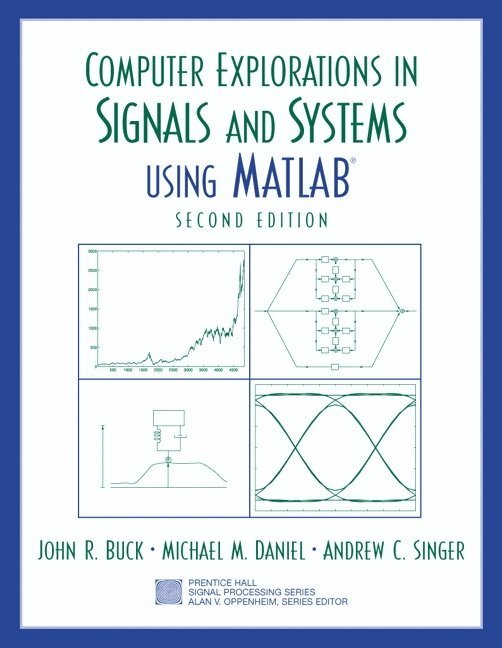
    Computer Explorations in Signals and Systems Using MATLAB

    AvJohn Buck,Michael Daniel

    Häftad, Engelska, 2001

    1 097 kr

    Beställningsvara. Skickas inom 7-10 vardagar. Fri frakt över 249 kr.

    Beskrivning

    For undergraduate courses on Signals and Linear Systems. This book contains a comprehensive set of computer exercises of varying levels of difficulty covering the fundamentals of signals and systems. The exercises require the reader to compare answers they compute in MATLAB(R) with results and predictions made based on their understanding of the material. The book is compatible with any introductory course or text on signals and systems.

    Produktinformation

    • Utgivningsdatum:2001-07-31
    • Mått:216 x 277 x 13 mm
    • Vikt:480 g
    • Format:Häftad
    • Språk:Engelska
    • Antal sidor:224
    • Upplaga:2
    • Förlag:Pearson Education
    • ISBN:9780130421555

    Utforska kategorier

    • Systemvetenskap och AI inom Data och IT

    Innehållsförteckning

    • 1. Signals and Systems. Tutorial: Basic MATLAB Functions for Representing Signals. Discrete-Time Sinusoidal Signals. Transformations of the Time Index for Discrete-Time Signals. Properties of Discrete-Time Systems. Implementing a First-Order Difference Equation. Continuous-Time Complex Exponential Signals. Transformations of the Time Index for Continuous-Time Signals. Energy and Power for Continuous-Time Signals. 2. Linear Time-Invariant Systems. Tutorial: conv. Tutorial: filter. Tutorial: lsim with Differential Equations. Properties of Discrete-Time LTI Systems. Linearity and Time-Invariance. Noncausal Finite Impulse Response Filters. Discrete-Time Convolution. Numerical Approximations of Continuous-Time Convolution. The Pulse Response of Continuous-Time LTI Systems. Echo Cancellation via Inverse Filtering. 3. Fourier Series Representation of Periodic Signals. Tutorial: Computing the Discrete-Time Fourier Series with fft. Tutorial: freqz. Tutorial: lsim with System Functions. Eigenfunctions of Discrete-Time LTI Systems. Synthesizing Signals with the Discrete-Time Fourier Series. Properties of the Continuous-Time Fourier Series. Energy Relations in the Continuous-Time Fourier Series. First-Order Recursive Discrete-Time Filters. Frequency Response of a Continuous-Time System. Computing the Discrete-Time Fourier Series. Synthesizing Continuous-Time Signals with the Fourier Series. The Fourier Representation of Square and Triangle Waves. Continuous-Time Filtering. 4. The Continuous-Time Fourier Transform. Tutorial: freqs. Numerical Approximation to the Continuous-Time Fourier Transform. Properties of the Continuous-Time Fourier Transform. Time- and Frequency-Domain Characterizations of Systems. Impulse Responses of Differential Equations by Partial Fraction Expansion. Amplitude Modulation and the Continuous-Time Fourier Transform. Symbolic Computation of the Continuous-Time Fourier Transform. 5. The Discrete-Time Fourier Transform. Computing Samples of the DTFT. Telephone Touch-Tone. Discrete-Time All-Pass Systems. Frequency Sampling: DTFT-Based Filter Design. System Identification. Partial Faction Expansion for Discrete-Time Systems. 6. Time and Frequency Analysis of Signals and Systems. A Second-Order Shock Absorber. Image Processing with One-Dimensional Filters. Filter Design by Transformation. Phase Effects for Lowpass Filters. Frequency Division Multiple-Access. Linear Prediction on the Stock Market. 7. Sampling. Aliasing due to Undersampling. Signal Reconstruction from Samples. Upsampling and Downsampling. Bandpass Sampling. Half-Sample Delay. Discrete-Time Differentiation. 8. Communications Systems. The Hilbert Transform and Single-Sideband AM. Vector Analysis of Amplitude Modulation with Carrier. Amplitude Demodulation and Receiver Synchronization. Intersymbol Interference in PAM Systems. Frequency Modulation. 9. The Laplace Transform. Tutorial: Making Continuous-Time Pole-Zero Diagrams. Pole Locations for Second-Order Systems. Butterworth Filters. Surface Plots of Laplace Transforms. Implementing Noncausal Continuous-Time Filters. 10. The z-Transform. Tutorial: Making Discrete-Time Pole-Zero Diagrams. Geometric Interpretation of the Discrete-Time Frequency Response. Quantization Effects in Discrete-Time Filter Structures. Designing Discrete-Time Filters with Euler Approximations. Discrete-Time Butterworth Filter Design Using the Bilinear Transformation. 11. Feedback Systems. Feedback Stabilization: Stick Balancing. Stabilization of Unstable Systems. Using Feedback to Increase the Bandwidth of an Amplifier. Bibliography. Index.