• Fri frakt över 249 kr
  • •
  • Snabba leveranser
  • •
  • Billiga böcker
Kundservice

Du är på sajten för privatpersoner.

Företag, bibliotek eller offentlig verksamhet?

Du handlar på classic.bokus.com, där alla dina funktioner finns intakta.
Till classic.bokus.com
Bokus logotyp. Gå till startsidan.
  • Erbjudanden
  • Nyheter
  • Student
  • Topplistor
  • Barn & ungdom
  • Bokus Play
  • E-böcker
  • Pocketböcker
  • Spel & pussel

10% rabatt på allt med kod: NYSTART10 →

Sidfot

Mina sidor

    Hjälp

    • Kundservice
    • Vanliga frågor och svar
    • Frakt och leverans
    • Retur vid ångerrätt
    • Reklamera vara
    • Betalning
    • Köpvillkor
    • Allmänna villkor
    • Information om webbplatsens tillgänglighet

    Om Bokus

    • Om oss
    • Pressrum
    • För studenter
    • För företag
    • För bibliotek och offentlig verksamhet
    • För leverantörer
    • Hållbarhet

    Populärt

    • Aktuella erbjudanden
    • Presentkort
    • Studentlitteratur
    • Nya böcker
    • Topplistor
    • Signerade böcker
    • Engelska böcker

    Inspiration

    • Boktips
    • BookTok
    • Populära bokserier
    • Barnbokskaraktärer
    • Populära författare
    Logotyp för Bokus
    Följ oss på Facebook (extern länk)Följ oss på Instagram (extern länk)Följ oss på YouTube (extern länk)Följ oss på TikTok (extern länk)
    bokus @ CookiesAnpassa cookiesIntegritetspolicyKöpvillkor
    Till Citymail hemsida (extern länk)Till Budbee hemsida (extern länk)Till Postnord hemsida (extern länk)Till Schenker hemsida (extern länk)Till Early Bird hemsida (extern länk)Till Walleys hemsida (extern länk)
    1. Naturvetenskap och teknik
    2. Teknik och industri
    3. Elektronik och kommunikationer

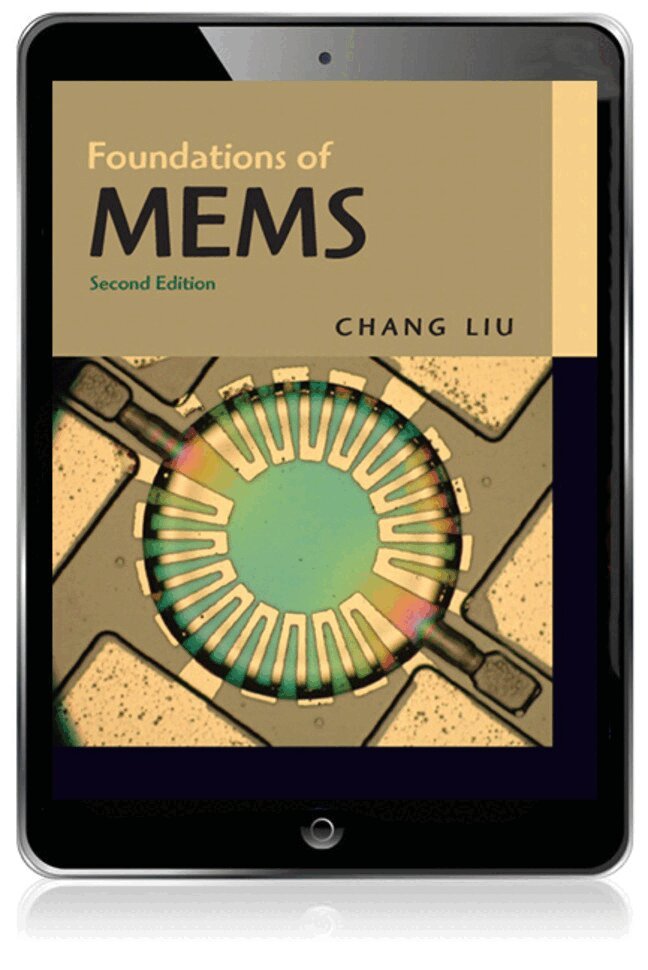
    Foundations of MEMS

    AvChang Liu

    Inbunden, Engelska, 2011

    4 097 kr

    Beställningsvara. Skickas inom 3-6 vardagar. Fri frakt över 249 kr.

    Beskrivning

    For courses in Micro-Electro-Mechanical Systems (MEMS) taken by advanced undergraduate students, beginning graduate students, and professionals.

    Foundations of MEMS is an entry-level text designed to systematically teach the specifics of MEMS to an interdisciplinary audience. Liu discusses designs, materials, and fabrication issues related to the MEMS field by employing concepts from both the electrical and mechanical engineering domains and by incorporating evolving microfabrication technology — all in a time-efficient and methodical manner. A wealth of examples and problems solidify students’ understanding of abstract concepts and provide ample opportunities for practicing critical thinking.

    Produktinformation

    • Utgivningsdatum:2011-05-26
    • Mått:100 x 100 x 100 mm
    • Vikt:100 g
    • Format:Inbunden
    • Språk:Engelska
    • Antal sidor:576
    • Upplaga:2
    • Förlag:Pearson Education
    • ISBN:9780132497367

    Utforska kategorier

    • Elektronik och kommunikationer inom Naturvetenskap och teknik
    • Systemvetenskap och AI inom Data och IT

    Mer om författaren

    Chang Liu received his M.S. and Ph.D. degrees from the California Institute of Technology in 1991 and 1995, respectively. His Ph.D. thesis was titled Micromachined sensors and actuators for fluid mechanics applications. In January 1996, he joined the Microelectronics Laboratory of the University of Illinois as a postdoctoral researcher. In January 1997, he became an assistant professor with major appointment in the Electrical and Computer Engineering Department and joint appointment in the Mechanical and Industrial Engineering Department. In 2003, he was promoted to the rank of Associate Professor with tenure. In 2007, Chang Liu joined Northwestern University (Evanston, Illinois) as a full professor of engineering. He established the MedX Laboratory to conduct advanced engineering research for medicine and health care.Dr. Liu has 20 years of research experience in the MEMS area and has published 200 technical papers in journals and refereed conference proceedings. He teaches undergraduate and graduate courses covering broad-ranging topics, including MEMS, solid-state electronics, electromechanics, sensor technology, circuits, dynamics, and heat transfer. He won a campus "Incomplete list of teachers ranked as excellent" honor in 2001 for developing and teaching the MEMS class, a precursor to this book. He received the National Science Foundation’s CAREER award in 1998 for his research proposal of developing artificial haircells using MEMS technology. He is currently a Subject Editor of the IEEE/ASME Journal of MEMS, and was an Associate Editor of the IEEE Sensors Journal. His work has been cited in popular media. Dr. Liu is a cofounder of Integrated Micro Devices (IMD) Corporation and a member of the scientific advisory board of NanoInk Corporation (Chicago, IL). In 2004, he won the University of Illinois College of Engineering Xerox Award for Faculty Research. In the same year, he was elected a Faculty Associate at the Center for Advanced Studies at the University of Illinois, to pursue research in large-format integrated sensors. He is a Fellow of the IEEE, the world’s largest professional association for the advancement of technology.

    Innehållsförteckning

    • Preface to Second EditionPreface to First EditionNote to InstructorsAbout the AuthorNotational ConventionsChapter 1: Introduction1.0. Preview    1.1.  The History of MEMS Development     1.1.1. From the Beginning to 1990     1.1.2. From 1990 to 2001     1.1.3. 2002 to present     1.1.4. Future Trends     1.2. The Intrinsic Characteristics of MEMS     1.2.1. Miniaturization     1.2.2. Microelectronics Integration     1.2.3. Parallel Fabrication with Precision     1.3. Devices: Sensors and Actuators          1.3.1. Energy Domains and Transducers          1.3.2. Sensors Considerations          13.3.  Sensor Noise and Design Complexity          1.3.4. Actuators Considerations          Summary   Problems References Chapter 2: First-Pass Introduction to Microfabrication            2.0. Preview          2.1. Overview of Microfabrication          2.2. Essential Overview of Frequently Used Microfabrication Processes     2.2.1. Photolithography          2.2.2. Thin film deposition          2.2.3. Thermal oxidation of silicon          2.2.4. Wet Etching          2.2.5. Silicon anisotropic etching          2.2.6. Plasma etching and reactive ion etching          2.2.7. Doping          2.2.8. Wafer dicing          2.2.9. Wafer bonding          2.3. The Microelectronics Fabrication Process Flow          2.4. Silicon-based MEMS Processes          2.5. Packaging and Integration          2.5.1. Integration Options          2.5.2. Encapsulation          2.6. New Materials and Fabrication Processes          2.7. Process Selection and Design          2.7.1. Points of Consideration for Deposition Processes     2.7.2. Points of Consideration for Etching Processes          2.7.3. Ideal Rules for Building a Process Flow          2.7.4. Rules for Building a Robust Process          Summary          Problems          References          Chapter 3: Review of Essential Electrical and Mechanical Concepts          3.0 Preview          3.1. Conductivity of Semiconductors          3.1.1. Semiconductor Materials          3.1.2. Calculation of Charge Carrier Concentration          3.1.3. Conductivity and Resistivity          3.2. Crystal Planes and Orientations          3.3. Stress and Strain          3.3.1. Internal Force Analysis: Newton's Laws of Motion          3.3.2. Definitions of Stress and Strain          3.3.3. General Scalar Relation between Tensile Stress and Strain          3.3.4. Mechanical Properties of Silicon and Related Thin Films          3.3.5. General Stress — Strain Relations          3.4. Flexural Beam Bending Analysis under Simple Loading Conditions          3.4.1. Types of Beams          3.4.2. Longitudinal Strain under Pure Bending          3.4.3. Deflection of Beams          3.4.4. Finding the Spring Constants          3.5. Torsional Deflections          3.6. Intrinsic Stress          3.7. Dynamic System, Resonant Frequency, and Quality Factor          3.7.1. Dynamic System and Governing Equation          3.7.2. Response under Sinusoidal Resonant Input          3.7.3. Damping and Quality Factor          3.7.4. Resonant Frequency and Bandwidth          3.8. Active Tuning of Spring Constant and Resonant Frequency          3.9. A List of Suggested Courses and Books          Summary          Problems          References           Chapter 4: Electrostatic Sensing and ActuationSection 4.0. Preview          Section 4.1.  Introduction to Electrostatic Sensors and Actuators          Section 4.2. Parallel Plate Capacitor          4.2.1. Capacitance of Parallel Plates          4.2.2.  Equilibrium Position of Electrostatic Actuator under Bias          4.2.3. Pull-in Effect of Parallel-Plate Actuators          Section 4.3. Applications of Parallel-Plate Capacitors          4.3.1. Inertia Sensor          4.3.2. Pressure Sensor          4.3.3. Flow Sensor          4.3.4. Tactile sensor          4.3.5. Parallel-plate actuators          Section 4.4. Interdigitated Finger Capacitors          Section 4.5. Applications of Comb-Drive Devices          4.5.1. Inertia Sensors          4.5.2. Actuators          Summary          Problems          References          Chapter 5: Thermal Sensing and Actuation5.0.     Preview          5.1. Introduction          5.1.1. Thermal Sensors          5.1.2. Thermal Actuators          5.1.3. Fundamentals of Thermal Transfer          5.2. Sensors and Actuators Based on Thermal Expansion5.2.1. Thermal Bimorph Principle          5.2.2. Thermal Actuators with a Single Material          5.3. Thermal Couples          5.4. Thermal Resistors          5.5. Applications          5.5.1. Inertia Sensors          5.5.2. Flow Sensors          5.5.3. Infrared Sensors          5.5.4. Other Sensors          Summary          Problems          References          Chapter 6:  Piezoresistive Sensors          6.0.     Preview          6.1.     Origin and Expression of Piezoresistivity          6.2.     Piezoresistive Sensor Materials          6.2.1. Metal Strain Gauges          6.2.2.     Single Crystal Silicon          6.2.3. Polycrystalline Silicon          6.3. Stress Analysis of Mechanical Elements          6.3.1. Stress in Flexural Cantilevers          6.3.2. Stress and Deformation in Membrane          6.4. Applications of Piezoresistive Sensors          6.4.1. Inertial Sensors          6.4.2. Pressure Sensors          6.4.3. Tactile sensor          6.4.4. Flow sensor          Summary          Problems          References          Chapter 7: Piezoelectric Sensing and Actuation    7.0. Preview    7.1. Introduction    7.1.1. Background   7.1.2. Mathematical description of piezoelectric effects    7.1.3. Cantilever piezoelectric actuator model    7.2. Properties of Piezoelectric Materials    7.2.1. Quartz    7.2.2. PZT    7.2.3. PVDF    7.2.4. ZnO    7.2.5. Other Materials    7.3. Applications    7.3.1. Inertia Sensors    7.3.2. Acoustic Sensors    7.3.3. Tactile Sensors    7.3.4. Flow Sensors    7.3.5. Surface Elastic Waves    Summary    Problems    References    Chapter 8: Magnetic Actuation    8.0. Preview    8.1. Essential Concepts and Principles    8.1.1. Magnetization and Nomenclatures    8.1.3. Selected Principles of Micro Magnetic Actuators    8.2 Fabrication of Micro Magnetic Components    8.2.1. Deposition of Magnetic Materials    8.2.2. Design and Fabrication of Magnetic Coil    8.3. Case Studies of MEMS Magnetic Actuators   Summary    Problems    References    Chapter 9: Summary of Sensing and Actuation Methods9.0. Preview    9.1. Comparison of Major Sensing and Actuation Methods   9.2. Other Sensing and Actuation Methods   9.2.1. Tunneling Sensing    9.2.3 Optical Sensing    9.2.4. Field Effect Transistors    9.2.5. Radio Frequency Resonance Sensing    Summary    Problems   References   Chapter 10: Bulk Micromachining and Silicon Anisotropic Etching    10.0.      Preview    10.1.     Introduction    10.2.     Anisotropic Wet Etching    10.2.1. Introduction    10.2.2. Rules of Anisotropic Etching–Simplest Case  10.2.3. Rules of Anisotropic Etching–Complex Structures    10.2.4. Forming Protrusions  10.2.5. Interaction of Etching Profiles from Isolated Patterns    10.2.6. Summary of design methodology   10.2.7. Chemicals for Wet Anisotropic Etching    10.3. Dry Etching and Deep Reactive Ion Etching    10.4. Isotropic Wet Etching  10.5. Gas Phase Etchants    10.6. Native Oxide    10.7. Special Wafers and Techniques    Summary    Problems    References    Chapter 11: Surface Micromachining    11.0. Preview    11.1. Basic Surface Micromachining Processes    11.1.1.     Sacrificial Etching Process    11.1.2. Micro Motor Fabrication Process–A First Pass    11.2.3. Micro Motor Fabrication Process–A Second Pass    11.1.4. Micro Motor Fabrication Process–Third Pass    11.2. Structural and Sacrificial Materials    11.2.1. Material Selection Criteria for a Two-layer Process   11.2.2. Thin Films by Low Pressure Chemical Vapor Deposition    11.2.3. Other Surface Micromachining Materials and Processes    11.3. Acceleration of Sacrificial Etch    11.4. Stiction and Anti-stiction Methods    Summary    Problems    References    Chapter 12: Process Synthesis: Putting It all Together    12.0.     Preview    12.1. Process for Suspension Beams    12.2. Process for Membranes    12.3. Process for Cantilevers    12.3.1. SPM Technologies Case Motivation    12.3.2. General Fabrication Methods for Tips   12.3.3. Cantilevers with Integrated Tips    12.3.4. Cantilevers with Integrated Sensors    12.3.5. SPM Probes with Actuators    12.4. Practical Factors Affecting Yield of MEMS    Summary    Problems    References    Chapter 13: Polymer MEMS    13.0. Preview    13.1. Introduction    13.2. Polymers in MEMS    13.2.1. Polyimide    13.2.2. SU-8    13.2.3. Liquid Crystal Polymer (LCP)    13.2.4. PDMS    13.2.5. PMMA   13.2.6. Parylene  13.2.7. Fluorocarbon   13.2.8. Other Polymers    13.3. Representative Applications    13.3.1. Acceleration Sensors    13.3.2. Pressure Sensors    13.3.3. Flow sensors    13.3.4. Tactile Sensors    Summary    Problems    Reference    Chapter 14: Micro Fluidics Applications   14.0. Preview    14.1. Motivation for Microfluidics    14.2. Essential Biology Concepts    14.3. Basic Fluid Mechanics Concepts   14.3.1. The Reynolds Number and Viscosity    14.3.2. Methods for Fluid Movement in Channels    14.3.3. Pressure Driven Flow    14.3.4. Electrokinetic Flow    14.3.5. Electrophoresis and Dielectrophoresis    14.4. Design and Fabrication of Selective Components    14.4.1. Channels    14.4.2. Valves    Summary    Problems    References    Chapter 15: Case Studies of Selected MEMS Products    15.0. Preview    15.1. Case Studies: Blood Pressure (BP) Sensor   15.1.1. Background and History   15.1.2. Device Design Considerations    15.1.3. Commercial Case: NovaSensor BP Sensor    15.2. Case Studies: Microphone    15.2.1. Background and History    15.2.2. Design Considerations    15.2.3. Commercial Case: Knowles Microphone    15.3. Case Studies: Acceleration Sensors    15.3.1. Background and History    15.4.2. Design Considerations    15.4.1. Commercial Case: Analog Devices and MEMSIC   15.4. Case Studies: Gyros    15.4.1. Background and History    15.4.2. The Coriolis Force  15.4.3. MEMS Gyro Design    15.4.4. Single Axis Gyro Dynamics   15.4.4. Commercial Case: InvenSense Gyro    15.5 Summary of Top Concerns for MEMS Product Development    15.5.1. Performance and Accuracy    15.5.2. Repeatability and Reliability    15.5.3. Managing the Cost of MEMS Products    15.5.4. Market Uncertainties, Investment, and Competition    Summary    Problems    References    Appendix 1: Characteristics of selected MEMS materialAppendix 2: Frequently Used Formula for Beams, Cantilevers, and PlatesAppendix 3: Basic Tools for Dealing with a Mechanical Second-order Dynamic SystemAppendix 4: Most Commonly Encountered MaterialsAppendix 5: Most Commonly Encountered Material Removal Process StepsAppendix 6: A List of General Compatibility between General Materials and ProcessesAppendix 7: Comparison of Commercial Inertial SensorsAnswers to selected problemsIndex