• Fri frakt över 249 kr
  • •
  • Snabba leveranser
  • •
  • Billiga böcker
Kundservice

Du är på sajten för privatpersoner.

Företag, bibliotek eller offentlig verksamhet?

Du handlar på classic.bokus.com, där alla dina funktioner finns intakta.
Till classic.bokus.com
Bokus logotyp. Gå till startsidan.
  • Erbjudanden
  • Nyheter
  • Student
  • Topplistor
  • Barn & ungdom
  • Bokus Play
  • E-böcker
  • Pocketböcker
  • Spel & pussel

10% rabatt på allt med kod NYSTART10 →

Sidfot

Mina sidor

    Hjälp

    • Kundservice
    • Vanliga frågor och svar
    • Frakt och leverans
    • Retur vid ångerrätt
    • Reklamera vara
    • Betalning
    • Köpvillkor
    • Allmänna villkor
    • Information om webbplatsens tillgänglighet

    Om Bokus

    • Om oss
    • Pressrum
    • För studenter
    • För företag
    • För bibliotek och offentlig verksamhet
    • För leverantörer
    • Hållbarhet

    Populärt

    • Aktuella erbjudanden
    • Presentkort
    • Studentlitteratur
    • Nya böcker
    • Topplistor
    • Signerade böcker
    • Engelska böcker

    Inspiration

    • Boktips
    • BookTok
    • Populära bokserier
    • Barnbokskaraktärer
    • Populära författare
    Logotyp för Bokus
    Följ oss på Facebook (extern länk)Följ oss på Instagram (extern länk)Följ oss på YouTube (extern länk)Följ oss på TikTok (extern länk)
    bokus @ CookiesAnpassa cookiesIntegritetspolicyKöpvillkor
    Till Citymail hemsida (extern länk)Till Budbee hemsida (extern länk)Till Postnord hemsida (extern länk)Till Schenker hemsida (extern länk)Till Early Bird hemsida (extern länk)Till Walleys hemsida (extern länk)
    1. Data och IT
    2. Nätverk och kommunikation

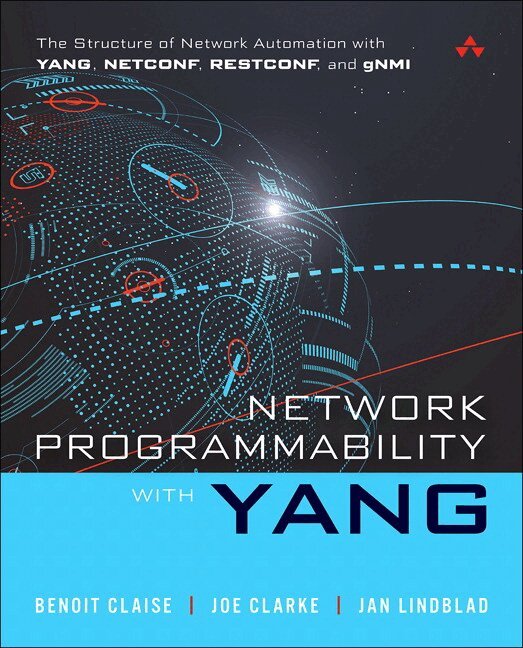
    Network Programmability with YANG

    The Structure of Network Automation with YANG, NETCONF, RESTCONF, and gNMI

    AvBenoit Claise,Joe Clarke

    Inbunden, Engelska, 2019

    809 kr

    Beställningsvara. Skickas inom 3-6 vardagar. Fri frakt över 249 kr.

    Beskrivning

    Today, networks must evolve and scale faster than ever. You can’t manage everything by hand anymore: You need to automate relentlessly. YANG, along with the NETCONF, RESTCONF, or gRPC/gNMI protocols, is the most practical solution, but most implementers have had to learn by trial and error. Now, Network Programmability with YANG gives you complete and reliable guidance for unlocking the full power of network automation using model-driven APIs and protocols.

    Authored by three YANG pioneers, this plain-spoken book guides you through successfully applying software practices based on YANG data models. The authors focus on the network operations layer, emphasizing model-driven APIs, and underlying transports.

    Whether you’re a network operator, DevOps engineer, software developer, orchestration engineer, NMS/OSS architect, service engineer, or manager, this guide can help you dramatically improve value, agility, and manageability throughout your network.

    • Discover the value of implementing YANG and Data Model-Driven Management in your network
    • Explore the layers and components of a complete working solution
    • Build a business case where value increases as your solution grows
    • Drill down into transport protocols: NETCONF, RESTCONF, and gNMI/gRPC
    • See how telemetry can establish a valuable automated feedback loop
    • Find data models you can build on, and evaluate models with similar functionality
    • Understand models, metadata, and tools from several viewpoints: architect, operator, module author, and application developer
    • Walk through a complete automation journey: business case, service model, service implementation, device integration, and operation
    • Leverage the authors’ experience to design successful YANG models and avoid pitfalls

    Produktinformation

    • Utgivningsdatum:2019-01-25
    • Mått:196 x 234 x 30 mm
    • Vikt:999 g
    • Format:Inbunden
    • Språk:Engelska
    • Antal sidor:512
    • Upplaga:1
    • Förlag:Pearson Education
    • ISBN:9780135180396

    Utforska kategorier

    • Nätverk och kommunikation inom Data och IT

    Mer om författaren

    Benoît Claise, CCIE No. 2686, is a Cisco Fellow, working as an architect for embedded management. Areas of passion and expertise include Internet traffic monitoring, accounting, performance, fault, and configuration management. Benoît’s area of focus these days is network automation with YANG as the data modeling language, NETCONF/RESTCONF, and telemetry as a feedback loop to solve intent-based networking.Benoît was IETF Operations and Management Area (OPS) co-director from 2012 to 2018, a period during which much of the data model–driven management protocols, encoding, and data models were specified. He blogs on these topics on his web site http://www.claise.be/ and spends time on the yangcatalog.org developments. Benoît is a contributor to the IETF, with 35 RFCs in the area of NetFlow, IPFIX (IP Flow Information eXport), PSAMP (Packet Sampling), IPPM (IP Performance Metrics), YANG, MIB module, energy management, and network management in general. Benoît is the co-author of the Cisco Press book Network Management: Accounting and Performance Strategies.As a Cisco Customer Experience Engineer, Joe Clarke, CCIE No. 5384, has contributed to the development and adoption of many of Cisco’s network management and automation products and technologies. He helps to support, enhance, and promote the embedded automation and programmability features, such as the Embedded Event Manager, Tcl, Python, NETCONF/RESTCONF, and YANG.Joe evangelizes these programmability and automation skills in order to build the next generation of network engineers. He is a Cisco Certified Internetworking Expert and certified Cisco Network Programmability Engineer. Joe has authored numerous technical documents on Cisco network management, automation, and programmability products and technologies, as well as a chapter as co-author of Network-Embedded Management and Applications: Understanding Programmable Networking Infrastructure. He also served as one of the technical editors for the Cisco Press books Tcl Scripting for Cisco IOS and Programming and Automating Cisco Networks: A Guide to Network Programmability and Automation in the Data Center, Campus, and WAN. He is an alumnus of the University of Miami and holds a Bachelor of Science degree in computer science.Outside of Cisco, Joe is a member of the FreeBSD project and the co-chair of the Ops Area Working Group at the IETF. Joe is a certified commercial pilot for single-engine airplanes with an instrument rating. He lives with his beautiful wife in the RTP area of North Carolina.Jan Lindblad soldered together his first computer at age 12, wrote his first compiler at 16, and reached the million lines of code mark by 30. In 2006, when NETCONF was first published by IETF, Jan was at the then newly founded start-up company Tail-f Systems. Tail-f built the first commercial implementation of NETCONF and was a driving force behind the introduction of YANG.Jan is an IETF YANG Doctor and has also authored and reviewed many YANG modules in other organizations. Jan has trained several hundred people on the theory and practice of NETCONF and YANG. At the yearly NETCONF/YANG interop event organized by EANTC in Berlin, Germany, Jan plays a central role.Outside Cisco, Jan is an avid climate activist and environmentalist. He lives outside Stockholm, Sweden, and commutes to work by bike every day.

    Innehållsförteckning

    • Introduction xxii1 The Network Management World Must Change: Why Should You Care? 2Introduction 2The Industry Has Changed: What Are the Trends? 6Existing Network Management Practices and Related Limitations 24Data Modeling Is Key for Automation 39Interview with the Experts 48Summary 52References in This Chapter 53Endnotes 532 Data Model—Driven Management 56The Beginning: A New Set of Requirements 56Network Management Is Dead, Long Live Network Management 59YANG: The Data Modeling Language 61The Management Architecture 69Data Model—Driven Management Components 70The Encoding (Protocol Binding and Serialization) 74The Server Architecture: Datastore 77The Protocols 78The Programming Language 85Telemetry 86The Bigger Picture: Using NETCONF to Manage a Network 86Interview with the Experts 91Summary 93References in This Chapter 93Endnotes 943 YANG Explained 96Introduction 96Describe Your World of Data 96Describing Possible Events 113Separating Configuration from Operational Data 117Constraints Keep Things Meaningful 122Augmenting, Extending, and Possibly Deviating 142Network Management Datastore Architecture (NMDA) 149Interview with the Expert 154Summary 156References in This Chapter 1574 NETCONF, RESTCONF, and gNMI Explained 158Introduction 158NETCONF 158RESTCONF 190OpenConfig and gNMI 214Interview with the Expert 225Summary 227References in This Chapter 2275 Telemetry Explained 230Introduction 230Data Model—Driven Telemetry 230Moving Away from SNMP to Telemetry 232Telemetry Use Cases 235Telemetry Components 236Telemetry Standard Mechanisms 242Interview with the Experts 249Summary 252References in This Chapter 253Endnotes 2536 YANG Data Modeling Developments in the Industry 256Introduction 256The Beginning: The IETF 256Embracing YANG Throughout the Industry 263The OpenConfig YANG Model 268Industry Coordination Is Required 270Interoperability Testing 272Implementing More Than One YANG Model for a Specific Functionality 274Interview with the Expert 275Summary 278References in This Chapter 279Endnotes 2797 Automation Is as Good as the Data Models, Their RelatedMetadata, and the Tools: For the Network Architect and Operator 282Introduction 282Getting to Know the Structure of a YANG Module 283Finding the Right Modules Using the YANG Catalog 287Interacting with Devices 299Interview with the Experts 331Summary 335Endnotes 3358 Automation Is as Good as the Data Models,Their Related Metadata, and the Tools: For the Module Author 336Introduction 336Designing Modules 336Understanding Your Module’s Impact 349Interview with the Expert 350Summary 352Endnotes 3529 Automation Is as Good as the Data Models, Their Related Metadata, and the Tools: For the Application Developer 354Introduction 354Working with YANG Modules 355Interacting with the Network 366Making YANG Language Native 373Interview with the Expert 380Summary 381Endnotes 38210 Using NETCONF and YANG 384Introduction 384So the Story Goes 385Top-Down Service Model 386Bottom-Up Device Templates 392Service Logic Connecting the Dots 394Setting Up NETCONF on a Device 398Discovering What’s on a Device 400Managing Services 405Manager Synchronization with Devices 413Network-Wide Transactions 417Interview with the Experts 425Summary 42811 YANG Model Design 430Introduction 430Modeling Strategy 430YANG Modeling Tips 433Common YANG Mistakes 443Backward Compatibility 457Interview with the Experts 460Summary 462References in This Chapter 4639780135180396, TOC, 4/4/19