• Fri frakt över 249 kr
  • •
  • Snabba leveranser
  • •
  • Billiga böcker
Kundservice

Du är på sajten för privatpersoner.

Företag, bibliotek eller offentlig verksamhet?

Du handlar på classic.bokus.com, där alla dina funktioner finns intakta.
Till classic.bokus.com
Bokus logotyp. Gå till startsidan.
  • Erbjudanden
  • Nyheter
  • Student
  • Topplistor
  • Barn & ungdom
  • Bokus Play
  • E-böcker
  • Pocketböcker
  • Spel & pussel

10% rabatt på allt med kod: NYSTART10 →

Sidfot

Mina sidor

    Hjälp

    • Kundservice
    • Vanliga frågor och svar
    • Frakt och leverans
    • Retur vid ångerrätt
    • Reklamera vara
    • Betalning
    • Köpvillkor
    • Allmänna villkor
    • Information om webbplatsens tillgänglighet

    Om Bokus

    • Om oss
    • Pressrum
    • För studenter
    • För företag
    • För bibliotek och offentlig verksamhet
    • För leverantörer
    • Hållbarhet

    Populärt

    • Aktuella erbjudanden
    • Presentkort
    • Studentlitteratur
    • Nya böcker
    • Topplistor
    • Signerade böcker
    • Engelska böcker

    Inspiration

    • Boktips
    • BookTok
    • Populära bokserier
    • Barnbokskaraktärer
    • Populära författare
    Logotyp för Bokus
    Följ oss på Facebook (extern länk)Följ oss på Instagram (extern länk)Följ oss på YouTube (extern länk)Följ oss på TikTok (extern länk)
    bokus @ CookiesAnpassa cookiesIntegritetspolicyKöpvillkor
    Till Citymail hemsida (extern länk)Till Budbee hemsida (extern länk)Till Postnord hemsida (extern länk)Till Schenker hemsida (extern länk)Till Early Bird hemsida (extern länk)Till Walleys hemsida (extern länk)
    1. Samhälle och politik
    2. Politik och statsskick
    3. Internationella relationer

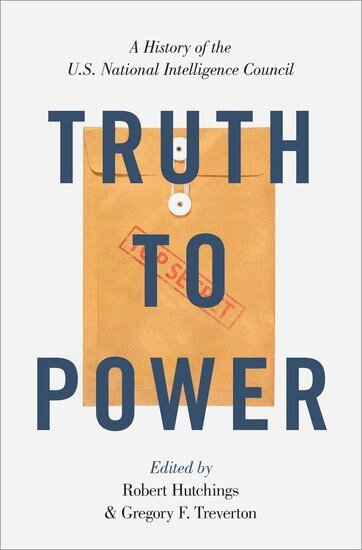
    Truth to Power

    A History of the U.S. National Intelligence Council

    AvRobert Hutchings,Gregory F. Treverton

    Häftad, Engelska, 2019

    762 kr

    Beställningsvara. Skickas inom 5-8 vardagar. Fri frakt över 249 kr.

    Beskrivning

    Truth to Power, the first-ever history of the U.S. National Intelligence Council (NIC), is told through the reflections of its eight Chairs in the period from the end of the Cold War until 2017. Co-editors Robert Hutchings and Gregory Treverton add a substantial introduction placing the NIC in its historical context going all the way back to the Board of National Estimates in the 1940s, as well as a concluding chapter that highlights key themes and judgments. This historic mission of this remarkable but little-known organization, now almost forty years old, is strategic intelligence assessment in service of senior American foreign policymakers. Its signature inside products, National Intelligence Estimates, are now accompanied by the NIC's every-four-years Global Trends. Unclassified, Global Trends has become a noted NIC brand, its release awaited by officials, academics and private sector managers around the world.Each chapter places its particular period of the NIC's history in context (the global situation, the administration, the intelligence community) and assesses the most important issues with which the NIC grappled during the period, acknowledging failures as well as claiming successes. For example, Hutchings' chapter examines the invasion and occupation of Iraq, the fallout from the ill-fated Iraqi WMD estimate, the debate over intelligence community reform, and the year-long National Intelligence Council 2020 project.With the creation of the Director of National Intelligence in 2005, the NIC's mission mushroomed to include direct intelligence support to the two main policymaking committees in the government: the Principals Committee (cabinet secretaries in the foreign affairs departments) and the Deputies Committee (their deputies or number threes). The mission shift took the NIC directly into the thick of the action but at some cost to its abilities to do strategic thinking: of some 700 NIC papers in 2016, more than half were responses to questions from the National Security Adviser or her deputies, most, though hardly all, of which were current and tactical, not longer-term and strategic.

    Produktinformation

    • Utgivningsdatum:2019-06-27
    • Mått:241 x 155 x 12 mm
    • Vikt:363 g
    • Format:Häftad
    • Språk:Engelska
    • Antal sidor:256
    • Förlag:OUP USA
    • ISBN:9780190940010

    Utforska kategorier

    • Internationella relationer inom Samhälle och politik

    Mer om författaren

    Robert Hutchings is the Walt and Elspeth Rostow Chair in National Security and Professor of Public Affairs at the Lyndon B. Johnson School of Public Affairs at the University of Texas at Austin, and served as Dean of the LBJ School from 2010 to 2015. Before coming to UT, he was Diplomat in Residence at Princeton University, where he had also served as Assistant Dean of the Woodrow Wilson School of Public and International Affairs. During a public service leave from Princeton in 2003-05, he was Chairman of the National Intelligence Council in Washington, D.C. His combined academic and diplomatic career has included service as Fellow and Director of International Studies at the Woodrow Wilson International Center for Scholars, Director for European Affairs with the National Security Council, and Special Adviser to the Secretary of State, with the rank of ambassador.He is author or editor of four books, including American Diplomacy and the End of the Cold War and, with Jeremi Suri, Foreign Policy Breakthroughs: Cases in Successful Diplomacy.Gregory F. Treverton is Professor of the Practice of International Relations and Spatial Sciences at the USC Dornsife College of Letters, Arts and Sciences and Visiting Fellow at the Center for Asymmetric Threat Studies, Swedish National Defense University. He served as chairman of the National Intelligence Council from 2014 to 2017. Earlier, he directed the RAND Corporation's Center for Global Risk and Security, and before that its Intelligence Policy Center and its International Security and Defense Policy Center, and he was associate dean of the Pardee RAND Graduate School.He has served in government for the first Senate Select Committee on Intelligence, handling Europe for the National Security Council and as vice chair of the National Intelligence Council, overseeing the writing of America's National Intelligence Estimates (NIEs). He has taught at Harvard and Columbia universities, in addition to RAND, been a Senior Fellow at the Council on Foreign Relations, and Deputy Director of the International Institute for Strategic Studies in London. His latest books are Dividing Divided States and, with Wilhelm Agrell, Beyond the Great Divide: Relevance and Uncertainty in National Intelligence and Science for Policy (Oxford).

    Recensioner i media

    Hutchings and Treverton's volume offers valuable perspectives on the analytical work of the NIC in three decades of global transition, which shows the lasting importance of future-oriented strategic analysis.

    Innehållsförteckning

    • Introduction, Robert Hutchings Chapter 1: Estimative Intelligence after the Cold War: 1993-1994, Joseph S. Nye, Jr. Chapter 2: Controlling Controversy: 1995-1997, Richard N. Cooper Chapter 3: A New Global Agenda: 1997-2001, John Gannon Chapter 4: The Trauma of 9/11: 2001-2002, John L. Helgerson Chapter 5: America at War: 2003-2005, Robert Hutchings Chapter 6: New Missions, New Challenges, 2005-2008, Thomas Fingar Chapter 7: Intelligence Integration and Reform at the NIC: 2009-2014, Christopher Kojm Chapter 8: From Afghanistan to Trump, 2014-2017, Gregory Treverton Conclusion: Looking to the Next Chapter, Gregory Treverton