• Fri frakt över 249 kr
  • •
  • Snabba leveranser
  • •
  • Billiga böcker
Kundservice

Du är på sajten för privatpersoner.

Företag, bibliotek eller offentlig verksamhet?

Du handlar på classic.bokus.com, där alla dina funktioner finns intakta.
Till classic.bokus.com
Bokus logotyp. Gå till startsidan.
  • Erbjudanden
  • Student
  • Topplistor
  • Barn & ungdom
  • Bokus Play
  • E-böcker
  • Ljudböcker
  • Pocketböcker
  • Spel och pussel

5% studentrabatt – använd koden KURSBOK27 →

Sidfot

Mina sidor

    Hjälp

    • Kundservice
    • Vanliga frågor och svar
    • Frakt och leverans
    • Retur vid ångerrätt
    • Reklamera vara
    • Betalning
    • Köpvillkor
    • Allmänna villkor
    • Information om webbplatsens tillgänglighet

    Om Bokus

    • Om oss
    • Pressrum
    • För studenter
    • För företag
    • För bibliotek och offentlig verksamhet
    • För leverantörer
    • Hållbarhet

    Populärt

    • Aktuella erbjudanden
    • Presentkort
    • Studentlitteratur
    • Nya böcker
    • Topplistor
    • Signerade böcker
    • Engelska böcker

    Inspiration

    • Boktips
    • BookTok
    • Barnbokskaraktärer
    • Populära författare
    Logotyp för Bokus
    Följ oss på Facebook (extern länk)Följ oss på Instagram (extern länk)Följ oss på YouTube (extern länk)Följ oss på TikTok (extern länk)
    bokus @ CookiesAnpassa cookiesIntegritetspolicyKöpvillkor
    Till Citymail hemsida (extern länk)Till Budbee hemsida (extern länk)Till Postnord hemsida (extern länk)Till Schenker hemsida (extern länk)Till Early Bird hemsida (extern länk)Till Walleys hemsida (extern länk)
    1. Naturvetenskap och teknik
    2. Geovetenskap
    3. Geovetenskap
    4. Geologi

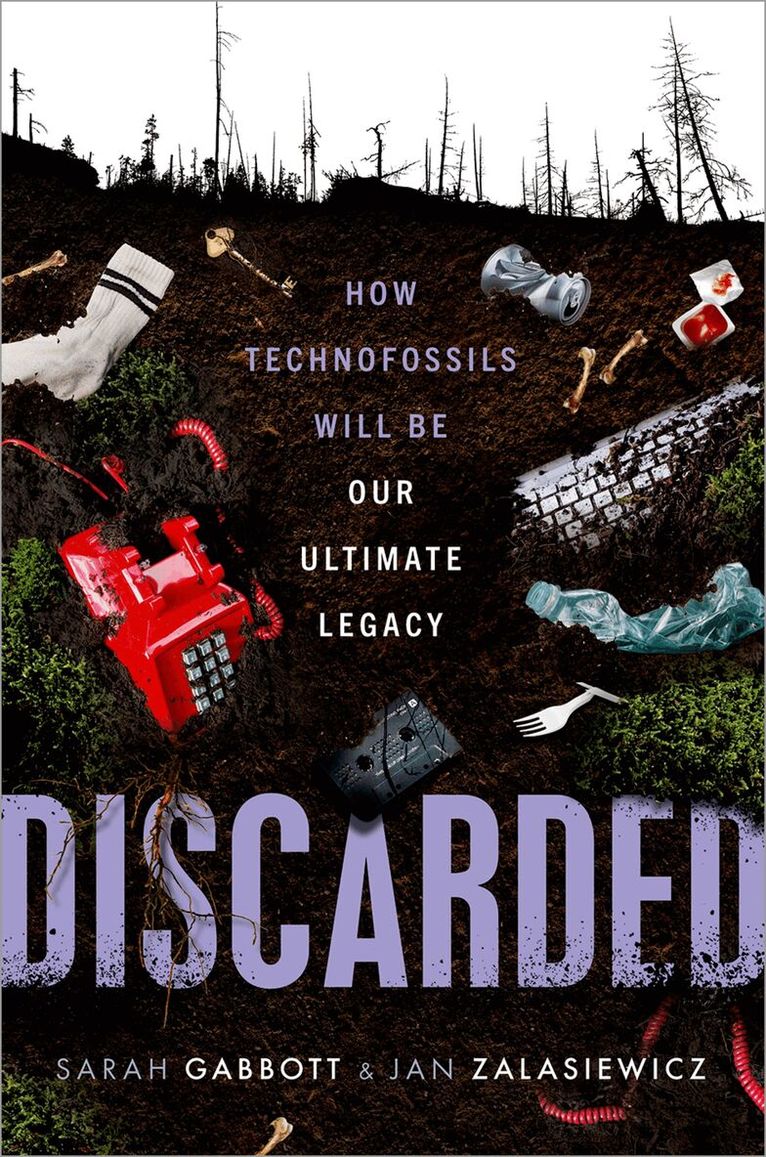
    Discarded

    How Technofossils Will be Our Ultimate Legacy

    AvSarah Gabbott,Jan Zalasiewicz

    Inbunden, Engelska, 2025

    212 kr

    Skickas . Fri frakt över 249 kr.

    Beskrivning

    What will remain of our plastic, cans, and other junk long after humans have vanished?What kind of fossils will we leave, as relics into the far future? A blizzard of new objects has suddenly appeared on Earth: plastic bottles, ballpoint pens, concrete flyways, outsize chicken bones, aluminium cans, teabags, mobile phones, T-shirts. They're produced for our comfort and pleasure ^—^ then quickly discarded. The number of our constructions has exploded, to outweigh the whole living world. This new-made treasure chest underpins our lives. But it is also giving a completely new style of fossilization to our planet, as hyper-diverse and hyper-rapidly-evolving technofossils spin out of our industrialized economy. Designed to resist sun, wind, rain, corrosion and decay, and buried in soils, seafloor muds and the gigantic middens of our landfill sites, many will remain, petrified, as future geology. What will these technofossils look like, in future rock? How long will they last and how will they change, as they lie underground for decades, then millennia, then millions of years? Discarded describes how they transform as they are attacked by bacteria, baked by the Earth's inner heat, squashed by overlying rock, permeated by subterranean fluids, crumpled by mountain-building movements ^—^ and what will be left of them. These new fossils also have meaning for our lives today. For we live on a world increasingly buried under our growing waste. As our discarded artefacts begin to change into fossils, they may be swallowed by birds, entangle fish, alter microbial communities and release toxins. Even deeply buried in rock, technofossils may break down into new-formed oil and gas, change the composition of groundwater, and attract new mineral growths. They will have a lasting impact.It is a new planetary phenomenon, now unfolding around us. Scientists are only just beginning to grasp its scale, and get to grips with how it functions. This book describes, for the general reader, the kind of science that is emerging to show the far-future human footprint on Earth. It offers a different perspective upon fossils and fossilization, one that expands the idea of what people think of as fossils, and what they can tell us.

    Produktinformation

    • Utgivningsdatum:2025-02-13
    • Mått:163 x 241 x 24 mm
    • Vikt:450 g
    • Format:Inbunden
    • Språk:Engelska
    • Antal sidor:256
    • Förlag:OUP OXFORD
    • ISBN:9780192869333

    Utforska kategorier

    • Geologi inom Naturvetenskap och teknik
    • Böcker om stenar och mineraler inom Djur och Natur
    • Paleontologi inom Naturvetenskap och teknik

    Mer om författaren

    Sarah Gabbott is a Professor of Palaeobiology at the University of Leicester. She researches the fossil record of ancient life and is particularly interested in understanding how fossils form and what they reveal about evolution and ecology. She actively seeks new fossil specimens from across the globe, going on digs to China, South Africa and the Canadian Rockies. She also works in the laboratory analyzing fossils and undertaking grisly experiments to determine how decomposition affects fossilization. Recently, she has turned her attention to the potential fossil record created by human activity, especially thinking about how long our 'artefacts' will endure.Jan Zalasiewicz is Emeritus Professor of Palaeobiology at the University of Leicester. He was formerly a field geologist and palaeontologist with the British Geological Survey, involved in the geological mapping of eastern England and central Wales. His interests include Early Palaeozoic fossils, notably the graptolites (a kind of extinct zooplankton), mud and mudrocks, the Quaternary Ice Ages, the nature of geological time, and the geology made by humans. In recent years he has helped develop the concept of an Anthropocene epoch. He has written many popular science articles and books.

    Recensioner i media

    An imaginative, vivid story of how human civilisation might be viewed in the future. Gabbott and Zalasiewicz explore how our plastics, concrete, cars, power plants, clothes, chickens and toxic chemicals, what they call 'technofossils,' will survive the millennia. Using thorough application of science, they argue a case for what we leave behind and what some future intelligent species might make of us. Sobering, but thought-provoking.

    Innehållsförteckning

    • Prologue 1: Plastic planet 2: The concrete strata 3: Energy ghosts 4: Fossil Fashion 5: Eternal literature 6: Fast food forever 7: Toxic shock 8: Silicon futures