• Fri frakt över 249 kr
  • •
  • Snabba leveranser
  • •
  • Billiga böcker
Kundservice

Du är på sajten för privatpersoner.

Företag, bibliotek eller offentlig verksamhet?

Du handlar på classic.bokus.com, där alla dina funktioner finns intakta.
Till classic.bokus.com
Bokus logotyp. Gå till startsidan.
  • Erbjudanden
  • Nyheter
  • Student
  • Topplistor
  • Barn & ungdom
  • Bokus Play
  • E-böcker
  • Pocketböcker
  • Spel & pussel

Må bättre, för mindre! Upp till 50% rabatt på hälsoböcker

Sidfot

Mina sidor

    Hjälp

    • Kundservice
    • Vanliga frågor och svar
    • Frakt och leverans
    • Retur vid ångerrätt
    • Reklamera vara
    • Betalning
    • Köpvillkor
    • Allmänna villkor
    • Information om webbplatsens tillgänglighet

    Om Bokus

    • Om oss
    • Pressrum
    • För studenter
    • För företag
    • För bibliotek och offentlig verksamhet
    • För leverantörer
    • Hållbarhet

    Populärt

    • Aktuella erbjudanden
    • Presentkort
    • Studentlitteratur
    • Nya böcker
    • Topplistor
    • Signerade böcker
    • Engelska böcker

    Inspiration

    • Boktips
    • BookTok
    • Populära bokserier
    • Barnbokskaraktärer
    • Populära författare
    Logotyp för Bokus
    Följ oss på Facebook (extern länk)Följ oss på Instagram (extern länk)Följ oss på YouTube (extern länk)Följ oss på TikTok (extern länk)
    bokus @ CookiesAnpassa cookiesIntegritetspolicyKöpvillkor
    Till Citymail hemsida (extern länk)Till Budbee hemsida (extern länk)Till Postnord hemsida (extern länk)Till Schenker hemsida (extern länk)Till Early Bird hemsida (extern länk)Till Walleys hemsida (extern länk)
    1. Språk och ordböcker
    2. Språkvetenskap och lingvistik
    • Nyhet

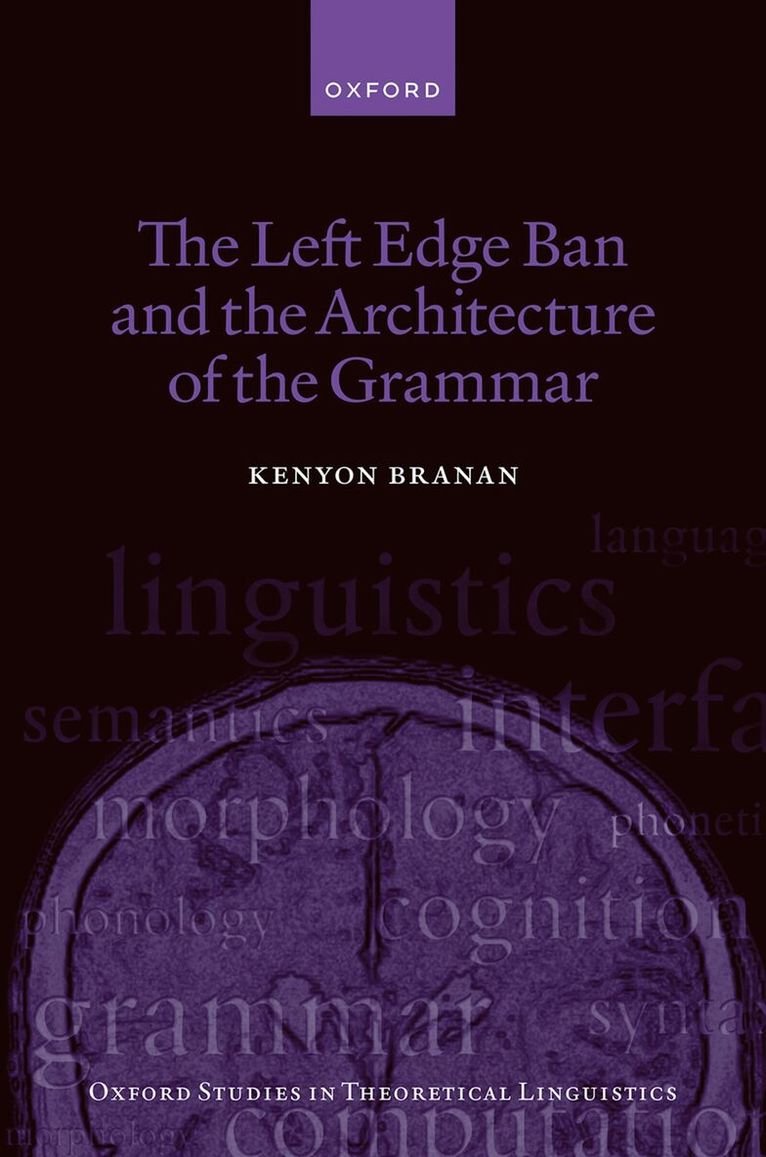
    The Left Edge Ban and the Architecture of the Grammar

    AvKenyon Branan

    Inbunden, Engelska, 2026

    Del 89 i serien Oxford Studies in Theoretical Linguistics

    1 259 kr

    Beställningsvara. Skickas inom 5-8 vardagar. Fri frakt över 249 kr.

    Beskrivning

    This book proposes and motivates a ban on words and sentences of a particular form, and shows that there are differences between how this ban is satisfied at the word level and at the sentence level. One striking finding is that syntactic operations may serve as a means of avoiding violation of the ban, which might not be expected on a strictly feed-forward grammatical architecture. A theoretically interesting consequence of this is that the syntax must be able to see at least some information that the phonology can access, motivating an architecture of the grammar that is different from what is commonly assumed.Empirically, this ban can account for a variety of apparently disparate linguistic facts including, but not limited to: cross-linguistic skews in attested stress patterns, morphophonological differences between prefixes and suffixes, restrictions on certain disharmonic word orders and cases where this restriction is apparently lifted, and a requirement that heavy elements undergo obligatory extraposition from a variety of fronted constituents. Each of these cases can be understood as the consequence of the grammar of a particular language employing a limited set of strategies to ensure that the proposed ban is satisfied.

    Produktinformation

    • Utgivningsdatum:2026-07-09
    • Mått:165 x 243 x 20 mm
    • Vikt:538 g
    • Format:Inbunden
    • Språk:Engelska
    • Serie:Oxford Studies in Theoretical Linguistics
    • Antal sidor:256
    • Förlag:OUP OXFORD
    • ISBN:9780192882363

    Utforska kategorier

    • Språkvetenskap och lingvistik inom Språk och ordböcker

    Mer om författaren

    Kenyon Branan is a research associate affiliated with the Georg-August-Universität Göttingen. After completing his PhD at MIT, he held positions at the National University of Singapore and the Leibniz-Zentrum Allgemeine Sprachwissenschaft. His research explores syntax and the interactions between syntax and the interfaces.

    Innehållsförteckning

    • 1: Introduction 2: The LEB at the word level 3: Bridging the gap between syntax and phonology 4: The LEB at the clause level: Comparing two approaches 5: Derived positions and the limits of LEB repair 6: Conclusions and meditations on bigger picture issues