• Fri frakt över 249 kr
  • •
  • Snabba leveranser
  • •
  • Billiga böcker
Kundservice

Du är på sajten för privatpersoner.

Företag, bibliotek eller offentlig verksamhet?

Du handlar på classic.bokus.com, där alla dina funktioner finns intakta.
Till classic.bokus.com
Bokus logotyp. Gå till startsidan.
  • Erbjudanden
  • Nyheter
  • Student
  • Topplistor
  • Barn & ungdom
  • Bokus Play
  • E-böcker
  • Pocketböcker
  • Spel & pussel

10% rabatt på allt med kod: NYSTART10 →

Sidfot

Mina sidor

    Hjälp

    • Kundservice
    • Vanliga frågor och svar
    • Frakt och leverans
    • Retur vid ångerrätt
    • Reklamera vara
    • Betalning
    • Köpvillkor
    • Allmänna villkor
    • Information om webbplatsens tillgänglighet

    Om Bokus

    • Om oss
    • Pressrum
    • För studenter
    • För företag
    • För bibliotek och offentlig verksamhet
    • För leverantörer
    • Hållbarhet

    Populärt

    • Aktuella erbjudanden
    • Presentkort
    • Studentlitteratur
    • Nya böcker
    • Topplistor
    • Signerade böcker
    • Engelska böcker

    Inspiration

    • Boktips
    • BookTok
    • Populära bokserier
    • Barnbokskaraktärer
    • Populära författare
    Logotyp för Bokus
    Följ oss på Facebook (extern länk)Följ oss på Instagram (extern länk)Följ oss på YouTube (extern länk)Följ oss på TikTok (extern länk)
    bokus @ CookiesAnpassa cookiesIntegritetspolicyKöpvillkor
    Till Citymail hemsida (extern länk)Till Budbee hemsida (extern länk)Till Postnord hemsida (extern länk)Till Schenker hemsida (extern länk)Till Early Bird hemsida (extern länk)Till Walleys hemsida (extern länk)
    1. Språk och ordböcker
    2. Språkvetenskap och lingvistik
    • Nyhet

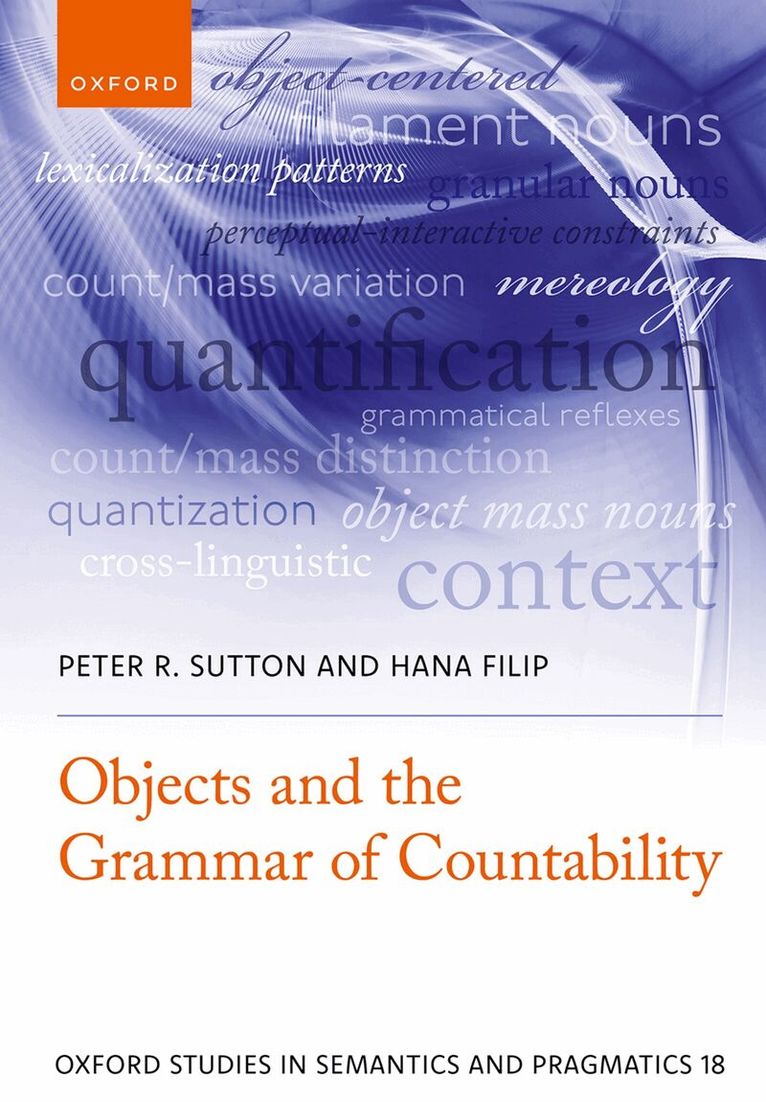
    Objects and the Grammar of Countability

    AvPeter R. Sutton,Hana Filip

    Inbunden, Engelska, 2026

    Del 18 i serien Oxford Studies in Semantics and Pragmatics

    1 486 kr

    Beställningsvara. Skickas inom 5-8 vardagar. Fri frakt över 249 kr.

    Beskrivning

    This book proposes an object-centred and contextualist account of the count/mass distinction. The main empirical finding is that there is a connection between variation in count/mass lexicalization patterns across and within languages and the ways in which mass or count nouns can diverge from manifesting the canonical grammatical reflexes expected of the count/mass distinction in a given language. Assuming compositional semantics enriched with Classical Extensional Mereology, Peter Sutton and Hana Filip propose that mass-count pairs of nouns (across and within languages) lexicalize the same number-neutral core property that is satisfied by objects, which comprises not only one discrete entity separate from other entities, but also a discrete entity based on its affordances and topological properties. For a concrete common noun to be grammatically count, as needed in counting and quantificational constructions, it must specify a quantized set of objects relative to a context of individuation. Context plays a crucial role, since it can afford different ways of viewing the entities in a noun's extension, and so what counts as 'one' for that noun in that context. The book outlines a system of three perceptual-interactive constraints, based upon how we perceive and interact with objects, that predicts the propensity for a number-neutral core property that is satisfied by objects to nonetheless be lexicalized as mass. These constraints are also key to explaining variation in the count/mass lexicalization patterns of such properties. The authors also show that the extent to which a core property can satisfy these constraints can be estimated from a corpus, and how these corpus measures can be used to model variation in count/mass lexicalization patterns. The main data relies on concrete common nouns in number-marking languages, namely Czech, English, Finnish, and German, but the account is also extended to abstract nouns, and to two non-number-marking languages, namely Mandarin and Yudja.

    Produktinformation

    • Utgivningsdatum:2026-08-27
    • Mått:180 x 254 x 23 mm
    • Vikt:702 g
    • Format:Inbunden
    • Språk:Engelska
    • Serie:Oxford Studies in Semantics and Pragmatics
    • Antal sidor:304
    • Förlag:OUP OXFORD
    • ISBN:9780192891143

    Utforska kategorier

    • Språkvetenskap och lingvistik inom Språk och ordböcker

    Mer om författaren

    Peter R. Sutton is a postdoctoral researcher at the University of Potsdam, where he is a PI on the project 'Nouns in Contexts of Evaluation'. His previous project 'Polysemy and Countability in Abstract Nouns' was based at Pompeu Fabra University in Barcelona. He originally trained in philosophy, specializing in the philosophy of language, but has worked in the fields of semantics and pragmatics for over 10 years. His primary areas of interest are in the lexical-compositional semantics interface, namely countability and the count/mass distinction, polysemy and the use of polysemous expressions in quantifier and numeral constructions, and vagueness.Hana Filip is Professor of Semantics at Heinrich Heine University in Düsseldorf. Her research focuses on aspect, genericity, the mass/count distinction, the interaction of noun phrase semantics with verbal aspect, (in)definiteness, and context-dependence in semantic interpretation. The theoretical background of much of her research is that of mereological semantics, which integrates formal and lexical semantics. She received her PhD in Linguistics from the University of California at Berkeley. Prior to her current appointment, she held appointments at Stanford University, Northwestern University, the University of Rochester, University of Illinois at Urbana-Champaign, and the University of Florida.

    Innehållsförteckning

    • 1: Introduction and overview 2: Variation in count/mass lexicalization patterns and the non-canonical reflexes of countability 3: Implications for theories of countability 4: An object-centred, contextualist theory of countability 5: Constraints on lexicalization patterns 6: Extending the analysis 7: Conclusions Appendix A. List of definitions Appendix B. Results: Stubbornly distributive predicate corpus study Appendix C. Results: Constraints corpus study