• Fri frakt över 249 kr
  • •
  • Snabba leveranser
  • •
  • Billiga böcker
Kundservice

Du är på sajten för privatpersoner.

Företag, bibliotek eller offentlig verksamhet?

Du handlar på classic.bokus.com, där alla dina funktioner finns intakta.
Till classic.bokus.com
Bokus logotyp. Gå till startsidan.
  • Erbjudanden
  • Student
  • Topplistor
  • Barn & ungdom
  • Bokus Play
  • E-böcker
  • Ljudböcker
  • Pocketböcker
  • Spel och pussel

Pocketfynda! Hundratals böcker för 49 kr/st →

Sidfot

Mina sidor

    Hjälp

    • Kundservice
    • Vanliga frågor och svar
    • Frakt och leverans
    • Retur vid ångerrätt
    • Reklamera vara
    • Betalning
    • Köpvillkor
    • Allmänna villkor
    • Information om webbplatsens tillgänglighet

    Om Bokus

    • Om oss
    • Pressrum
    • För studenter
    • För företag
    • För bibliotek och offentlig verksamhet
    • För leverantörer
    • Hållbarhet

    Populärt

    • Aktuella erbjudanden
    • Presentkort
    • Studentlitteratur
    • Nya böcker
    • Topplistor
    • Signerade böcker
    • Engelska böcker

    Inspiration

    • Boktips
    • BookTok
    • Barnbokskaraktärer
    • Populära författare
    Logotyp för Bokus
    Följ oss på Facebook (extern länk)Följ oss på Instagram (extern länk)Följ oss på YouTube (extern länk)Följ oss på TikTok (extern länk)
    bokus @ CookiesAnpassa cookiesIntegritetspolicyKöpvillkor
    Till Citymail hemsida (extern länk)Till Budbee hemsida (extern länk)Till Postnord hemsida (extern länk)Till Schenker hemsida (extern länk)Till Early Bird hemsida (extern länk)Till Walleys hemsida (extern länk)
    1. Ekonomi och Ledarskap
    2. Industrier och branscher
    3. Media och underhållning

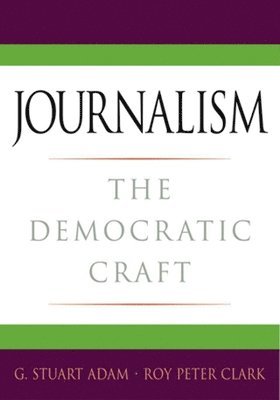
    Journalism

    AvAdam,Clark

    Häftad, Engelska, 2005

    2 549 kr

    Beställningsvara. Skickas inom 3-6 vardagar. Fri frakt över 249 kr.

    Beskrivning

    How does an instructor integrate journalism theory and practice in ways that are meaningful to students? G. Stuart Adam and Roy Peter Clark answer this question by combining relevant and engaging readings and practical writing instruction in Journalism: The Democratic Craft. An anthology and textbook in one, this volume enhances students' critical thinking skills and overall understanding of their discipline. It begins with inspirational reflections on journalism and democracy, followed by commentary on the journalistic craft. Adam and Clark, seasoned instructors at the Poynter Institute for Media Studies and elsewhere, present published works from a diversity of voices-from George Orwell, V. S. Naipaul, Susan Sontag, and John Hersey, to Seymour Hersh, David Halberstam, and Tom Wolfe. The book's content and organization are designed to strengthen students' practical skills. The authors introduce and promote the development of "The Editor's Lexicon"-terms that guide the creation of journalistic texts and direct their repair and evaluation.A language that master editors speak in their supervisory roles, this lexicon is also used by reporters when they make news judgments, gather evidence, compose stories, and interpret events. Each section features a concluding study guide and exercises that have been class-tested by the authors. These features provide for the effective use of the book by educators and students alike. Journalism: The Democratic Craft narrows the gap between the classroom and the profession, providing an all-in-one solution to the long lists of required books for advanced news writing and reporting courses.

    Produktinformation

    • Utgivningsdatum:2005-11-24
    • Vikt:610 g
    • Format:Häftad
    • Språk:Engelska
    • Antal sidor:416
    • Förlag:Oxford University Press Inc
    • ISBN:9780195182071

    Utforska kategorier

    • Media och underhållning inom Ekonomi och Ledarskap

    Innehållsförteckning

    • Part I: Authorship & Craft 1. Introduction 2. George Orwell, "Why I Write" 3. V.S. Naipaul, "On Being a Writer" 4. Joan Didion, "Why I Write" 5. Salman Rushdie, "In Good Faith" 6. George Plimpton, "Maya Angelou" 7. Robert Stone, "The Reason for Stories" 8. Study Guide: Talking Points and Workbench Part II: The Elements of Journalism A. NEWS 9. Introduction 10. Walter Lippmann, "The Nature of News" 11. Helen MacGill Hughes, "From Politics to Human Interest" 12. Frank Luther Mott, "What's the News?" 13. Daniel Boorstin, "From News Gathering to News Making: A Flood of Pseudo-Events" 14. Max Ways, "What's Wrong with News? It's Not New Enough" 15. Study Guide: Talking Points and Workbench B. FACTS AND EVIDENCE 16. Introduction 17. Walter Lippmann, "News, Truth, and a Conclusion" 18. John Carey, "Introduction" 19. James S. Ettema & Theodore L. Glasser, "On the Epistemology of Investigative Journalism" 20. John G. Morris, "Tuesday Was a Good D-Day for Life" 21. David Halberstam, "Getting the Story in Vietnam" 22. John Hersey, "The Legend on the License" 23. Seymour Hersh, "How I Broke the Mylai 4 Story" 24. Bill Kovach & Tom Rosenstiell, "Journalism of Verification" 25. Christopher Lydon, "The Boston Hoax: She Fought It, He Bought It" 26. Victor Cohn, "The Scientific Way" 27. Susan Sontag, "In Plato's Cave" 28. Roy Peter Clark, "The Line Between Fact and Fiction" 29. Robert Ezra Park, "News as a Form of Knowledge" 30. Study Guide: Talking Points and Workbench C. LANGUAGE AND NARRATIVE 31. Introduction 32. George Orwell, "Politics and the English Language" 33. Hugh Kenner, "The Politics of Plain Style" 34. S.I. Hayakawa & Alan R. Hayakawa, "Reports, Inferences, Judgments" 35. Robert Scholes & Robert Kellog, "The Narrative Tradition" 36. Tom Wolfe, "The Feature Game", "Like a Novel, "Seizing the Power" 37. Study Guide: Talking Points and Workbench D. INTERPRETATION 38. Introduction 39. Commission on Freedom of the Press, "The Requirements" 40. James Carey, "The Dark Continent of American Journalism" 41. Paul Starobin (with Pamela Varley), "Covering Campaign '96: The Conceptual Scoop" 42. Study Guide: Talking Points and Workbench Part III: Summation 43. An Introduction 44. G. Stuart Adam, Notes Towards a Definition of Journalism: Understanding an Old Craft as an Art Form 45. Study Guide: Talking Points and Workbench