• Fri frakt över 249 kr
  • •
  • Snabba leveranser
  • •
  • Billiga böcker
Kundservice

Du är på sajten för privatpersoner.

Företag, bibliotek eller offentlig verksamhet?

Du handlar på classic.bokus.com, där alla dina funktioner finns intakta.
Till classic.bokus.com
Bokus logotyp. Gå till startsidan.
  • Erbjudanden
  • Nyheter
  • Student
  • Topplistor
  • Barn & ungdom
  • Bokus Play
  • E-böcker
  • Pocketböcker
  • Spel & pussel

10% rabatt på allt med kod: NYSTART10 →

Sidfot

Mina sidor

    Hjälp

    • Kundservice
    • Vanliga frågor och svar
    • Frakt och leverans
    • Retur vid ångerrätt
    • Reklamera vara
    • Betalning
    • Köpvillkor
    • Allmänna villkor
    • Information om webbplatsens tillgänglighet

    Om Bokus

    • Om oss
    • Pressrum
    • För studenter
    • För företag
    • För bibliotek och offentlig verksamhet
    • För leverantörer
    • Hållbarhet

    Populärt

    • Aktuella erbjudanden
    • Presentkort
    • Studentlitteratur
    • Nya böcker
    • Topplistor
    • Signerade böcker
    • Engelska böcker

    Inspiration

    • Boktips
    • BookTok
    • Populära bokserier
    • Barnbokskaraktärer
    • Populära författare
    Logotyp för Bokus
    Följ oss på Facebook (extern länk)Följ oss på Instagram (extern länk)Följ oss på YouTube (extern länk)Följ oss på TikTok (extern länk)
    bokus @ CookiesAnpassa cookiesIntegritetspolicyKöpvillkor
    Till Citymail hemsida (extern länk)Till Budbee hemsida (extern länk)Till Postnord hemsida (extern länk)Till Schenker hemsida (extern länk)Till Early Bird hemsida (extern länk)Till Walleys hemsida (extern länk)
    1. Psykologi och pedagogik
    2. Psykologi
    3. Psykologiska teorier och skolor

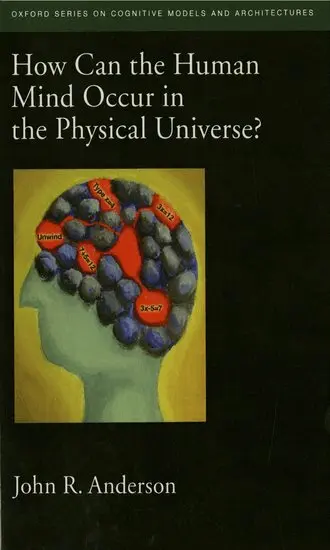
    How Can the Human Mind Occur in the Physical Universe?

    AvJohn R. Anderson

    Häftad, Engelska, 2009

    Del i serien Oxford Series on Cognitive Models and Architectures

    628 kr

    Beställningsvara. Skickas inom 5-8 vardagar. Fri frakt över 249 kr.

    Fler format och utgåvor

    E-bok

    332 kr

    Inbunden

    1 346 kr

    E-bok

    332 kr

    Beskrivning

    'The question for me is how can the human mind occur in the physical universe. We now know that the world is governed by physics. We now understand the way biology nestles comfortably within that. The issue is how will the mind do that as well.'--Alan Newell, December 4, 1991, Carnegie Mellon UniversityThe argument John Anderson gives in this book was inspired by the passage above, from the last lecture by one of the pioneers of cognitive science. Newell describes what, for him, is the pivotal question of scientific inquiry, and Anderson gives an answer that is emerging from the study of brain and behavior. Humans share the same basic cognitive architecture with all primates, but they have evolved abilities to exercise abstract control over cognition and process more complex relational patterns. The human cognitive architecture consists of a set of largely independent modules associated with different brain regions. In this book, Anderson discusses in detail how these various modules can combine to produce behaviors as varied as driving a car and solving an algebraic equation, but focuses principally on two of the modules: the declarative and procedural. The declarative module involves a memory system that, moment by moment, attempts to give each person the most appropriate possible window into his or her past. The procedural module involves a central system that strives to develop a set of productions that will enable the most adaptive response from any state of the modules. Newell argued that the answer to his question must take the form of a cognitive architecture, and Anderson organizes his answer around the ACT-R architecture, but broadens it by bringing in research from all areas of cognitive science, including how recent work in brain imaging maps onto the cogntive architecture.

    Produktinformation

    • Utgivningsdatum:2009-08-28
    • Mått:155 x 231 x 17 mm
    • Vikt:431 g
    • Format:Häftad
    • Språk:Engelska
    • Serie:Oxford Series on Cognitive Models and Architectures
    • Antal sidor:304
    • Förlag:OUP USA
    • ISBN:9780195398953

    Utforska kategorier

    • Psykologiska teorier och skolor inom Psykologi och pedagogik

    Mer om författaren

    John Anderson received his B.A. from the University of British Columbia in 1968 and his Ph.D. from Stanford University 1972. He has been at Carnegie Mellon University since 1978 where he is a professor of psychology and computer science. His current research is concerned with developing the ACT-R theory of cognition and involves two related enterprises. One effort is concerned with modeling the acquisition of intellectual competences with major foci being the dynamic problem solving skills such as in air traffic control and mathematical problem solving skills. This research is also tied into efforts to develop computer-based instructional systems. The second effort is concerned with using fMRI brain imaging to track different components of the cognitive architecture in the performance of complex tasks.

    Recensioner i media

    In this ground-breaking book, John Anderson brings together research on computational models of the mind and research on the operation of the brain. The book also provides the best description of the latest version of ACT, which is a significant extension in functionality and theory from its predecessors. The book is a must read for researchers and students in Cognitive Science.

    Innehållsförteckning

    • Preface ; 1 Cognitive Architecture ; 2 The Modular Organization of the Mind ; 3 Human Associative Memory ; 4 The Adaptive Control of Thought ; 5 What does it Take to be Human? Lessons from High-School Algebra ; 6 How Can the Human Mind Occur? ; Bibiliography