• Fri frakt över 249 kr
  • •
  • Snabba leveranser
  • •
  • Billiga böcker
Kundservice

Du är på sajten för privatpersoner.

Företag, bibliotek eller offentlig verksamhet?

Du handlar på classic.bokus.com, där alla dina funktioner finns intakta.
Till classic.bokus.com
Bokus logotyp. Gå till startsidan.
  • Erbjudanden
  • Nyheter
  • Student
  • Topplistor
  • Barn & ungdom
  • Bokus Play
  • E-böcker
  • Pocketböcker
  • Spel & pussel

10% rabatt på allt med kod: NYSTART10 →

Sidfot

Mina sidor

    Hjälp

    • Kundservice
    • Vanliga frågor och svar
    • Frakt och leverans
    • Retur vid ångerrätt
    • Reklamera vara
    • Betalning
    • Köpvillkor
    • Allmänna villkor
    • Information om webbplatsens tillgänglighet

    Om Bokus

    • Om oss
    • Pressrum
    • För studenter
    • För företag
    • För bibliotek och offentlig verksamhet
    • För leverantörer
    • Hållbarhet

    Populärt

    • Aktuella erbjudanden
    • Presentkort
    • Studentlitteratur
    • Nya böcker
    • Topplistor
    • Signerade böcker
    • Engelska böcker

    Inspiration

    • Boktips
    • BookTok
    • Populära bokserier
    • Barnbokskaraktärer
    • Populära författare
    Logotyp för Bokus
    Följ oss på Facebook (extern länk)Följ oss på Instagram (extern länk)Följ oss på YouTube (extern länk)Följ oss på TikTok (extern länk)
    bokus @ CookiesAnpassa cookiesIntegritetspolicyKöpvillkor
    Till Citymail hemsida (extern länk)Till Budbee hemsida (extern länk)Till Postnord hemsida (extern länk)Till Schenker hemsida (extern länk)Till Early Bird hemsida (extern länk)Till Walleys hemsida (extern länk)
    1. Samhälle och politik
    2. Politik och statsskick
    3. Internationella relationer

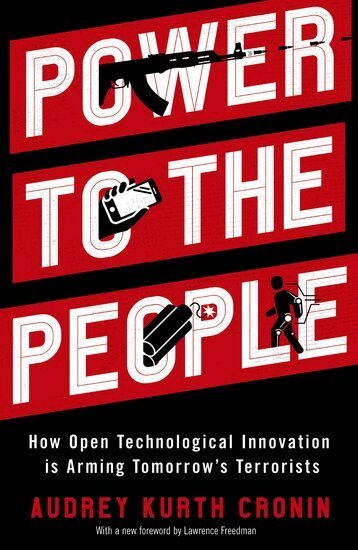
    Power to the People

    How Open Technological Innovation is Arming Tomorrow's Terrorists

    AvAudrey Kurth Cronin

    Häftad, Engelska, 2022

    283 kr

    Tillfälligt slut

    Fler format och utgåvor

    Inbunden

    315 kr

    E-bok

    142 kr

    E-bok

    142 kr

    Beskrivning

    Essential reading on how technology empowers rogue actors and how society can adapt.Never have so many possessed the means to be so lethal. A dramatic shift from 20th century "closed" military innovation to "open" innovation driven by commercial processes is underway. The diffusion of modern technology--robotics, cyber weapons, 3-D printing, synthetic biology, autonomous systems, and artificial intelligence--to ordinary people has given them access to weapons of mass violence previously monopolized by the state. As Audrey Kurth Cronin explains in Power to the People, what we are seeing now is the continuation of an age-old trend. Over the centuries, from the invention of dynamite to the release of the AK-47, many of the most surprising developments in warfare have occurred because of technological advances combined with changes in who can use them. That shifting social context illuminates our current situation, in which new "open" technologies are reshaping the future of war. Cronin explains why certain lethal technologies spread, which ones to focus on, and how individuals and private groups will adapt lethal off-the-shelf technologies for malevolent ends. Now in paperback with a foreword by Lawrence Freedman and a new epilogue, Power to the People focuses on how to both preserve the promise of emerging technologies and reduce risks. Power is flowing to the people, but the same digital technologies that empower can imperil global security--unless we act strategically.

    Produktinformation

    • Utgivningsdatum:2022-04-29
    • Mått:236 x 154 x 26 mm
    • Vikt:635 g
    • Format:Häftad
    • Språk:Engelska
    • Antal sidor:448
    • Förlag:OUP USA
    • ISBN:9780197578933

    Utforska kategorier

    • Internationella relationer inom Samhälle och politik
    • Vapen och utrustning inom Samhälle och politik

    Mer om författaren

    Audrey Kurth Cronin is one of the world's leading experts on security and terrorism, with high-level experience in public service and academia. She is currently Distinguished Professor of International Security and founding Director of the Center for Security, Innovation and New Technology at American University.

    Recensioner i media

    A Foreign Affairs Best Book of 2019

    Innehållsförteckning

    • Foreword by Lawrence FreedmanIntroduction: The Age of Lethal Empowerment PART ONE: THEORY Chapter 1: Classic Models of Military Innovation: Shaped by the Nuclear Revolution Introduction The Historical Relationship between War and Technology Innovation is Double-Edged The Social Nature of Diffusion Technology is Not Strategy Historical Context Matters Opening Pandora's Box Chapter 2: The Arsenal for Anarchy: When and How Violent Individuals and Groups Innovate Introduction The Historical Relationship between Political Violence and TechnologyHow Technologies Were Harnessed How Lethal Nonstate Actors Innovate Everett Rogers' Theory of Commercial Diffusion Revisited PART TWO: HISTORY Chapter 3: Dynamite and the Birth of Modern Terrorism Introduction The Advent of Gunpowder Early Explosive Violence from Below Gunpowder Helps Build the Modern World Alfred Nobel's Vision Dynamite Becomes the People's Weapon The Narodnaya Volya and the Killing of the Tsar The Skirmishers and Clan na Gael The International Anarchist Movement Why Dynamite Diffused Chapter 4: How Dynamite Diffused IntroductionInnovation Was Not Driven by the Military The Global Production of DynamiteGrowth Despite DangerInexorable Downward Pressure on PriceThe Stoking of Discontent The International Anarchist Convention of 1881 and 'Propaganda of the Deed' Dynamite Schools and Pamphlets Anarchist Newspapers and Periodicals Worldwide Mass Market Sensationalism Patterns in Numbers of AttacksHow Global Dynamitings Ended Nobel's Remorse Chapter 5: The Kalashnikov and the Global Wave of Insurgencies Introduction The Evolution of Firearms and the Introduction of the Machine Gun Kalashnikov's Invention of the AK-47 Why the AK-47 Was so Widely Adopted A Humble, Yet Disruptive Innovation Chapter 6: How the Kalashnikov Diffused The Kalashnikov's Debut and Public Demonstration Trading in Kalashnikovs The Diffusion of KalashnikovsA Proliferation of Factories The Revolutionary's Weapon of ChoiceBack to the USA The Impact on the Power of States Why the Kalashnikov SpreadThe Floodgates Opened Kalashnikov's RegretThe Power of Unintended Consequences PART THREE: CONVERGENCE: WIDESPREAD LETHAL EMPOWERMENT Chapter 7: Open Innovation of Mobilization: Social Media and Conquering Digital Terrain Introduction The New Nature of Mobilization New Tools for Old Tactics New Tools Used in New WaysBoundless Interactivity Mobile Streaming Videos and Live-streaming Quality First-Person Filmmaking TechnologyViral Fake News End-to-End Encryption Hijacking Psychological TacticsUnintended Consequences Redux Chapter 8: Open Innovation of Reach: From AK-47s to Drones, Robots, Smartphones, and 3-D Printing Introduction Convergent Technologies and Extended Reach The Scope of Unmanned Systems How Unmanned Aerial Vehicles Extend Private Reach Predators, Reapers, Global Hawk: Sustaining Technologies The Pattern of State-to-State Proliferation of UAVs State-to-Group Proliferation of UAVs: Hezbollah and Hamas These Are Not the Drones You're Looking For Terrorist and Insurgent Groups' Lethal UAV Programs Crowd-funded, "Grey Zone," and Private UAV Intelligence Advances in the Works Drones as Missiles Democratized Precision Strike Capability Everyone Manufactures Everything with 3D Printing Individual Flying Devices Lagging Countermeasures Chapter 9: An Army of One Launches Many: Autonomy and Artificial IntelligenceIntroductionA Spectrum of AutonomyThe Perils of Full Artificial IntelligenceThe Predictions of Lethal Empowerment TheoryAutonomous ReachSelf-driving Truck BombsHijacking the Internet of ThingsAutonomous SwarmsSmall Autonomous Killer RobotsTailored for Terrorism Conclusion: Strategy in an Age of Lethal Empowerment Powerful Economic Incentives for DiffusionTechnological Optimism and a Boom in TinkeringNew Communications Technologies Are Powerful Incentives to ViolenceMilitaries Are Facing the Innovator's DilemmaDisruptive Private Armies: The ISIS PrecedentResponding to the ThreatThe Profit Motive for ProtectionsRegulation Is Not Necessarily StrangulationBuilding Up National SecurityStrategy in an Age of Lethal Empowerment Epilogue