• Fri frakt över 249 kr
  • •
  • Snabba leveranser
  • •
  • Billiga böcker
Kundservice

Du är på sajten för privatpersoner.

Företag, bibliotek eller offentlig verksamhet?

Du handlar på classic.bokus.com, där alla dina funktioner finns intakta.
Till classic.bokus.com
Bokus logotyp. Gå till startsidan.
  • Erbjudanden
  • Student
  • Topplistor
  • Barn & ungdom
  • Bokus Play
  • E-böcker
  • Ljudböcker
  • Pocketböcker
  • Spel och pussel

Skapa nya rutiner – hälsoböcker upp till 50% →

Sidfot

Mina sidor

    Hjälp

    • Kundservice
    • Vanliga frågor och svar
    • Frakt och leverans
    • Retur vid ångerrätt
    • Reklamera vara
    • Betalning
    • Köpvillkor
    • Allmänna villkor
    • Information om webbplatsens tillgänglighet

    Om Bokus

    • Om oss
    • Pressrum
    • För studenter
    • För företag
    • För bibliotek och offentlig verksamhet
    • För leverantörer
    • Hållbarhet

    Populärt

    • Aktuella erbjudanden
    • Presentkort
    • Studentlitteratur
    • Nya böcker
    • Topplistor
    • Signerade böcker
    • Engelska böcker

    Inspiration

    • Boktips
    • BookTok
    • Barnbokskaraktärer
    • Populära författare
    Logotyp för Bokus
    Följ oss på Facebook (extern länk)Följ oss på Instagram (extern länk)Följ oss på YouTube (extern länk)Följ oss på TikTok (extern länk)
    bokus @ CookiesAnpassa cookiesIntegritetspolicyKöpvillkor
    Till Citymail hemsida (extern länk)Till Budbee hemsida (extern länk)Till Postnord hemsida (extern länk)Till Schenker hemsida (extern länk)Till Early Bird hemsida (extern länk)Till Walleys hemsida (extern länk)
    1. Filosofi och religion
    2. Filosofi
    3. Filosofiska discipliner

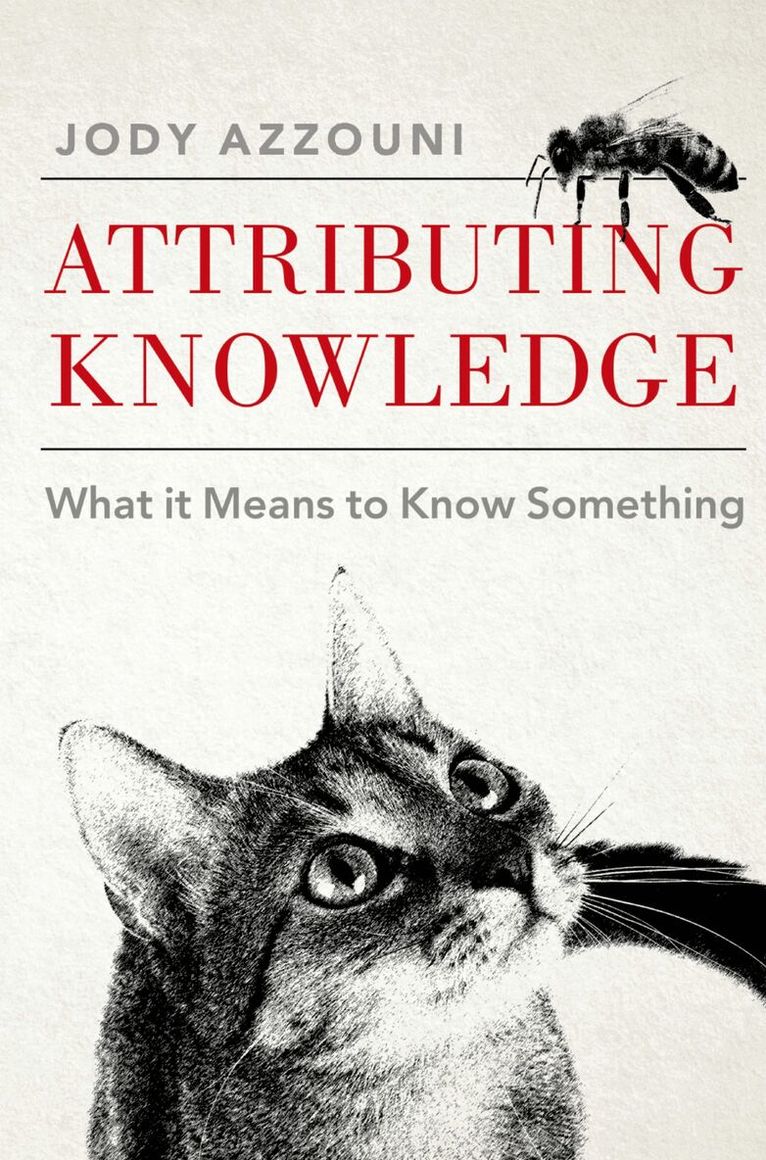
    Attributing Knowledge

    What It Means to Know Something

    AvJody Azzouni

    Häftad, Engelska, 2025

    283 kr

    Beställningsvara. Skickas inom 5-8 vardagar. Fri frakt över 249 kr.

    Fler format och utgåvor

    Inbunden

    1 374 kr

    E-bok

    1 083 kr

    E-bok

    1 083 kr

    Beskrivning

    In Attributing Knowledge, Jody Azzouni challenges philosophical conventions about what it means to know something. He argues that the restrictive conditions philosophers place on knowers only hold in special cases; knowledge can be attributed to babies, sophisticated animals (great apes, orcas), unsophisticated animals (bees), and machinery (drones, driverless cars). Azzouni also gives a fresh defense of fallibilism. Relying on lexical semantics and ordinary usage, he shows that there are no knowledge norms for assertion or action. He examines everyday cases of knowledge challenge and attribution to show many recent and popular epistemological positions are wrong. By providing a long-sought intelligible characterization of knowledge attribution, Azzouni explains why the concept has puzzled philosophers so long, and he solves longstanding and recent puzzles that have perplexed epistemologists--including the dogmatism paradox, Gettier puzzles, and the surprise-exam paradox. "This is a terrific book, full of surprises. For instance, Chapter 9 is full of points that are original, insightful, and useful in helping to resolve stale debates. I especially liked the points that we don't ordinarily describe someone as losing knowledge by gaining defeating evidence, that "knows" is vague and tri-scoped, that vagueness needn't be explained by appeal to precise metasemantic machinery, and that Williamson's anti-luminosity argument founders on the fact that knowledge doesn't require confidence. Bravo!" --Ram Neta, University of North Carolina, Chapel HillPraise for Jody Azzouni's Ontology without Borders:"Azzouni offers a very strong drink, proposing that we do without central elements of what almost anyone would call logic or ontology. His arguments are serious and wide-ranging. If he's right, the reader will have learned something very important. If he's wrong, then the reader who figures out how he went wrong will also have learned something very important. Not every book has this feature." --Michael Gorman, The Catholic University of America

    Produktinformation

    • Utgivningsdatum:2025-08-18
    • Mått:163 x 231 x 35 mm
    • Vikt:680 g
    • Format:Häftad
    • Språk:Engelska
    • Antal sidor:480
    • Förlag:OUP USA
    • ISBN:9780197803042

    Utforska kategorier

    • Filosofiska discipliner inom Filosofi och religion

    Mer om författaren

    Jody Azzouni received his doctorate from The CUNY Graduate Center and is Professor of Philosophy at Tufts University. He writes broadly in philosophy of mathematics, science, logic and language, as well as in epistemology and metaphysics.

    Recensioner i media

    ... an excellent, engaging piece of analytic philosophy...Summing Up: Recommended. Graduate students, researchers, faculty.

    Innehållsförteckning

    • ContentsIntroduction1. Knowledge attributions to minimal epistemic agents2. Knowledge and knowing that P; "knowledge" and "knowing that P"3. The variability of know(s) that judgments4. Assertion norms5. Usage traps in the language of iterated knowledge attributions6. Iterated and ground-floor knowledge, KK and K¬K, arguments and empirical studies7. Inferential justification8. Representational justification and challenges to "the given"9. Confidence, belief and knowledge; the vagueness of "know(s)"10. Usage challenges to fallibilism11. The (complex) structure of the meaning of "know(s)"Appendix: The aesthetics of hangman knots Detailed ContentsIntroductionPart 1i. Epistemology: What it isii. The importance of wordsiii. Some of the distinctive epistemic claims I attempt in this bookiv. Brief synopses of the chapters in this bookPart 2v. Insights from lexical semantics: Ambiguity and polysemyvi. Insights from lexical semantics: Retraction and the factivity of "know(s)"vii. Insights from lexical semantics: Literality and metaphoricalityviii. Insights from lexical semantics: Semantic entailmentsix. The lexical analysis of words versus the functional analysis of themx. An example: "true" xi. Xphilosophy and the threat of idiolectical scepticism1. Knowledge attributions to minimal epistemic agents1.1 First remarks1.2 What animals know1.3 Insects and non-biological things know a lot too1.4 The flexibility of cognition attributions: *Q ing that p1.5 Knowledge, belief, action and consciousness1.6 Knowledge and belief (and consciousness too)1.7 Mindless knowing1.8 Final lesson from knowledge attributions to animals: Methods of knowing aren't modular1.9 What's been done and a look ahead2. Knowledge and knowing that A; "knowledge" and "knowing that"2.1 First remarks2.2 "Knowledge"2.3 "Knowing P" and "knowing that P"3. The variability of know(s)-that judgments3.1 First remarks3.2 Some thought experiments that are problematic for classic invariantists3.3 Hawthorne's DSK principle3.4 Comparing knowing and knowledge attributions across contexts3.5 Comparing knowing and knowledge attributions across agents3.6 Knowledge-relativism denied3.7 What speaker-hearers can reasonably be taken to be confused about with respect to their own usage3.8 Making progress? (Where we are and where we're going)4. Assertion norms4.1 Introduction; preliminaries about assertion4.2 Semantic perceptions4.3 Experiencing asserting, assertions, and their differences4.4 The assertions of spokespersons and Moorean remarks4.5 Assertions: Of journalists, in advertisements, by cartoon characters and flakes4.6 Assertion norms4.7 Burge's acceptance principle4.8 Expectations in special cases4.9 Concluding remarks5. Usage traps in the language of iterated knowledge attributions5.1 Introductory remarks about KK and K¬K, and about metacognition5.2 Exclamation and redundancy uses of "know(s)"5.3 Redundancy usages for "aware" and the puzzling case of pain5.4 Iterated knowledge and an agent's command of her concepts5.5 Davidson, Dretske, Esken, and Malcolm on metacognition, cognition, belief and metabelief5.6 Iterated knowledge and belief, and justification5.7 Level-confusions in epistemology5.8 Conclusion and transition to the next chapter6. Iterated and ground-floor cognition, KK and K¬K arguments and empirical studies6.1 Introduction6.2 The Cartesian perspective: Full metacognition about the self6.3 A very minimal ground-floor epistemic agent who cognizes and knows without iterated knowledge or cognitions6.4 The non-transparency of knowing state6.5 Iterated knowledge about deduction6.6 Nonhuman-animal studies in "metacognition"6.7 A possible case of nonhuman-animal iterated cognition?6.8 Conclusion7. Inferential justification7.1 First remarks7.2 Justification truth7.3 Justifications based on truth-preserving deduction7.4 Infinite chains of justifications7.4.1 Infinite deductive sequences of justifications7.4.2 Probabilistic infinite sequences of justifications7.4.3 A failing grade for infinitism, nevertheless7.5 Conclusion8. Representational justification and challenges to the given8.1 Representational justification characterized8.2 Representation and deduction exhaust justification8.3 The given-dilemma for nonpropositional justification8.4 Why representational justifications needn't be experiential8.5 There are justificational stopping points8.6 Justificational stopping points in conversation8.7 Metacognitive motivations for enriching justification8.8 Concluding remarks9. Confidence, belief and knowledge; the vagueness of "know(s)"9.1 Introduction9.2 Piecemeal knowledge and piecemeal iterated knowledge9.3 Confidence, knowledge and iterated knowledge9.4 The invisibility of epistemic standards; the invisibility of the vagueness of epistemic standards9.5 Williamson on KK9.6 Concluding remarks10. Usage challenges to fallibilism10.1 Introduction10.2 Preliminaries: Characterizing fallibilism, infallibilism and parity reasoning10.3 When factivity misleads10.4 The factivity of "know(s)" and Kripke's dogmatism paradox10.5 The factivity and fallibility of "know(s)," and lotteries10.6 Going to extremes10.7 Prefaces and lotteries10.8 Fallibility implies the denial of knowledge closure10.9 Rational belief and concluding remarks11. The (complex) structure of the meaning of "know(s)"11.1 Introduction11.2 Necessary conditions and sufficient conditions for "know(s)"; the relation of these conditions to criterion transcendence11.3 Why "know(s)" evades a definition11.4 Conceptually engineering a successor notion to "know(s)"?11.5 Social-role epistemology11.6 Conclusion (to the whole book)Appendix: The aesthetics of hangman knots
    Hoppa över listan

    Mer från samma författare

    Jody Azzouni - Ontology Without Borders, Häftad

    Ontology Without Borders

    Jody Azzouni

    Häftad, 2019

    620 kr

    Jody Azzouni - Knowledge and Reference in Empirical Science, Inbunden

    Knowledge and Reference in Empirical Science

    Jody Azzouni

    Inbunden, 2000

    2 402 kr

    Jody Azzouni - Semantic Perception, Häftad

    Semantic Perception

    Jody Azzouni

    Häftad, 2015

    874 kr

    Jody Azzouni - Deflating Existential Consequence, E-bok

    Deflating Existential Consequence

    Jody Azzouni

    E-bok
    2004

    409 kr

    Jody Azzouni - Tracking Reason, E-bok

    Tracking Reason

    Jody Azzouni

    E-bok
    2005

    378 kr

    Jody Azzouni - Ontology Without Borders, Inbunden

    Ontology Without Borders

    Jody Azzouni

    Inbunden, 2017

    1 772 kr

    Jody Azzouni - Ontology Without Borders, E-bok

    Ontology Without Borders

    Jody Azzouni

    E-bok
    2017

    409 kr

    Jody Azzouni - Ontology Without Borders, E-bok

    Ontology Without Borders

    Jody Azzouni

    E-bok
    2017

    409 kr

    Jody Azzouni - Deflating Existential Commitment, Inbunden

    Deflating Existential Commitment

    Jody Azzouni

    Inbunden, 2004

    1 666 kr

    Jody Azzouni - Tracking Reason, Inbunden

    Tracking Reason

    Jody Azzouni

    Inbunden, 2006

    816 kr

    Hoppa över listan

    Du kanske också är intresserad av

    Jody Azzouni - Attributing Knowledge, E-bok

    Attributing Knowledge

    Jody Azzouni

    E-bok
    2020

    1 083 kr

    Jody Azzouni - Attributing Knowledge, Inbunden

    Attributing Knowledge

    Jody Azzouni

    Inbunden, 2020

    1 374 kr

    Jody Azzouni - Attributing Knowledge, E-bok

    Attributing Knowledge

    Jody Azzouni

    E-bok
    2020

    1 083 kr

    Jody Azzouni - Tracking Reason, E-bok

    Tracking Reason

    Jody Azzouni

    E-bok
    2005

    347 kr

    Jody Azzouni - Ontology Without Borders, E-bok

    Ontology Without Borders

    Jody Azzouni

    E-bok
    2017

    409 kr

    Jody Azzouni - Deflating Existential Commitment, Inbunden

    Deflating Existential Commitment

    Jody Azzouni

    Inbunden, 2004

    1 666 kr

    Jody Azzouni - Rule-Following Paradox and its Implications for Metaphysics, Inbunden

    Rule-Following Paradox and its Implications for Metaphysics

    Jody Azzouni

    Inbunden, 2017

    968 kr

    Jody Azzouni - Anatomy of Experience, E-bok

    Anatomy of Experience

    Jody Azzouni

    E-bok
    2026

    876 kr

    Jody Azzouni - Challenging Knowledge, E-bok

    Challenging Knowledge

    Jody Azzouni

    E-bok
    2025

    950 kr

    Jody Azzouni - Deflating Existential Consequence, E-bok

    Deflating Existential Consequence

    Jody Azzouni

    E-bok
    2004

    363 kr