• Fri frakt över 249 kr
  • •
  • Snabba leveranser
  • •
  • Billiga böcker
Kundservice

Du är på sajten för privatpersoner.

Företag, bibliotek eller offentlig verksamhet?

Du handlar på classic.bokus.com, där alla dina funktioner finns intakta.
Till classic.bokus.com
Bokus logotyp. Gå till startsidan.
  • Erbjudanden
  • Nyheter
  • Student
  • Topplistor
  • Barn & ungdom
  • Bokus Play
  • E-böcker
  • Pocketböcker
  • Spel & pussel

10% studentrabatt med kod TERM26

Sidfot

Mina sidor

    Hjälp

    • Kundservice
    • Vanliga frågor och svar
    • Frakt och leverans
    • Retur vid ångerrätt
    • Reklamera vara
    • Betalning
    • Köpvillkor
    • Allmänna villkor
    • Information om webbplatsens tillgänglighet

    Om Bokus

    • Om oss
    • Pressrum
    • För studenter
    • För företag
    • För bibliotek och offentlig verksamhet
    • För leverantörer
    • Hållbarhet

    Populärt

    • Aktuella erbjudanden
    • Presentkort
    • Studentlitteratur
    • Nya böcker
    • Topplistor
    • Signerade böcker
    • Engelska böcker

    Inspiration

    • Boktips
    • BookTok
    • Populära bokserier
    • Barnbokskaraktärer
    • Populära författare
    Logotyp för Bokus
    Följ oss på Facebook (extern länk)Följ oss på Instagram (extern länk)Följ oss på YouTube (extern länk)Följ oss på TikTok (extern länk)
    bokus @ CookiesAnpassa cookiesIntegritetspolicyKöpvillkor
    Till Citymail hemsida (extern länk)Till Budbee hemsida (extern länk)Till Postnord hemsida (extern länk)Till Schenker hemsida (extern länk)Till Early Bird hemsida (extern länk)Till Walleys hemsida (extern länk)
    1. Språk och ordböcker
    2. Språkvetenskap och lingvistik

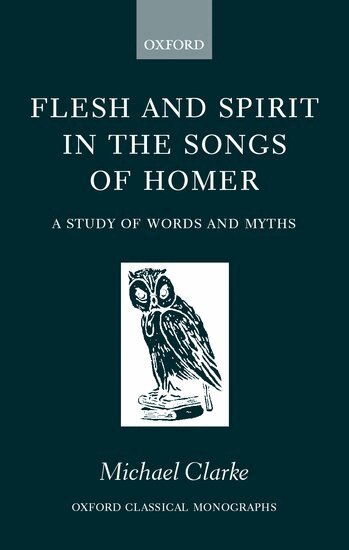
    Flesh and Spirit in the Songs of Homer

    A Study of Words and Myths

    AvMichael Clarke

    Inbunden, Engelska, 2000

    Del i serien Oxford Classical Monographs

    4 520 kr

    Beställningsvara. Skickas inom 5-8 vardagar. Fri frakt över 249 kr.

    Beskrivning

    In the epics of Homer people experience emotions, carry out thought, express themselves, suffer death, and survive in a shadowy afterlife. When Homer describes these processes he reveals his sense of human identity; his conception of the self and its relation to the visible body. Despite many generations of study a fully satisfactory account of that conception has never been offered, partly because analyses of word-meanings, world-picture, and literary tradition have proceeded along separate paths. This book offers a newly integrated interpretation of Homeric man. The author starts with the working hypothesis that, in this poetry, the human being is not divided into two parts - inner and outer; body and soul; flesh and spirit - but stands as an indivisible unity. Thought and emotion are precisely the same as the movement of breath, blood, and fluids in the breast; the thinking self and the visible flesh are inextricably united, with no sense of man having either a mind or a body as a constituent part of himself; and at death the journey to the Underworld is fundamentally the same as the descent of the corpse into the soil. The last part of this analysis leads to a reassessment of the Homeric psuche, an entity which leaves the mouth at death and whose name is often misleadingly translated as soul. This study of the psuche leads to a new view of life in the Underworld, with wider implications for the study of the interrelation between myth, poetic narrative, and the meanings of early Greek words.

    Produktinformation

    • Utgivningsdatum:2000-03-09
    • Mått:144 x 224 x 26 mm
    • Vikt:630 g
    • Format:Inbunden
    • Språk:Engelska
    • Serie:Oxford Classical Monographs
    • Antal sidor:394
    • Förlag:Clarendon Press
    • ISBN:9780198152637

    Utforska kategorier

    • Språkvetenskap och lingvistik inom Språk och ordböcker
    • Litteraturvetenskap inom Skönlitteratur

    Mer om författaren

    Michael Clarke is a Lecturer at the Department of Ancient Classics, National University of Ireland, Maynooth.

    Recensioner i media

    by close and detailed attention to the words of Homer, C. has arrived at a sophisticated reconsideration of previous understandings of a set of slippery terms that are at the centre of how the corporeal self is constituted in the Homeric world.