• Fri frakt över 249 kr
  • •
  • Snabba leveranser
  • •
  • Billiga böcker
Kundservice

Du är på sajten för privatpersoner.

Företag, bibliotek eller offentlig verksamhet?

Du handlar på classic.bokus.com, där alla dina funktioner finns intakta.
Till classic.bokus.com
Bokus logotyp. Gå till startsidan.
  • Erbjudanden
  • Nyheter
  • Student
  • Topplistor
  • Barn & ungdom
  • Bokus Play
  • E-böcker
  • Pocketböcker
  • Spel & pussel

10% rabatt på allt med kod: NYSTART10 →

Sidfot

Mina sidor

    Hjälp

    • Kundservice
    • Vanliga frågor och svar
    • Frakt och leverans
    • Retur vid ångerrätt
    • Reklamera vara
    • Betalning
    • Köpvillkor
    • Allmänna villkor
    • Information om webbplatsens tillgänglighet

    Om Bokus

    • Om oss
    • Pressrum
    • För studenter
    • För företag
    • För bibliotek och offentlig verksamhet
    • För leverantörer
    • Hållbarhet

    Populärt

    • Aktuella erbjudanden
    • Presentkort
    • Studentlitteratur
    • Nya böcker
    • Topplistor
    • Signerade böcker
    • Engelska böcker

    Inspiration

    • Boktips
    • BookTok
    • Populära bokserier
    • Barnbokskaraktärer
    • Populära författare
    Logotyp för Bokus
    Följ oss på Facebook (extern länk)Följ oss på Instagram (extern länk)Följ oss på YouTube (extern länk)Följ oss på TikTok (extern länk)
    bokus @ CookiesAnpassa cookiesIntegritetspolicyKöpvillkor
    Till Citymail hemsida (extern länk)Till Budbee hemsida (extern länk)Till Postnord hemsida (extern länk)Till Schenker hemsida (extern länk)Till Early Bird hemsida (extern länk)Till Walleys hemsida (extern länk)
    1. Filosofi och religion
    2. Religion och tro
    3. Religion: allmänt

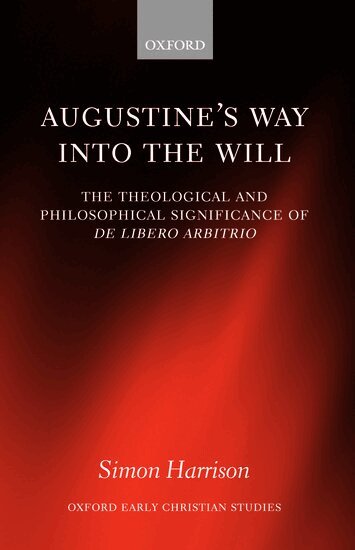
    Augustine's Way into the Will

    The Theological and Philosophical Significance of De libero arbitrio

    AvSimon Harrison

    Inbunden, Engelska, 2006

    Del i serien Oxford Early Christian Studies

    2 551 kr

    Beställningsvara. Skickas inom 5-8 vardagar. Fri frakt över 249 kr.

    Fler format och utgåvor

    E-bok

    1 633 kr

    Beskrivning

    Augustine's dialogue De libero arbitrio (On Free Choice) is, with his Confessions and City of God, one of his most important and widely read works. It contains one of the earliest accounts of the concept of 'free will' in the history of philosophy. Composed during a key period in Augustine's early career, between his conversion to Christianity and his ordination as a bishop, it has often been viewed as a an incoherent mixture of his 'early' and 'late' thinking. Simon Harrison offers an original account of Augustine's theory of will, taking seriously both the philosophical arguments and literary form of the text. Relating De libero arbitrio to other key texts of Augustine's, in particular the City of God and the Confessions, Harrison shows that Augustine approaches the problem of free will as a problem of knowledge: how do I know that I am free?, and that Augustine uses the dialogue form to instantiate his 'way into the will'.

    Produktinformation

    • Utgivningsdatum:2006-11-02
    • Mått:140 x 223 x 18 mm
    • Vikt:381 g
    • Format:Inbunden
    • Språk:Engelska
    • Serie:Oxford Early Christian Studies
    • Antal sidor:208
    • Förlag:OUP OXFORD
    • ISBN:9780198269847

    Utforska kategorier

    • Religion: allmänt inom Filosofi och religion
    • Kristendom inom Filosofi och religion

    Mer om författaren

    Simon Harrison was formerly a Research Fellow of St John's College, Cambridge, and is currently training in medicine.

    Recensioner i media

    Harrison's detailed attention to the text Lib. Arb., and in particular, to 1.12.25, is reminiscent of Jane Austen's description of 'the little bit (two inches wide) of ivory on which I work with so fine a brush'. The labour, however, is a rewarding one, demonstrating why for Augustine the reality of the human will is and remains undeniable, and showing us teh connectiions he drawsbetween the human will and our capacities to think and know.

    Innehållsförteckning

    • 1. Introduction ; 2. Dissecting 'de libero arbitrio' ; 3. The integrity of lib.arb. ; 4. Approaching the will ; 5. Understanding, knowledge, and reponsibility ; 6. Facilitas, difficultas, and voluntas ; 7. A cogito-like argument? ; 8. Conclusion