• Fri frakt över 249 kr
  • •
  • Snabba leveranser
  • •
  • Billiga böcker
Kundservice

Du är på sajten för privatpersoner.

Företag, bibliotek eller offentlig verksamhet?

Du handlar på classic.bokus.com, där alla dina funktioner finns intakta.
Till classic.bokus.com
Bokus logotyp. Gå till startsidan.
  • Erbjudanden
  • Nyheter
  • Student
  • Topplistor
  • Barn & ungdom
  • Bokus Play
  • E-böcker
  • Pocketböcker
  • Spel & pussel

10% rabatt på allt med kod: NYSTART10 →

Sidfot

Mina sidor

    Hjälp

    • Kundservice
    • Vanliga frågor och svar
    • Frakt och leverans
    • Retur vid ångerrätt
    • Reklamera vara
    • Betalning
    • Köpvillkor
    • Allmänna villkor
    • Information om webbplatsens tillgänglighet

    Om Bokus

    • Om oss
    • Pressrum
    • För studenter
    • För företag
    • För bibliotek och offentlig verksamhet
    • För leverantörer
    • Hållbarhet

    Populärt

    • Aktuella erbjudanden
    • Presentkort
    • Studentlitteratur
    • Nya böcker
    • Topplistor
    • Signerade böcker
    • Engelska böcker

    Inspiration

    • Boktips
    • BookTok
    • Populära bokserier
    • Barnbokskaraktärer
    • Populära författare
    Logotyp för Bokus
    Följ oss på Facebook (extern länk)Följ oss på Instagram (extern länk)Följ oss på YouTube (extern länk)Följ oss på TikTok (extern länk)
    bokus @ CookiesAnpassa cookiesIntegritetspolicyKöpvillkor
    Till Citymail hemsida (extern länk)Till Budbee hemsida (extern länk)Till Postnord hemsida (extern länk)Till Schenker hemsida (extern länk)Till Early Bird hemsida (extern länk)Till Walleys hemsida (extern länk)
    1. Språk och ordböcker
    2. Språkvetenskap och lingvistik

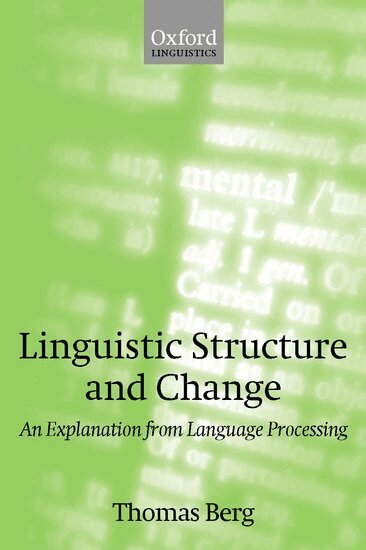
    Linguistic Structure and Change

    An Explanation from Language Processing

    AvThomas Berg

    Häftad, Engelska, 2001

    292 kr

    Beställningsvara. Skickas inom 7-10 vardagar. Fri frakt över 249 kr.

    Fler format och utgåvor

    Inbunden

    3 498 kr

    Beskrivning

    Thomas Berg challenges context-free theories of linguistics; he is concerned with how the term 'explanation' is typically used in the discipline. He argues that real explanations cannot emerge from a view which asserts the autonomy of language, but only from an approach which seeks to establish a connection between language and the contexts in which it is embedded.The author examines the psychological context in detail. He uses an interactive activation model of language processing to derive predictions about synchronic linguistic patterns, the course of linguistic change, and the structure of poetic rhymes. The majority of these predictions are borne out, and the author concludes that the structure of language is shaped by the properties of the mechanism which puts it to use, and that psycholinguistics thus qualifies as one likely approach from which to derive an explanation of linguistic structure.

    Produktinformation

    • Utgivningsdatum:2001-02-15
    • Mått:156 x 233 x 20 mm
    • Vikt:507 g
    • Format:Häftad
    • Språk:Engelska
    • Antal sidor:350
    • Förlag:OUP OXFORD
    • ISBN:9780198299851

    Utforska kategorier

    • Språkvetenskap och lingvistik inom Språk och ordböcker

    Mer om författaren

    Thomas Berg is Professor of Linguistics at the University of Hamburg.

    Recensioner i media

    The book can be praised for the breadth of linguistic and psycholinguistic patterns that are discussed, and for the way the results are integrated into a complete model of linguistic patterning . . . a much needed contribution to a relatively understudied area of linguistic research that is gradually entering the theoretical realm. This work has broad implications for many of the foundational issues of linguistic theory.

    Innehållsförteckning

    • 1. On the 'Art' of Explanation ; 2. Explanation from a Macrolinguistic Perspective ; 3. Method ; 4. Language Structure ; 5. Language Change ; 6. Poetic Language ; 7. Discussion ; 8. A Psycholinguistic Model of Language Structure and Change ; 9. Implications for Psycholinguistic Theory ; 10. The Overall Perspective: Reductionist or Non-Reductionist?