• Fri frakt över 249 kr
  • •
  • Snabba leveranser
  • •
  • Billiga böcker
Kundservice

Du är på sajten för privatpersoner.

Företag, bibliotek eller offentlig verksamhet?

Du handlar på classic.bokus.com, där alla dina funktioner finns intakta.
Till classic.bokus.com
Bokus logotyp. Gå till startsidan.
  • Erbjudanden
  • Nyheter
  • Student
  • Topplistor
  • Barn & ungdom
  • Bokus Play
  • E-böcker
  • Pocketböcker
  • Spel & pussel

10% rabatt på allt med kod: NYSTART10 →

Sidfot

Mina sidor

    Hjälp

    • Kundservice
    • Vanliga frågor och svar
    • Frakt och leverans
    • Retur vid ångerrätt
    • Reklamera vara
    • Betalning
    • Köpvillkor
    • Allmänna villkor
    • Information om webbplatsens tillgänglighet

    Om Bokus

    • Om oss
    • Pressrum
    • För studenter
    • För företag
    • För bibliotek och offentlig verksamhet
    • För leverantörer
    • Hållbarhet

    Populärt

    • Aktuella erbjudanden
    • Presentkort
    • Studentlitteratur
    • Nya böcker
    • Topplistor
    • Signerade böcker
    • Engelska böcker

    Inspiration

    • Boktips
    • BookTok
    • Populära bokserier
    • Barnbokskaraktärer
    • Populära författare
    Logotyp för Bokus
    Följ oss på Facebook (extern länk)Följ oss på Instagram (extern länk)Följ oss på YouTube (extern länk)Följ oss på TikTok (extern länk)
    bokus @ CookiesAnpassa cookiesIntegritetspolicyKöpvillkor
    Till Citymail hemsida (extern länk)Till Budbee hemsida (extern länk)Till Postnord hemsida (extern länk)Till Schenker hemsida (extern länk)Till Early Bird hemsida (extern länk)Till Walleys hemsida (extern länk)
    1. Naturvetenskap och teknik
    2. Matematik och naturvetenskap
    3. Kemi

    The Chemical Bond in Inorganic Chemistry

    The Bond Valence Model

    AvI. David Brown

    Inbunden, Engelska, 2016

    Del 27 i serien International Union of Crystallography Monographs on Crystallography

    2 234 kr

    Beställningsvara. Skickas inom 5-8 vardagar. Fri frakt över 249 kr.

    Beskrivning

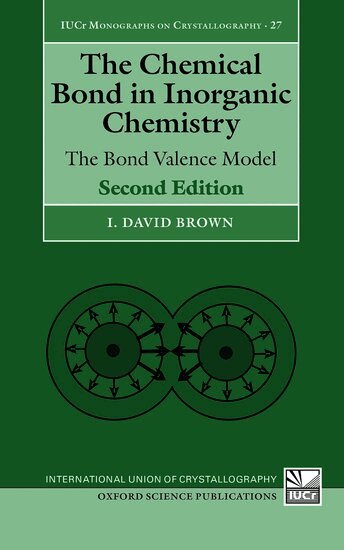
    The bond valence model, a description of acid-base bonding, is widely used for analysing and modelling the structures and properties of solids and liquids. Unlike other models of inorganic chemical bonding, the bond valence model is simple, intuitive, and predictive, and is accessible to anyone with a pocket calculator and a secondary school command of chemistry and physics. This new edition of 'The Chemical Bond in Inorganic Chemistry: The Bond Valence Model' shows how chemical properties arise naturally from the conflict between the constraints of chemistry and those of three-dimensional space. The book derives the rules of the bond valence model, as well as those of the traditional covalent, ionic and popular VSEPR models, by identifying the chemical bond with the electrostatic flux linking the bonded atoms. Most of the new edition is devoted to showing how to apply these ideas to real materials including crystals, liquids, glasses and surfaces. The work includes detailed examples of applications, and the final chapter explores the relationship between the flux and quantum theories of the bond.

    Produktinformation

    • Utgivningsdatum:2016-09-08
    • Mått:171 x 234 x 23 mm
    • Vikt:696 g
    • Format:Inbunden
    • Språk:Engelska
    • Serie:International Union of Crystallography Monographs on Crystallography
    • Antal sidor:330
    • Upplaga:2
    • Förlag:OUP OXFORD
    • ISBN:9780198742951

    Utforska kategorier

    • Kemi inom Naturvetenskap och teknik
    • Oorganisk kemi inom Naturvetenskap och teknik
    • Materietillstånd inom Naturvetenskap och teknik

    Mer om författaren

    David Brown is Professor Emeritus at the Department of Physics and Astronomy, McMaster University, Hamilton, Ontario, Canada.

    Recensioner i media

    Review from previous edition A highly readable book about a theory that, though it has long found application in inorganic crystal chemistry, deserves to be used more widely.

    Innehållsförteckning

    • Preface 1: Historical introduction 2: The flux theory of the chemical bond 3: The bond valence model 4: Cation coordination number 5: Hydrogen bonds 6: Liquids 7: Electronically distorted structures 8: Physical properties of bonds 9: Space and space groups 10: Modelling inorganic structures 11: Steric strain 12: Applications 13: Chemical implications App. 1: Bond valence parameters App. 2: Space group spectra App. 3: Refcodes App. 4: Glossary