• Fri frakt över 249 kr
  • •
  • Snabba leveranser
  • •
  • Billiga böcker
Kundservice

Du är på sajten för privatpersoner.

Företag, bibliotek eller offentlig verksamhet?

Du handlar på classic.bokus.com, där alla dina funktioner finns intakta.
Till classic.bokus.com
Bokus logotyp. Gå till startsidan.
  • Erbjudanden
  • Nyheter
  • Student
  • Topplistor
  • Barn & ungdom
  • Bokus Play
  • E-böcker
  • Pocketböcker
  • Spel & pussel

10% rabatt på allt med kod NYSTART10 →

Sidfot

Mina sidor

    Hjälp

    • Kundservice
    • Vanliga frågor och svar
    • Frakt och leverans
    • Retur vid ångerrätt
    • Reklamera vara
    • Betalning
    • Köpvillkor
    • Allmänna villkor
    • Information om webbplatsens tillgänglighet

    Om Bokus

    • Om oss
    • Pressrum
    • För studenter
    • För företag
    • För bibliotek och offentlig verksamhet
    • För leverantörer
    • Hållbarhet

    Populärt

    • Aktuella erbjudanden
    • Presentkort
    • Studentlitteratur
    • Nya böcker
    • Topplistor
    • Signerade böcker
    • Engelska böcker

    Inspiration

    • Boktips
    • BookTok
    • Populära bokserier
    • Barnbokskaraktärer
    • Populära författare
    Logotyp för Bokus
    Följ oss på Facebook (extern länk)Följ oss på Instagram (extern länk)Följ oss på YouTube (extern länk)Följ oss på TikTok (extern länk)
    bokus @ CookiesAnpassa cookiesIntegritetspolicyKöpvillkor
    Till Citymail hemsida (extern länk)Till Budbee hemsida (extern länk)Till Postnord hemsida (extern länk)Till Schenker hemsida (extern länk)Till Early Bird hemsida (extern länk)Till Walleys hemsida (extern länk)
    1. Skönlitteratur
    2. Litteraturvetenskap
    3. Litteraturvetenskap

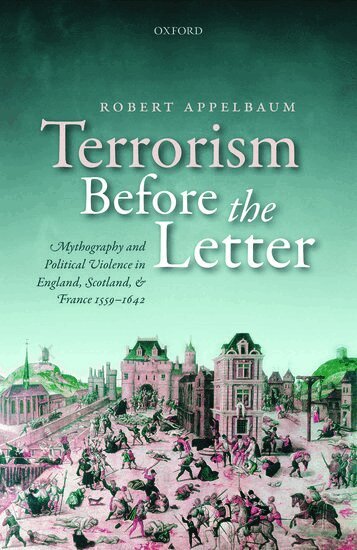
    Terrorism Before the Letter

    Mythography and Political Violence in England, Scotland, and France 1559-1642

    AvRobert Appelbaum

    Inbunden, Engelska, 2015

    2 466 kr

    Beställningsvara. Skickas inom 5-8 vardagar. Fri frakt över 249 kr.

    Fler format och utgåvor

    E-bok

    1 592 kr

    Beskrivning

    Beginning around 1559 and continuing through 1642, writers in England, Scotland, and France found themselves pre-occupied with an unusual sort of crime, a crime without a name which today we call 'terrorism'. These crimes were especially dangerous because they were aimed at violating not just the law but the fabric of law itself; and yet they were also, from an opposite point of view, especially hopeful, for they seemed to have the power of unmaking a systematic injustice and restoring a nation to its 'ancient liberty'. The Bible and the annals of classical history were full of examples: Ehud assassinating King Eglon of Moab; Samson bringing down the temple in Gaza; Catiline arousing a conspiracy of terror in republican Rome; Marcus Brutus leading a conspiracy against the life of Julius Caesar. More recent history provided examples too: legends about Mehmed II and his concubine Irene; the assassination in Florence of Duke Alessandro de 'Medici, by his cousin Lorenzino. Terrorism Before the Letter recounts how these stories came together in the imaginations of writers to provide a system of 'enabling fictions', in other words a 'mythography', that made it possible for people of the sixteenth and seventeenth centuries to think (with and about) terrorism, to engage in it or react against it, to compose stories and devise theories in response to it, even before the word and the concept were born. Terrorist violence could be condoned or condemned, glorified or demonised. But it was a legacy of political history and for a while an especially menacing form of aggression, breaking out in assassinations, abductions, riots, and massacres, and becoming a spectacle of horror and hope on the French and British stage, as well as the main theme of numerous narratives and lyrical poems.This study brings to life the controversies over 'terrorism before the letter' in the early modern period, and it explicates the discourse that arose around it from a rhetorical as well as a structural point of view. Kenneth Burke's 'pentad of motives' helps organise the material, and show how complex the concept of terrorist action could be. Terrorism is usually thought to be a modern phenomenon. But it is actually a foundational figure of the European imagination, at once a reality and a myth, and it has had an impact on political life since the beginnings of Europe itself. Terrorism is a violence that communicates, and the dynamics of communication itself reveal it special powers and inevitable failures.

    Produktinformation

    • Utgivningsdatum:2015-12-10
    • Mått:160 x 241 x 21 mm
    • Vikt:558 g
    • Format:Inbunden
    • Språk:Engelska
    • Antal sidor:284
    • Förlag:OUP OXFORD
    • ISBN:9780198745761

    Utforska kategorier

    • Litteraturvetenskap inom Skönlitteratur
    • Historia inom Historia och arkeologi

    Mer om författaren

    Robert Appelbaum received his BA (Tutorial Studies) from the University of Chicago an his PhD (English) from the University of California, Berkeley. He taught at the University of Cincinnati, the University of San Diego, and the Lancaster University before taking up his current position as Professor of English Literature at Uppsala University, Sweden. He has been a fellow of the Mellon Foundation, the Folger Shakespeare Library, the British Academy, the Leverhulme Foundation, the Arts and Humanities Research Council, and the Stellenbosch Institute for Advanced Study. In 2007 he received the Roland H. Bainton Prize for his study of food, literature and culture in the Renaissance, Aguecheek's Beef.

    Recensioner i media

    This ambitious work has a great deal to offer scholars of early modern history as well as the study of terrorism ... His thesis that there is a nascent 'line of descent' in terrorist violence, from the ancient world, to the early modern, to the modern day, is compelling. It suggests new directions for historians of violence when considering early instances of terror, and convincingly argues for a broader approach to critical terrorism studies.

    Innehållsförteckning

    • Introduction ; 1. Terrorism Before the Letter ; 2. The Act ; 3. Agents ; 4. Scene ; 5. Agency ; 6. Purpose ; A Brief Conclusion