• Fri frakt över 249 kr
  • •
  • Snabba leveranser
  • •
  • Billiga böcker
Kundservice

Du är på sajten för privatpersoner.

Företag, bibliotek eller offentlig verksamhet?

Du handlar på classic.bokus.com, där alla dina funktioner finns intakta.
Till classic.bokus.com
Bokus logotyp. Gå till startsidan.
  • Erbjudanden
  • Student
  • Topplistor
  • Barn & ungdom
  • Bokus Play
  • E-böcker
  • Ljudböcker
  • Pocketböcker
  • Spel och pussel

Pocketfynda! Hundratals böcker för 49 kr/st →

Sidfot

Mina sidor

    Hjälp

    • Kundservice
    • Vanliga frågor och svar
    • Frakt och leverans
    • Retur vid ångerrätt
    • Reklamera vara
    • Betalning
    • Köpvillkor
    • Allmänna villkor
    • Information om webbplatsens tillgänglighet

    Om Bokus

    • Om oss
    • Pressrum
    • För studenter
    • För företag
    • För bibliotek och offentlig verksamhet
    • För leverantörer
    • Hållbarhet

    Populärt

    • Aktuella erbjudanden
    • Presentkort
    • Studentlitteratur
    • Nya böcker
    • Topplistor
    • Signerade böcker
    • Engelska böcker

    Inspiration

    • Boktips
    • BookTok
    • Barnbokskaraktärer
    • Populära författare
    Logotyp för Bokus
    Följ oss på Facebook (extern länk)Följ oss på Instagram (extern länk)Följ oss på YouTube (extern länk)Följ oss på TikTok (extern länk)
    bokus @ CookiesAnpassa cookiesIntegritetspolicyKöpvillkor
    Till Citymail hemsida (extern länk)Till Budbee hemsida (extern länk)Till Postnord hemsida (extern länk)Till Schenker hemsida (extern länk)Till Early Bird hemsida (extern länk)Till Walleys hemsida (extern länk)
    1. Filosofi och religion
    2. Religion och tro
    3. Kristendom

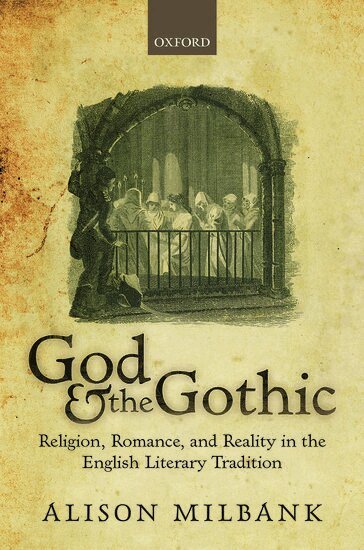
    God & the Gothic

    Religion, Romance, & Reality in the English Literary Tradition

    AvAlison Milbank

    Inbunden, Engelska, 2018

    1 874 kr

    Beställningsvara. Skickas inom 5-8 vardagar. Fri frakt över 249 kr.

    Fler format och utgåvor

    E-bok

    1 674 kr

    E-bok

    1 674 kr

    Beskrivning

    God and the Gothic: Romance and Reality in the English Literary Tradition provides a complete reimagining of the Gothic literary canon to examine its engagement with theological ideas, tracing its origins to the apocalyptic critique of the Reformation female martyrs, and to the Dissolution of the monasteries, now seen as usurping authorities. A double gesture of repudiation and regret is evident in the consequent search for political, aesthetic, and religious mediation, which characterizes the aftermath of the Glorious Revolution and Whig Providential discourse. Part one interprets eighteenth-century Gothic novels in terms of this Whig debate about the true heir, culminating in Ann Radcliffe's melancholic theology which uses distance and loss to enable a new mediation. Part two traces the origins of the doppelgänger in Calvinist anthropology and establishes that its employment by a range of Scottish writers offers a productive mode of subjectivity, necessary in a culture equally concerned with historical continuity. In part three, Irish Gothic is shown to be seeking ways to mediate between Catholic and Protestant identities through models of sacrifice and ecumenism, while in part four nineteenth-century Gothic is read as increasingly theological, responding to materialism by a project of re-enchantment. Ghost story writers assert the metaphysical priority of the supernatural to establish the material world. Arthur Machen and other Order of the Golden Dawn members explore the double and other Gothic tropes as modes of mystical ascent, while raising the physical to the spiritual through magical control, and the M. R. James circle restore the sacramental and psychical efficacy of objects.

    Produktinformation

    • Utgivningsdatum:2018-10-30
    • Mått:162 x 242 x 25 mm
    • Vikt:704 g
    • Format:Inbunden
    • Språk:Engelska
    • Antal sidor:366
    • Förlag:OUP OXFORD
    • ISBN:9780198824466

    Utforska kategorier

    • Kristendom inom Filosofi och religion
    • Litteraturvetenskap inom Skönlitteratur

    Mer om författaren

    Alison Milbank is Associate Professor of Literature and Theology at the University of Nottingham. She was John Rylands Research Fellow at the University of Manchester and after a temporary position at Cambridge, taught for five years at the University of Virginia. She has taught at Nottingham since 2004, and is also Priest Vicar and Canon Theologian at Southwell Minster. She has published widely on the Gothic, also publishes on Anglican ecclesiology and theology. Her publications include Daughters of the House: Modes of the Gothic in Victorian Fiction (1992) and Preaching Radical and Orthodox (co-edited with John Hughes and Arabella Milbank; 2017).

    Recensioner i media

    Milbank's work is valuable not just in that it should prompt in the literary academy a chastised return to the Gothic with a more religiously attuned critical sense, but also in that she raises important questions about what happens to faith when it is shorn of its imagination, its instinct for the liminal and its arcane ritual, and made to conform to too much rational dissection, reasonable practice and 'scientific' moderation.

    Innehållsförteckning

    • Introduction Part I: Whig Gothic in the Long Reformation 1: Cain's Castles: The Emergence of Protestant Gothic in the Reformation 2: Bare, Ruined Choirs: Gothic Nostalgia and the Reformation 3: The Secret of Divine Providence: Whig Gothic and the Grotesque in Horace Walpole, Clara Reeve, and Matthew Lewis 4: Beyond the Awful Veil: Melancholic Theology and the In-between in Ann Radcliffe 5: Paradoxes of the Heart: Religious Anthropology in Charles Brockden Brown 6: Hideous Progeny: Mary Shelley's Dantesque Theology of Creation Part II: Duality and Mediation in Scottish Gothic 7: Truly Two: Calvinist Anthropology and the Double from Christopher Marlowe to John Buchan 8: Black books and Brownies: Narrating the Reformation in Walter Scott and James Hogg Part III: The Ambivalence of Blood in Irish Gothic 9: Mimetic Contagion: Charles Maturin and the Theology of Sacrifice 10: In a Glass Darkly? Narrating Death and the Afterlife in Sheridan Le Fanu 11: Finding a Via Media: Bram Stoker and Mediation Part IV: Later Gothic: Re-enchanting the Material 12: Supernatural Naturalism in Margaret Oliphant, Elizabeth Gaskell, Charlotte, and Emily Brontë 13: Holy Terrors: The Mystical Gothic of Arthur Machen, Evelyn Underhill, and Charles Williams 14: Ecclesiastical Gothic: J. Meade Falkner and M. R. James Epilogue Bibliography