• Fri frakt över 249 kr
  • •
  • Snabba leveranser
  • •
  • Billiga böcker
Kundservice

Du är på sajten för privatpersoner.

Företag, bibliotek eller offentlig verksamhet?

Du handlar på classic.bokus.com, där alla dina funktioner finns intakta.
Till classic.bokus.com
Bokus logotyp. Gå till startsidan.
  • Erbjudanden
  • Nyheter
  • Student
  • Topplistor
  • Barn & ungdom
  • Bokus Play
  • E-böcker
  • Pocketböcker
  • Spel & pussel

10% rabatt på allt med kod: NYSTART10 →

Sidfot

Mina sidor

    Hjälp

    • Kundservice
    • Vanliga frågor och svar
    • Frakt och leverans
    • Retur vid ångerrätt
    • Reklamera vara
    • Betalning
    • Köpvillkor
    • Allmänna villkor
    • Information om webbplatsens tillgänglighet

    Om Bokus

    • Om oss
    • Pressrum
    • För studenter
    • För företag
    • För bibliotek och offentlig verksamhet
    • För leverantörer
    • Hållbarhet

    Populärt

    • Aktuella erbjudanden
    • Presentkort
    • Studentlitteratur
    • Nya böcker
    • Topplistor
    • Signerade böcker
    • Engelska böcker

    Inspiration

    • Boktips
    • BookTok
    • Populära bokserier
    • Barnbokskaraktärer
    • Populära författare
    Logotyp för Bokus
    Följ oss på Facebook (extern länk)Följ oss på Instagram (extern länk)Följ oss på YouTube (extern länk)Följ oss på TikTok (extern länk)
    bokus @ CookiesAnpassa cookiesIntegritetspolicyKöpvillkor
    Till Citymail hemsida (extern länk)Till Budbee hemsida (extern länk)Till Postnord hemsida (extern länk)Till Schenker hemsida (extern länk)Till Early Bird hemsida (extern länk)Till Walleys hemsida (extern länk)
    1. Samhälle och politik
    2. Politik och statsskick
    3. Internationella relationer

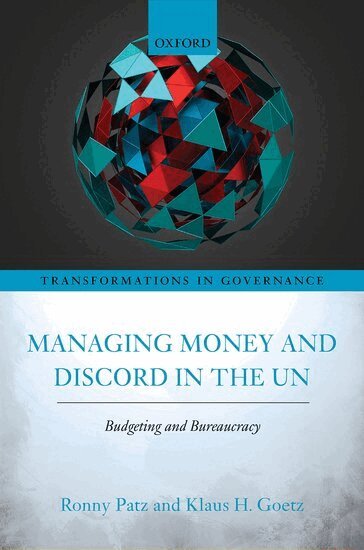
    Managing Money and Discord in the UN

    Budgeting and Bureaucracy

    AvRonny Patz,Klaus H. Goetz

    Inbunden, Engelska, 2019

    Del i serien Transformations in Governance

    1 719 kr

    Beställningsvara. Skickas inom 5-8 vardagar. Fri frakt över 249 kr.

    Beskrivning

    How do international organizations in the United Nations system put together their budgets? What is the role of complex principals - most notably member states - and the complex agents in the bureaucracies of international organizations in budgeting processes? And what does a focus on budgeting tell us about the changing nature of the system of international organizations? This book provides answers to these questions through a detailed examination of budgeting in the UN system. The analysis draws on both quantitative and qualitative observations for a total of 22 UN system organizations and detailed case studies for the United Nations, ILO, UNESCO, and WHO. The findings demonstrate the importance of three key organizational outcomes-- proceduralization, routinization, and budgetary segmentation - as international organizations grapple with managing discord over priorities as a result of complex principal-- agent constellations. Contrary to a common view of international bureaucracies as pathological organizations, core budget routines are mostly successfully maintained. However, principal constellations become more complex, notably through the rise of voluntary contributions and non-state donors; budgetary segmentation advances, in some cases even leading to the setting up of new international organizations; and budgeting and resource mobilization become ever more intertwined. As a consequence, the capacity of international bureaucracies to fulfil their budgeting responsibilities is stretched to the limits and beyond.Transformations in Governance is a major academic book series from Oxford University Press. It is designed to accommodate the impressive growth of research in comparative politics, international relations, public policy, federalism, and environmental and urban studies concerned with the dispersion of authority from central states to supranational institutions, subnational governments, and public-private networks. It brings together work that advances our understanding of the organization, causes, and consequences of multilevel and complex governance. The series is selective, containing annually a small number of books of exceptionally high quality by leading and emerging scholars. The series is edited by Liesbet Hooghe and Gary Marks of the University of North Carolina, Chapel Hill, and Walter Mattli of the University of Oxford.

    Produktinformation

    • Utgivningsdatum:2019-03-28
    • Mått:163 x 237 x 19 mm
    • Vikt:544 g
    • Format:Inbunden
    • Språk:Engelska
    • Serie:Transformations in Governance
    • Antal sidor:264
    • Förlag:OUP OXFORD
    • ISBN:9780198838333

    Utforska kategorier

    • Internationella relationer inom Samhälle och politik

    Mer om författaren

    Ronny Patz is a postdoctoral research fellow at LMU Munich, where he works in the Research Unit 'International Public Administration' financed by the German Research Foundation (DFG). In successive projects, he has researched budgeting in international organizations, in particular in the EU and in the UN system (2014-17), and resource mobilization by IOs in the domain of global refugee policy (since 2017).Klaus H. Goetz holds the Chair in Political Systems and European Integration at the University of Munich. He previously taught at LSE and the University of Potsdam. He has published widely on comparative government and public policy, and has a long-standing interest in time and politics. His most recent publications include a special issue of Global Policy on the resourcing of international organisations (co-edited with R. Patz, 2017) and a special issue of West European Politics on secrecy and politics (co-edited with B. Rittberger, 2018). He was a member of the Executive Committee of ECPR (2012-2018) and has been co-editor of West European Politics since 2000.

    Recensioner i media

    Managing Money and Discord in the UN Budgeting and Bureaucracy offer valuable insights on budgeting and its procedures in the UN System of organizations.

    Innehållsförteckning

    • 1: Introduction: Budgeting in the UN System 2: Theory: understanding Budgeting in International Organizations 3: The Historical Origins of UN System Budgeting 4: Budgeting in the UN System: A Comparative Analysis 5: The UN Core: Micromanaging Principals and Segmented Budgets 6: ILO: Simple Procedures Despite a Tripartite Principal 7: UNESCO: Between Sectoral Fragmentation and Budget Crisis 8: WHO: Between Regional Principals and Philanthrolateralism 9: Key Findings: Principal-Agent Complexity and Budgeting in the UN System The Future of UN Budgeting: Complexity and Prospect For Reform